11 Top-Rated Chess Courses for Online Learners

Chess is a game that has been played for centuries and has gained massive popularity among people of all age groups. It requires various skill sets, including patience, consciousness, and strategic thinking. Chess helps in improving concentration, memory, as well as problem-solving skills.

With the rise of online learning, it’s now easier to learn Chess from home and under the guidance of the best chess coach.

Learning Chess can be intimidating, especially for beginners who are not familiar with the game’s rules and strategies. However, there are a plethora of resources available to learn Chess online that can help to learn at your own pace.

We will be exploring the 11 Best Online Chess Classes (free & paid) in this blog. You can pick the best suitable course for yourself, ranging from beginner to advanced level, and improve your skills.

List of Free Online Chess Classes

Here are the best online chess classes and courses that will help you hop on board in no time:

1. Chess University’s Intro To Chess Crash Course [Udemy]
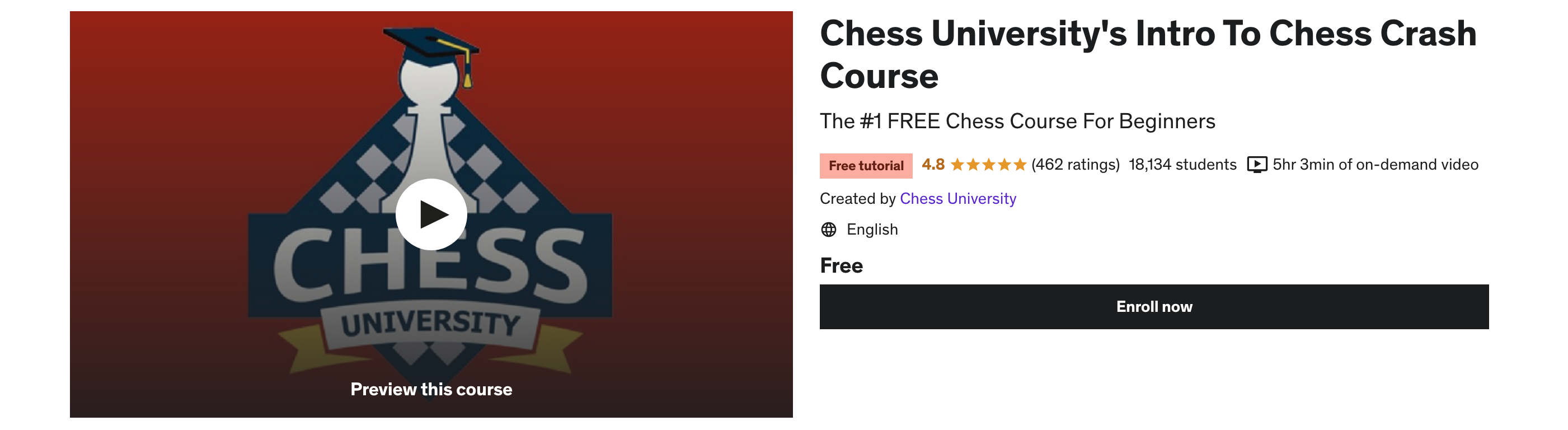
Chess University's Intro To Chess Crash Course

If you wish to learn Chess, then Udemy’s this course is just for you. Over 18K students have been enrolled in the course. It covers all Chess’s rules and basics and introduces more advanced topics such as tactics and strategy. Once students complete this course, they will be ready to start playing Chess over the board and ready to participate in tournaments.

Curated by Chess University, this online course contains on-demand videos by 4 instructors. This course caters to players of all ages whose chess strength is below the rating of 900 Elo (novices and beginners)

Topics Covered:

  • Introduction to Chess
  • Special Rules
  • Types of Advantages
  • Logical Thinking
  • Tactics
  • Chess Vocabulary
  • Concepts and Ideas
  • Phases of the Game

Prerequisites: None

Rating: 4.8

Duration: 5.3 hours

Certificate: No

Pros: Helpful, beginner-friendly, and popular

Cons: Some reviewers cite explanations as vague.

2. Kids Learn Chess the Fun & Easy Way! [Udemy]
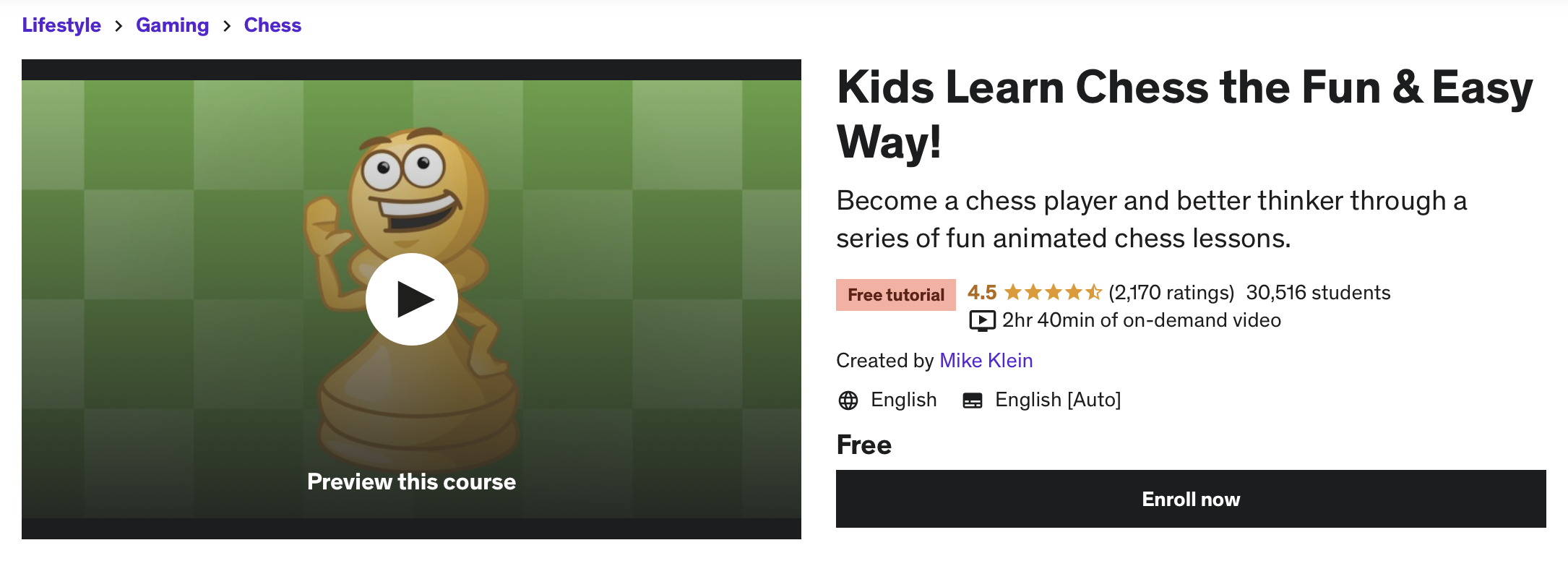
Kids Learn Chess the Fun & Easy Way!

Udemy’s course, Kids Learn Chess the Fun & Easy Way, offers engaging animated chess lessons for kids.Mike Klein is the instructor of this course; The course covers the basics and tactical tricks of the game.

With this course, kids will learn the basic rules of Chess and more advanced strategies through fun and interactive lessons. The course includes a variety of games and puzzles to help children develop their chess skills and apply what they have learned.

Overall, this course is an excellent option for parents looking to introduce their children to the world of Chess in a fun and engaging way.

The course has 27 lectures and is for children aged between 5-13. It has around 30K enrolled students.

Topics Covered:

  • Introduction to Chess
  • Movements of each piece
  • Most common checkmate patterns
  • Special moves
  • Counting Material
  • Five most common tactical tricks

Prerequisites: None

Rating: 4.7

Duration: 2.4 hours

Certificate: No

Pros: Animated chess lessons, kid-friendly, and highly rated.

Cons: Some reviewers cite the course as too fast.

3. Chess Lessons [Chess.com]
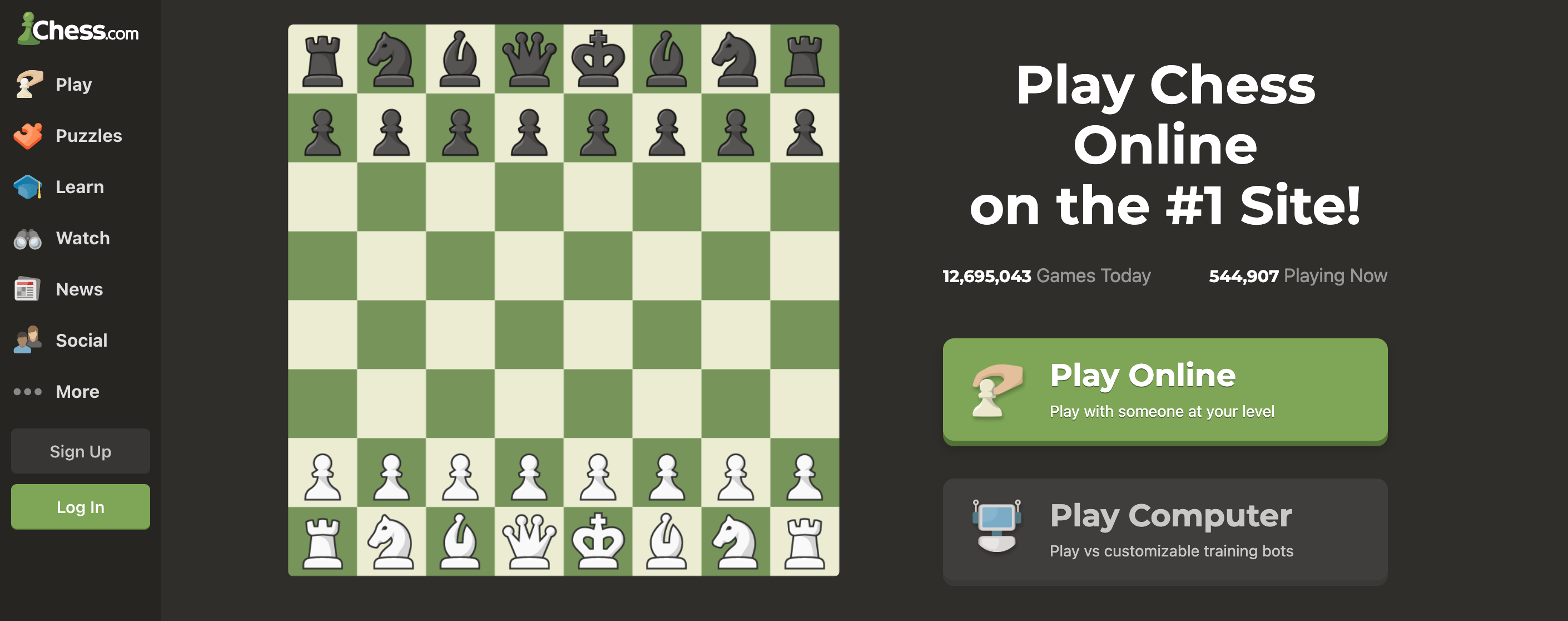
Chess Lessons

Chess.com has a collection of chess lessons for beginners to intermediate to advanced mastery levels. You can not only learn Chess but play online as well with other players. You can also watch other gamers’ chess events and live streams.

Chess.com is a popular online chess platform that allows players of all levels to play Chess, improve their skills, and connect with a global community of chess enthusiasts. With a wide range of features, including daily puzzles, lessons, and tournaments, Chess.com provides a comprehensive and engaging experience for players of all ages and abilities. So whether you’re a beginner or an experienced player, Chess.com offers something for everyone to enjoy and learn from.

The lessons are from the best chess coach, including Magnus Carlsen, Viswanathan Anand, and many more.

Topics Covered:

  • How to Play
  • Fundamentals
  • Key Concepts
  • Taking Control
  • Tactics
  • Play Like a world champion

Prerequisites: None

Rating: N/A

Duration: N/A

Certificate: No

Pros: Helpful, multiple lessons, learn from experts

Cons: N/A

4. Fundamentals of Chess: Tactics [Alison]
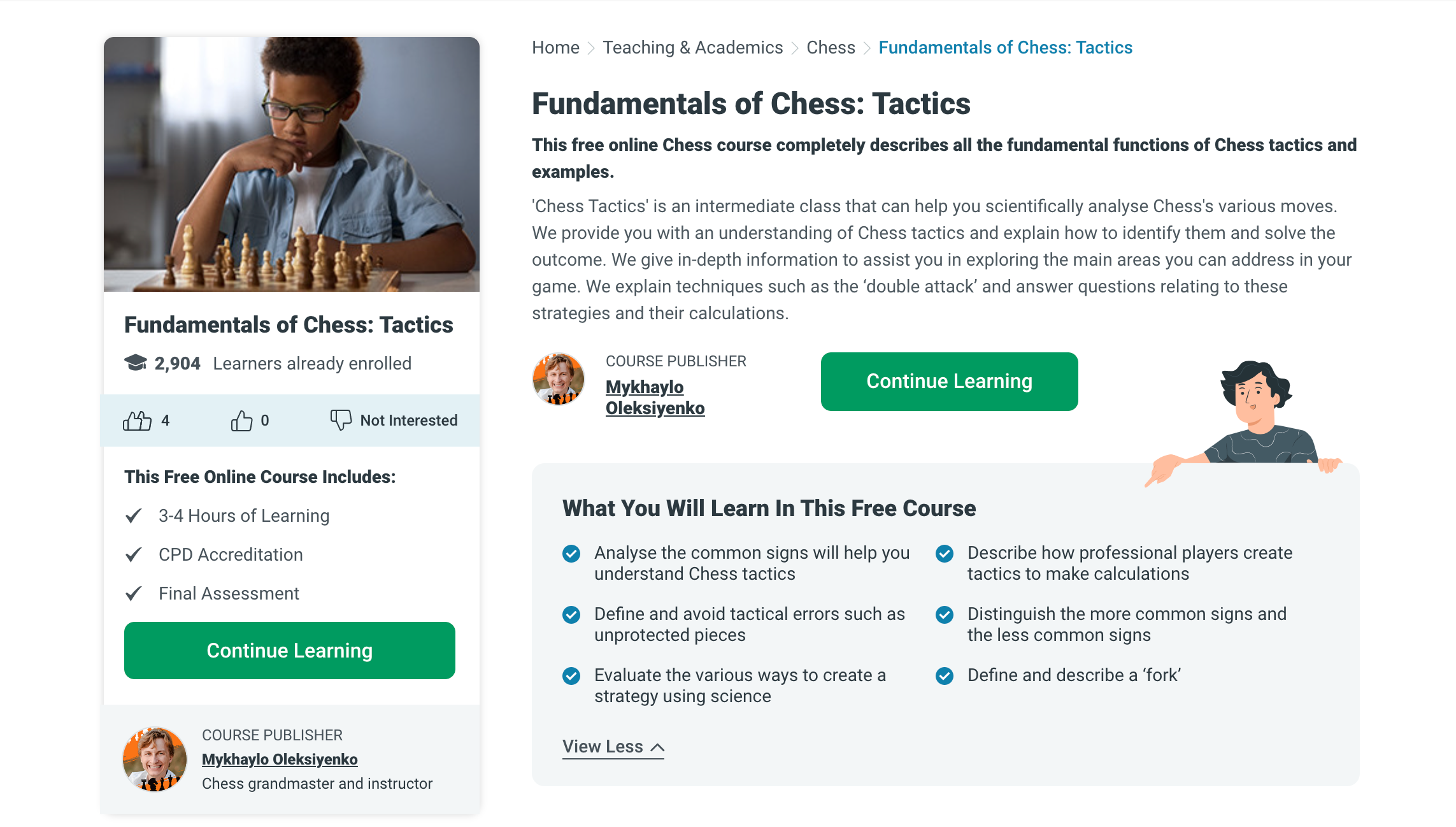
Fundamentals of Chess Tactics

Alison’s Fundamentals of Chess: Tactics provides knowledge of strategic moves in Chess, demonstrates the working principles of using them, and gives a fundamental understanding of chess tactics. It is designed for intermediate players and provides in-depth information for your assistance.

The course covers essential topics such as forks, pins, skewers, discovered attacks, and double attacks. Learners can improve their chess skills and strategic thinking with interactive activities and practice exercises. This course can help you develop your chess knowledge and tactics.

Topics Covered:

  • Basics of Chess
  • Chess tactics
  • Fundamentals of chess strategies
  • Techniques to apply

Prerequisites:None

Rating: N/A

Duration: 3-4 hours

Certificate: No

Pros: Thorough, engaging, knowledgeable.

Cons: N/A

5. Learn Chess By Playing! [Lichess]
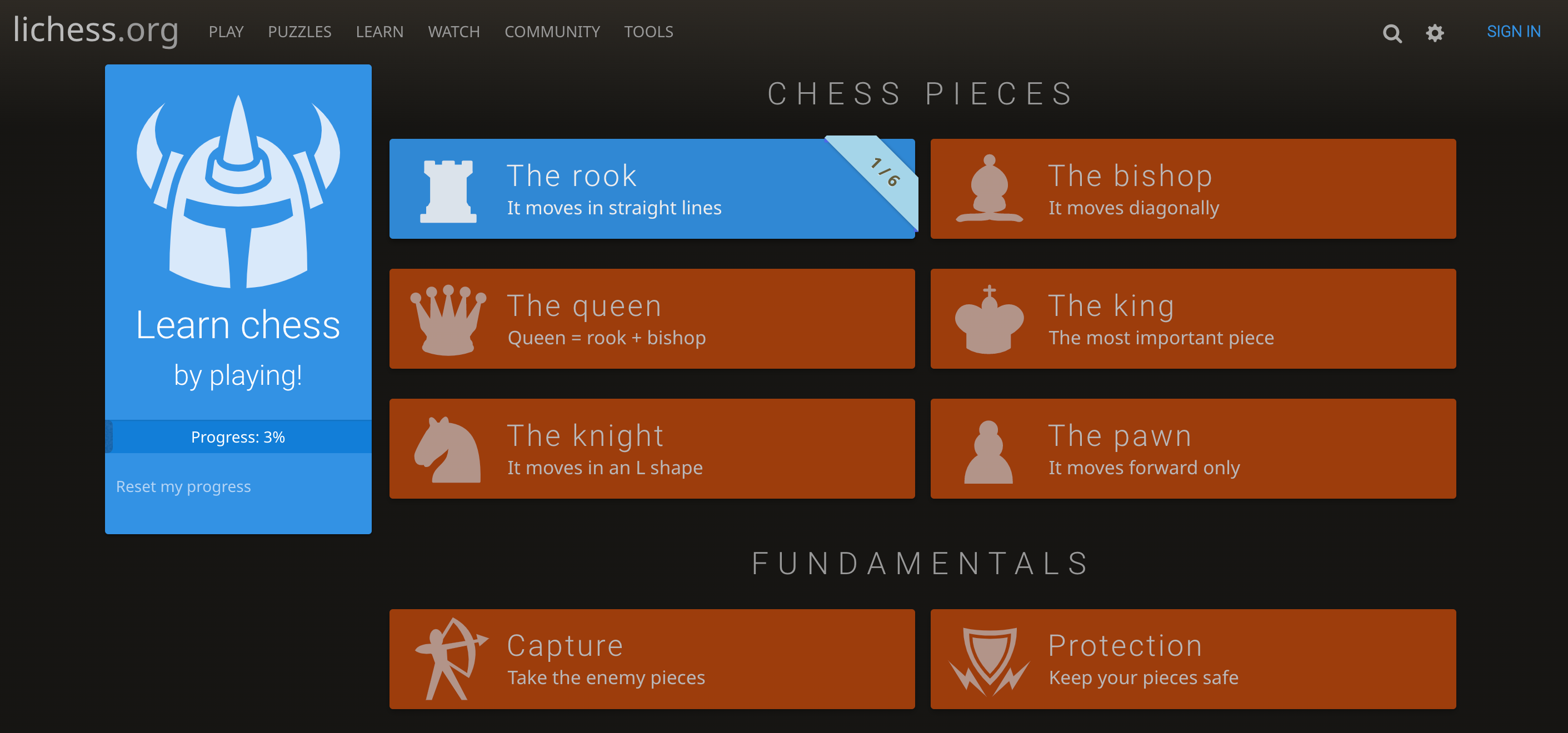
Learn Chess By Playing!

Lichess.org is a free, open-source online chess platform that allows players to play, learn, and analyze games. It offers a variety of features such as puzzles, practice exercises, tournaments, and computer analysis. Lichess.org has a user-friendly interface and can be accessed from any device without the need for any downloads or installations. As a result, it is a popular choice among chess enthusiasts of all levels, from beginners to advanced players, and offers a welcoming and supportive community.

Topics Covered:

  • Chess pieces
  • Fundamentals of Chess
  • Board set-up
  • Evaluate piece strength
  • Test you skills

Prerequisites:None

Rating: N/A

Duration: N/A

Certificate: No

Pros: Short; engaging; interactive

Cons: N/A

List of Paid Online Chess Classes

While free classes might be good at the start, you will need more in-depth knowledge and advanced training in the game in order to become the best at it. These classes typically provide in-depth analysis of games, personalized training plans, and access to exclusive learning resources.

In this list of the top 6 paid chess classes online, you’ll find an incredible range of options from some of the most rated online classes and highly qualified coaches.

6. Complete Chess Training by a Chess Grandmaster [Udemy]

Complete Chess Training by a Chess Grandmaster

This course promises to help students improve their chess skills through comprehensive and structured training. The course is taught by a Chess Grandmaster who shares extensive knowledge and game experience. It covers a wide range of topics, including opening theory, middlegame strategies, endgame techniques, and tactical motifs. With a focus on practical exercises and game analysis, the course is designed to help students become more confident and successful chess players.

The course was created by Igor Smirnov, the founder of the “Remote Chess Academy” company that has helped thousands of students worldwide to improve their chess results.

Topics Covered:

  • To take is a mistake
  • The offense is the best defense
  • Attacking moves
  • Attacking replies
  • Tasks

Prerequisites: None

Rating: 4.1

Duration: 1 hour

Certificate: Yes

Pros: Professional, advanced level, and popular

Cons: Some reviewers cite the course as too short and less descriptive.

7. Unleash Your Inner Grandmaster [MasterClass]
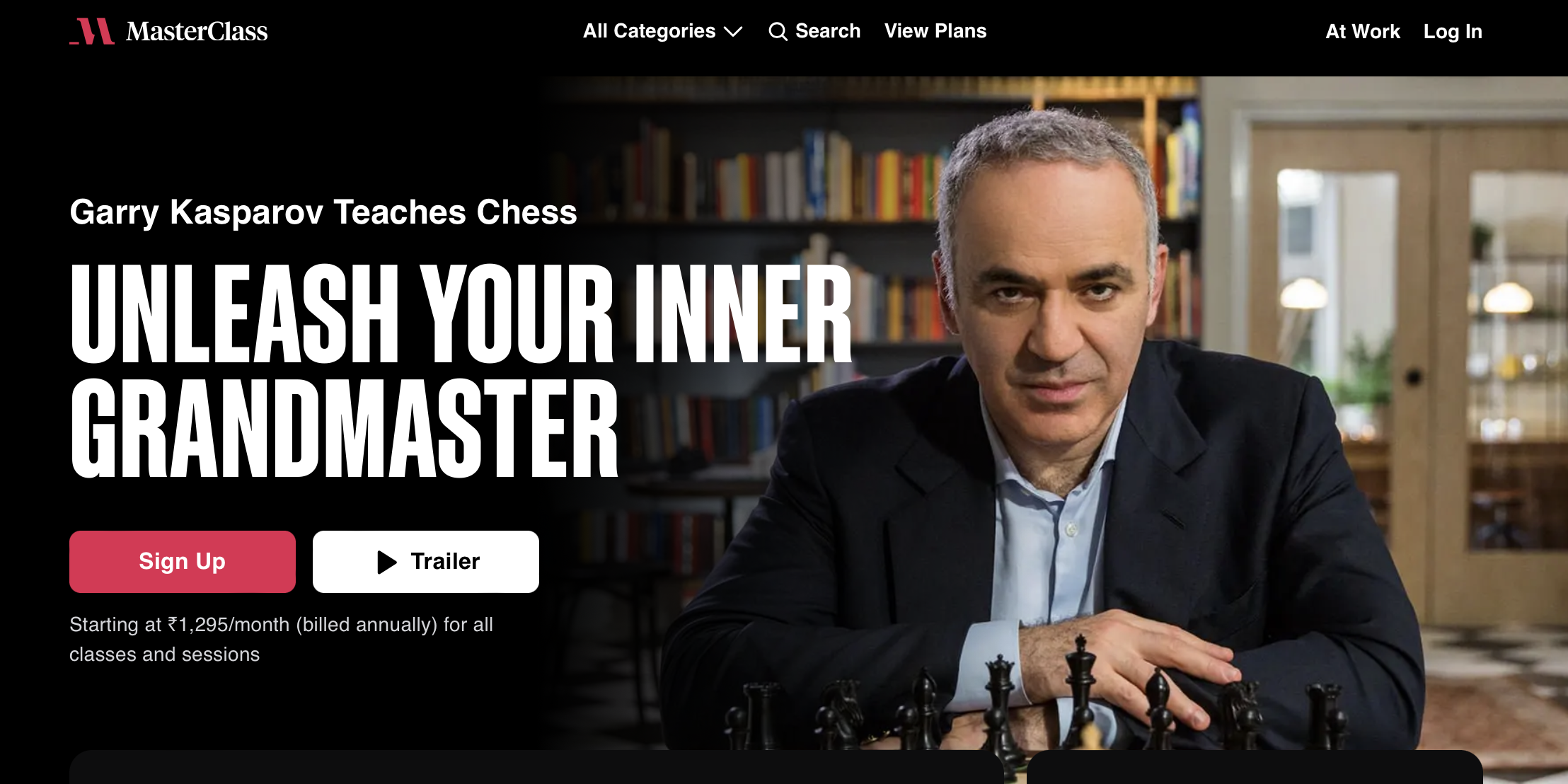
Unleash Your Inner Grandmaster

Unleash Your Inner Grandmaster is a comprehensive online course offered by Masterclass, taught by the world-renowned chess player Garry Kasparov. In this course, Kasparov shares his expertise and strategies for mastering Chess, covering topics such as openings, middlegame tactics, endgames, and analysis.

This course is designed to help players of all levels improve their game and take their skills to the next level. With interactive lessons, helpful tips, and engaging exercises, this course is the perfect choice for anyone looking to enhance their understanding of Chess and become a stronger player.

Topics Covered:

  • Chess Fundamentals
  • Chess Strategies
  • Openings
  • Middlegames
  • Endgames
  • Mental Toughness

Prerequisites: None

Ratings: N/A

Duration: 7.2 hours

Certificate: Yes

Pros: N/A

Cons: N/A

8. Understanding chess openings | How to play ANY opening well [Udemy]
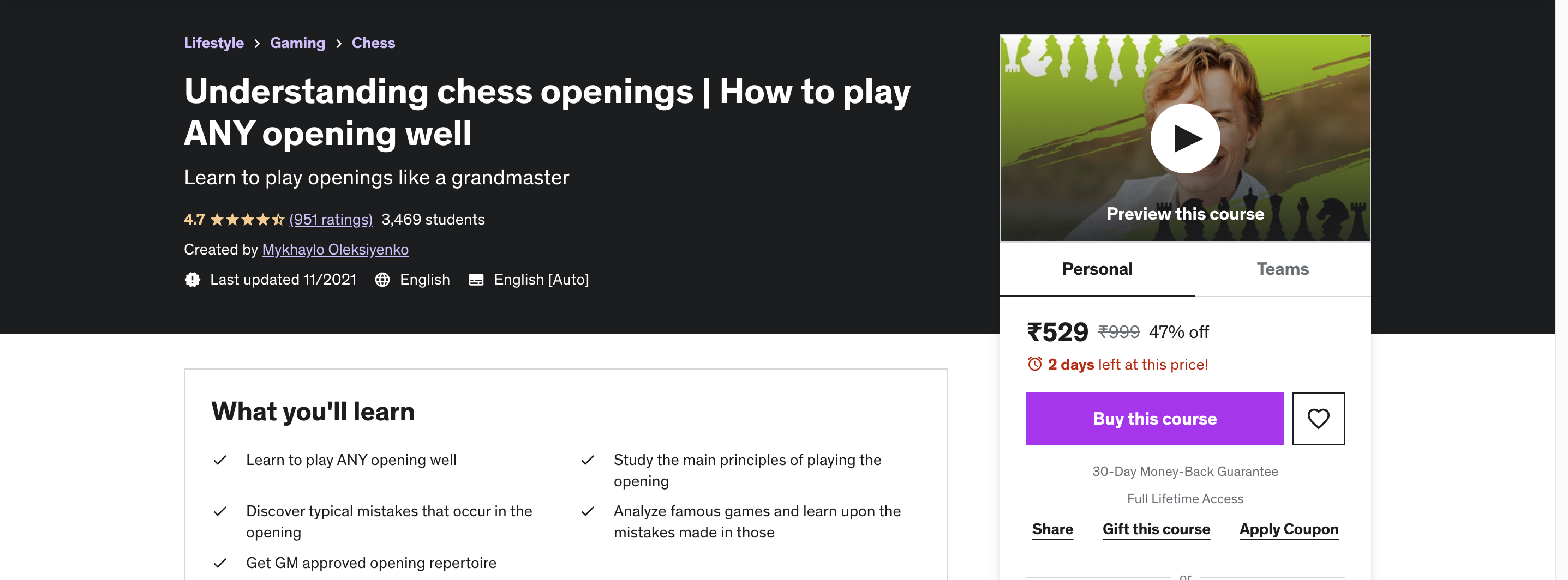
Understanding chess openings | How to play ANY opening well

Understanding chess openings is crucial for any chess player, whether you are a beginner or an advanced player. This Udemy course offers a comprehensive guide on how to play any opening well, covering the basic principles of chess openings, common variations, and strategies for both White and Black.

An experienced chess coach taught this course to help you understand the underlying principles of each opening rather than just memorizing moves. So whether you want to improve your chess skills or compete at a higher level, this course can help you unleash your potential and take your game to the next level.

Topics Covered:

  • General rules/guidelines of opening play
  • Principles of playing the opening
  • Analyze famous games
  • Suggested opening repertoire

Prerequisites: Basics of Chess.

Rating: 4.7

Duration: 3.5 hours

Certificate: Yes

Pros: Clarity, beginner-friendly, interactive.

Cons: Some reviewers cite the course as unuseful.

9. The Complete Guide to Chess Tactics [Udemy]
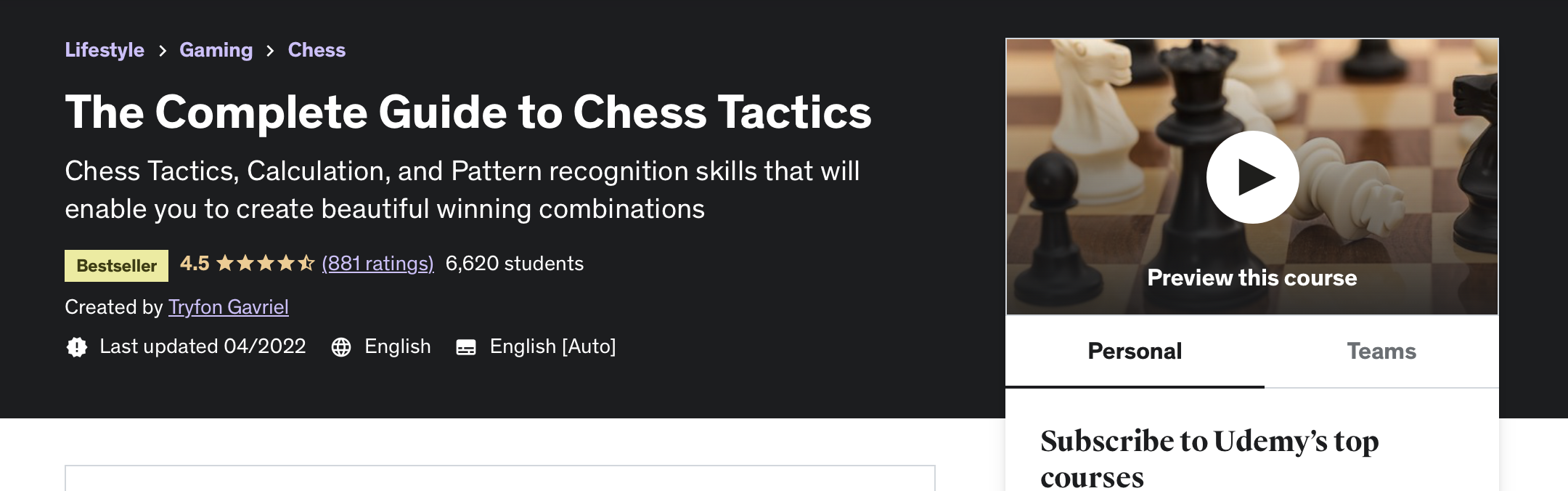
The Complete Guide to Chess Tactics

This comprehensive course on Udemy covers all the essential tactics and strategies required to become a proficient chess player. The course is designed for players of all levels, from beginners to advanced players, and is taught by an experienced chess coach.

The lessons include various tactical motifs, such as pins, forks, skewers, discovered attacks, and more.

The course also provides guidance on identifying and exploiting weaknesses in your opponent’s game. With the help of this course, you will be able to improve your tactical skills and outsmart your opponents in no time.

Topics Covered:

  • Chess tactics
  • Art of calculation
  • Various patterns
  • Applying Chess Tactics in Real Games
  • Advanced Tactical Patterns

Prerequisites: Basics of Chess.

Rating: 4.5

Duration: 21.5 hours

Certificate: Yes

Pros: Well-explained, practical, insightful.

Cons: N/A

10. Chess [Udemy]
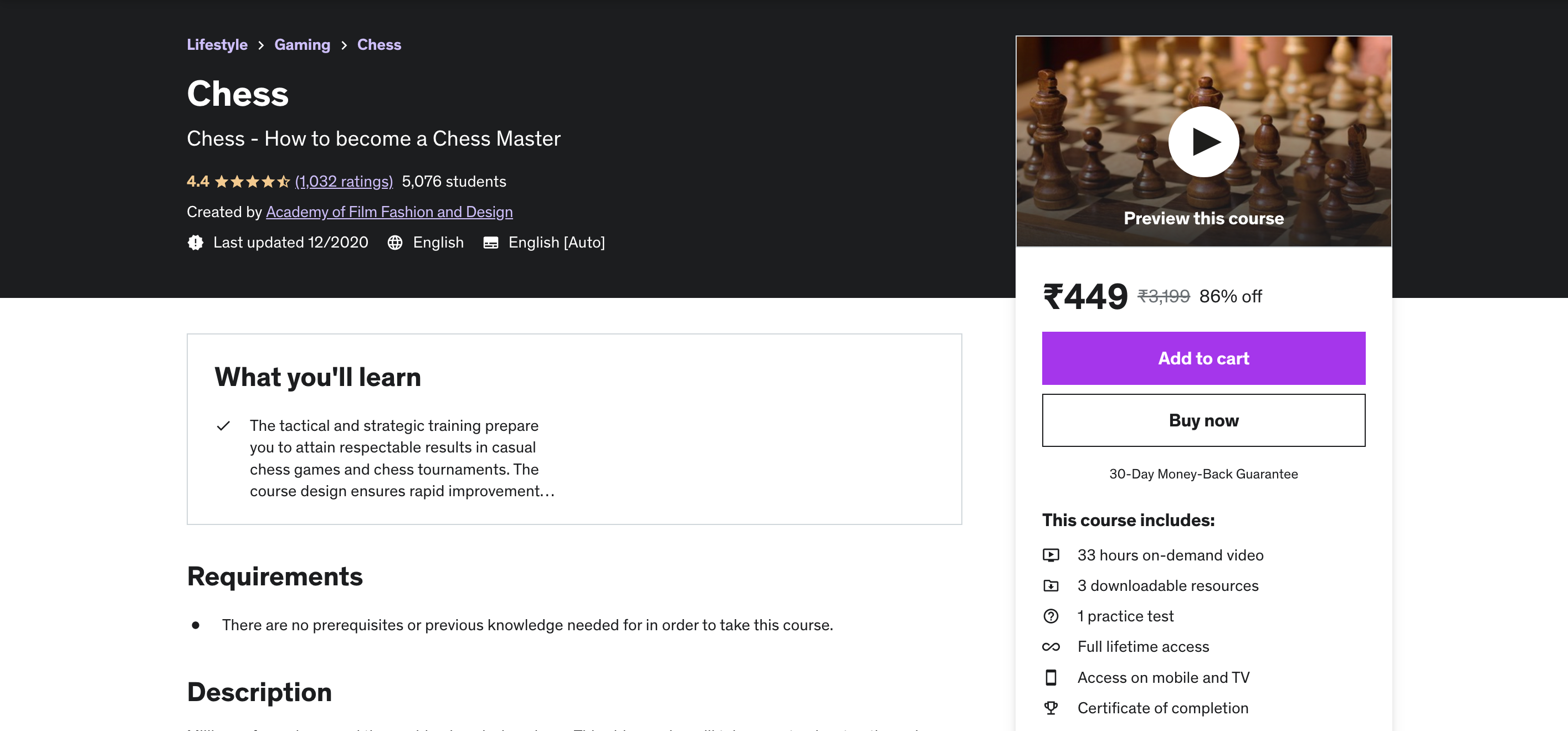
Chess

“Chess – How to become a Chess Master” is an extensive Udemy course designed to take your chess skills to the next level. The course covers everything from basic chess rules and strategies to advanced tactics and techniques used by chess masters. With the help of this course, you can learn how to think like a grandmaster and improve your decision-making skills.

The course includes video lectures, practical exercises, and quizzes to help you reinforce your learning. So whether you’re a beginner or an experienced player, this course can help you develop your skills and become a chess master.

Topics Covered:

  • Tactical training
  • Strategic training
  • Board Vision
  • Practical guidelines
  • Principles
  • Exercises

Prerequisites: None

Rating: 4.4

Duration: 33 hours

Certificate: Yes

Pros: Knowledgeable, beginner-friendly, and interactive.

Cons: Some reviewers cite the course as slow.

11. Chess For Everyone! [Udemy]
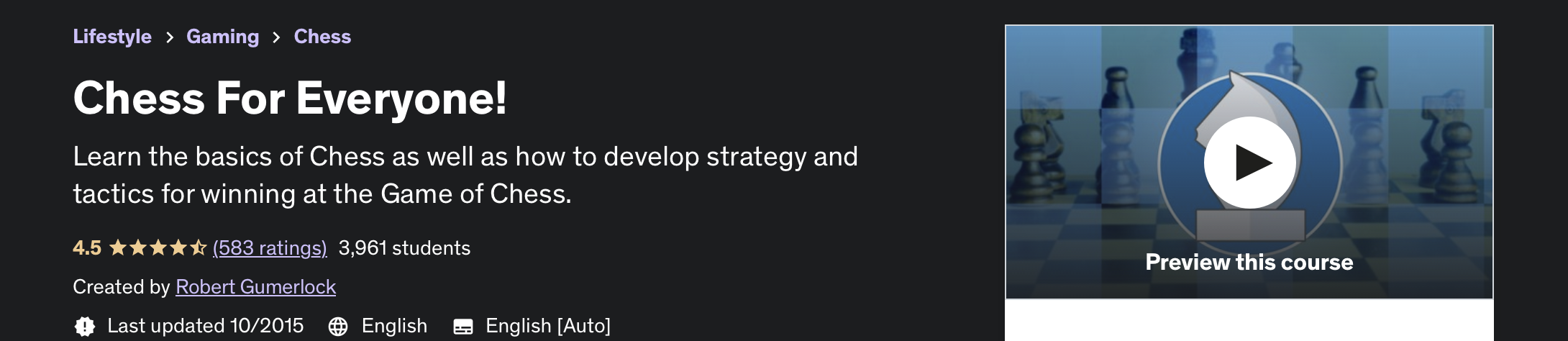
Chess For Everyone!

This course is offered by Udemy and aims to teach the fundamentals of Chess to beginners. The course is designed to make Chess accessible and enjoyable for anyone interested in learning the game, regardless of their prior experience. It covers the basics of Chess, including rules, tactics, strategy, and common mistakes to avoid. The course also includes practical exercises and quizzes to help learners practice their skills and measure their progress. By the end of the course, learners should be able to play Chess confidently and competently.

The course is curated by Robert Gumerlock, a chess teacher and coach with 50 years of playing experience.

Topics Covered:

  • Basics of Chess
  • Strategic thinking
  • Chess tactics
  • Endgame
  • Tips and tricks for improving your game

Prerequisites: None.

Rating: 4.5

Duration: 2.5 hours

Certificate: Yes

Pros: Beginner-friendly, interactive, good approach.

Cons: Some reviewers cite background music as a distraction.

Conclusion

Chess is a popular game, and with the rise of online learning, it is now easier to learn Chess at home from the best chess coach. In this article, we have explored the 11 best online chess classes (free and paid), ranging from beginner to advanced levels.

All these courses cover a wide range of topics from chess fundamentals to advanced strategies, openings, middlegames, endgames, and mental toughness, and offer certification upon completion.

Overall, learning Chess can be a fun and rewarding experience for all ages, and these online courses can be an excellent way to start your journey in Chess.

Frequently Asked Questions

What Is the Best Online Chess Course?

The best online chess course depends on your level of knowledge, expertise, learning style, and specific needs. Some popular options include courses from Chess.com, Udemy, MasterClass, and Lichess.org.

Are Online Chess Courses Effective for Improving My Game?

Yes, online chess courses can be very effective for improving your game, as they offer structured lessons, practice exercises, and feedback from experienced coaches.

How Much Do Online Chess Courses Cost?

Online chess course costs can vary widely, ranging from free to a few hundred or thousand rupees. Some popular options include free courses on Chess.com and Lichess.org and paid courses on Udemy, MasterClass, and other platforms.

What Topics Are Covered in Online Chess Courses?

Online chess courses can cover a wide range of topics, including chess basics, tactics, openings, endgames, strategy, and more. The specific topics covered will depend on the course.

Riane Lumer | Teaching and research are not mutually exclusive

03-20-23-lecture-hall-giuliana-alleva

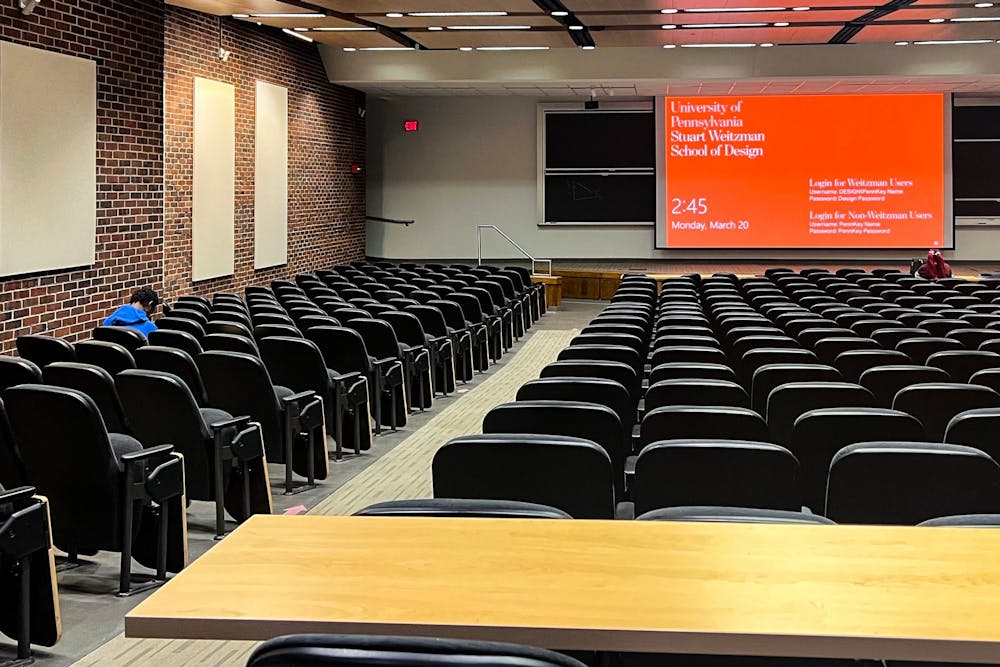
A lecture corridor in the Stuart Weitzman College of Design.
Credit score: Giuliana Alleva

The artwork of listening has been missing in each academic and day-to-day options, translating into disunity locally and globally. This is apparent as viewed in the signs plaguing the planet: polarization, disconnection, nationalism, insensitivity, and the systemic ills that are more propelled by our divisiveness. Listening need to be cultivated in transformative education and learning as it is the key to deliberation and challenge-resolving. To pay attention is not to basically listen to others’ sights, but to comprehend and digest what they are saying with responsive attempts. Energetic listening also boosts one’s ability to express their have ideas when finding out from other individuals.

Fostering tools for listening in higher instruction is a pedagogical problem — these types of developments of lively listening begin in the classroom and transcend beyond university. And nonetheless, professors of larger training, which include at Penn, are ill-prepared by their universities to hire pedagogical techniques creating these kinds of skills.  

“One of the points that a large amount of us have missing is really the capability to maintain discussions, specifically with men and women with whom we disagree,” mentioned Jonathan Zimmerman, Penn GSE professor and historian of education, “I assume we will need to imagine about the civic dimension of higher ed. We have a obligation to consider to enable folks understand civic competencies, and I consider classroom discussion is integral to that.”

Granted, some professors falsely presume that for the reason that students are not experts in their fields of study, university student-driven dialogue is unhelpful. To that, Zimmerman argued, “Students usually are not experts, but that is precisely the rationale that they need to talk about it. Not so that they can advise people always, but so they can examine the important concerns and try to get their heads all-around them.” And inspite of this, standard lectures are even now regular at Penn. 

Transformative schooling is diverging away from conventional strategies of training and assessment as they do not stimulate nor design essential expertise these as participating with one particular one more and listening carefully. Regular pedagogy, this kind of as lecturing, typically positions the teacher previously mentioned the college student, detracting from university student-led training. Pupils listen to the instructor but are not constantly listened to — earning schooling a lot less so a make a difference of dialogue in between equally the university student and the instructor, or learners with their peers. It is hazardous to omit prosperous discussion from the classroom, especially if school is intended to be a microcosm representative of the larger modern society. Students should really truly feel invited and empowered to lead and find out from their friends. 

Scientists are not inherently excellent presenters, nor educators. Someone may possibly be outstanding in their discipline, but pedagogical understanding needs a unique variety of mastery. Simply just set, rigors of the classroom are not able to be self-taught. Thus, the elaborate intricacies of instructing necessitates teaching. As part of the educational system that has a critical function in societal features, educators are obligated to administer the finest form of training that may well only kind immediately after producing a instrument kit to do so. 

But the reality is, increased training neglects trainer teaching vital to developing techniques that emphasize college student collaboration relatively than passive reception and regurgitation. This is thanks to professors’ absence of foundational know-how encompassing formative teaching strategies further than the antiquated methods they have been exposed to when they ended up taught, perpetuating a adverse cycle of defective instructing that has turn into normalized in larger training.

The job of a professor is two-fold, instructing and researching. And arguably, executing transformative training should really be at the forefront of a professor’s career. Nevertheless, there are restrictions to this provided how investigate demands of tenure might detract professors from focusing on pedagogical observe that is time-consuming and subtle. At Penn, with high anticipations for professors to conduct and generate analysis, standards for ample training capabilities typically tumble to the wayside at the expense of pupil gain. 

“That’s a fundamental flaw of the universities. We are learning on the position, generally,” Reto Gieré, Earth and Environmental Science professor, claimed. “They’re not educating us [professors] how to educate,” Political Science Professor Loren Goldman expressed.   

At Penn, the Middle for Training and Understanding is intended to aid instructors excel as educators as a result of the use of workshops, but its extremely existence is contradictory. It should really be a necessity for professors to be adept at instruction prior to commencing. “The Heart for Educating and Mastering expose[s] the reduced position of this company. If we basically valued [employing formative pedagogy], we wouldn’t will need a heart devoted to it,” Zimmerman asserted.

“[Penn] teaches folks, but it is really not centered on educating,” Goldman has discovered. “And so they test to do factors that make it more amenable by making a Middle for Training and Learning. The generation of skillful listeners [and] fantastic academic citizens is not what it does at the undergraduate stage. Penn sort of teaches folks to go off into the globe and not be citizens.” 

Gieré contended that the nature of the scale of lecture classes pose logistical obstacles to educating in the way he aspires. He uncovered that the most suitable, integrative instructing design for his discipline would be to “go into nature” to promote interactive scholar dialogue over and above recitations. Gieré also attested that pupil curiosity is consequential, noting that he “think[s] curiosity is a genuinely vital component of our life. And that consists of asking questions” among peers. 

“Would it be high priced in conditions of time and revenue and vitality to change the program? It would,” Zimmerman acknowledged. “But if we valued it, we would maintain that value. And the fact that we don’t sustain the expense or we are unwilling to clearly show that, we really don’t worth it.” 

Essentially, it is a jarring, systematic flaw that professors are not essential to study how to train in the course of action of embarking on a career in academia. Students are not guinea pigs. Even though having to pay high-priced tuition, they be expecting to acquire worthwhile schooling from excellent educators. But many students have come to be so accustomed to their classroom structure that they do not know to anticipate in different ways, regardless of encountering notions of detachment in articles. 

In Zimmerman’s e book “The Novice Hour” he discussed how in higher training, “we really don’t have a regular for what is very good. And we never have a set of devices for imposing it … nobody’s minding the retailer. It isn’t really all poor … [but] the issue is we never have methods to really differentiate in between [teachers’ quality].” And at institutions like Penn, professionalizing instructing is vastly disregarded professors truly feel a deficiency of incentive that would if not not be the case if expected to study pedagogical theories from the get-go of their professions. 

Though Penn is a prestigious establishment taught by really esteemed scientists, we can not continue to fall short to criticize insufficient educating approaches. Frequently, Penn opts for large-title scientists to insert to their employees in lieu of helpful educators. In the end, the precedence of the college should really be instructing — plain and easy. 

It truly is ideal to close this column with a basic remark from Gieré: “Mostly, we are professors: we ought to instruct.”


RIANE LUMER is a Higher education junior studying political science and journalistic creating from Huntingdon Valley, Pa.. Her e mail deal with is rlumer@sas.upenn.edu. 

12 questions to advance your online ed strategy (opinion)

The rising desire for online studying isn’t new, but it is listed here to stay. From 2012 to 2019, pre-pandemic, the proportion of pupils enrolled in at least 1 distance instruction study course elevated from 25.5 to 36.3 percent. And the range enrolled completely in such programs improved by almost a 3rd, from 2.6 million to 3.4 million students. With new enrollment and scholar and faculty study details emerging each and every day, the much more new and substantial advancement in demand may have much more sticking power than several expected, specially as units and individual institutions aim to diversify revenue streams, distinguish by themselves from current market level of competition and pursue curricular innovation to align with evolving scholar requirements and choices.

Whilst distance training has lengthy been perceived by some as inferior in high quality, additional than fifty percent of American adults surveyed in 2022 think that the quality of on-line instruction in larger schooling is the very same as—or better than—in-man or woman instruction, up from 37 percent the yr ahead of. One particular study uncovered that seven out of 10 pupils planned to just take at least some courses in a fully on line format put up-pandemic. The world current market for on-line levels and microcredentials is envisioned to increase to a $117 billion market place by 2025.

Parallel to this progress in demand from customers is the notion that the sector will carry on to be dominated by a small range of national players. The leading 10 on the net-only institutions enroll 20 percent of the online-only college students in the U.S., expending millions of pounds every single calendar year on advertising and marketing. This imbalance has left many condition programs and unique institutions wondering how they can carve out their piece of the pie and how massive a piece they should consider to slash.

Inside Higher Ed Careers

Research over 40,000 Vocation Chances in Increased Education
We have served more than 2,000 establishments employ the service of the greatest larger education and learning talent.

Look through all position openings »

Several general public establishments and systems have just lately acquired on the web providers—examples contain UMass Global, the University of Arizona Worldwide Campus and the College of Arkansas Grantham—to scale immediately and enchantment to broader audiences. Though certainly an option, the number of feasible acquisition targets is finite, and offered the expanded scrutiny and cultural implications that normally accompany an acquisition tactic, growth by acquisition will only get the job done for some.

A critique of latest market successes signifies an approach to on the net education that leverages finite institutional means, enhances strategic plans linked to obtain and student results, supports the plans of partner organizations, and makes sure a high-quality tutorial merchandise may well be beneficial.

In observing endeavours by institutional leaders to style market place-suitable approaches to on the net schooling in their special contexts, it is evident that each and every prosperous energy has addressed and tried to response strategic questions aligned to a few sequential pillars:

Acquire a Statement of Function Collaboratively

  • Do we watch on the internet training as a strategy for application growth and new enrollment growth, or for extra versatile choices for existing on-campus learners, or both of those?
  • How considerable of a new or expanded profits stream do we see on-line education and learning representing in the foreseeable future?
  • How vital is it to ensure that on-line pedagogy and instruction are of equal or better good quality in contrast to in-human being instruction? Are we offering on that aspiration these days?
  • How can we ensure the ideal harmony amongst investing methods to make certain higher-high quality college student results and expanding enrollments in new courses?

Look at Latest Marketplace Posture

  • What are the desires of present and possible employer partners in nearby economic hubs, workforce initiatives in the area or other external partners? Could we guidance these requires by on the web instruction?
  • What is our present footprint of online choices, and what are the properties of learners drawn to all those applications?
  • Do any of our tutorial disciplines have model recognition past a community or regional market place?
  • What other possibilities exist for prospective on line learners in the area? Are there certain gaps in the sector that align with our tutorial parts of power?

Examine Organizational Strengths and Gaps

  • Is our current on-line education and learning aid group dispersed, unified centrally in just a particular division or typically underrepresented? Does the recent group match our objective statement?
  • What are the capabilities and likely gaps of the existing on the web training guidance business to help higher-high quality on the net instruction by advertising and delivering ideal practices in educational layout, system expansion and innovation, advertising and marketing and recruitment, and method or training course evaluation?
  • In limited-functionality places, what is the institution’s capability and appetite to examine 3rd-celebration partnerships to accelerate development (e.g., on the web program administration vendors for internet marketing, recruitment and instructional layout support or exploration firms for sector intelligence)?
  • How do college members view the existing online instruction help corporation, particularly the resources out there to make sure superior-quality tutorial structure and delivery?

Upon answering these inquiries, some establishments or systems may possibly determine to leverage their national brand and make investments in pursuing sizeable in close proximity to-expression on the web scale through inorganic advancement, as in a merger or acquisition. Other folks might understand that their best placement is to aim on offering existing pupils with much more versatile training course choices and to go after the targeted growth of on the web applications aligned to the regional labor industry and scholar needs, and might as a consequence go after an internal and unified integration of aid means and college improvement units. Other solutions might also existing them selves for the duration of this discovery process.

Analyzing these questions (and possible other people) will guide your establishment in acquiring an on the web education method that is the appropriate in shape for your one of a kind context and market place situation. It will also allow you to capitalize on the the latest and projected long run growth in scholar demand for substantial-good quality on-line offerings and attain parallel results related to earnings diversification, alignment with industry traits and curricular innovation.

School libraries across the country adding books on gender and white supremacy | National News

In defense of languages (opinion)

In the age of Google Translate and ChatGPT, one may well fairly inquire what the goal of studying international languages is. Just after all, artificial intelligence is additional than able of having most messages throughout, typo-free and finish with flawless grammar and punctuation. Why place ourselves and our students as a result of the tedium of verb endings, countless pronouns and the normally-stultifying niceties of syntax?

I—and my colleagues—would argue that what we educate is not just the vocabulary or guidelines of a individual language, but the applications of mental humility and cultural exchange. The act of translating needs consciousness of and curiosity about a plurality of perspectives, as very well as a recognition of the restrictions of one’s possess know-how: every phrase of a international language provides with it a prosperity of nuance that is, only, unachievable to capture in any one particular translation. It requires that its practitioners set aside their preconceived notions and the thought that there is any 1 ideal answer, requiring as a substitute curiosity and an open-minded want for knowledge. What observe could be extra important for a planet rife with division and brief on the means to listen?

How devastating, then, that the pretty establishments greatest positioned to train not only these equipment but the urgency of their implementation are giving up on a sacred mission in the encounter of capitalist imperatives. Final month, the administration of my very own institution, the College of San Francisco, manufactured a unilateral choice to slice four language programs—Arabic, Hebrew, Greek and Portuguese—effective this fall (the administration has considering the fact that publicly indicated that school members are functioning on probable means to keep on Hebrew instruction as a result of philanthropic funding).

Inside Higher Ed Careers

Look for in excess of 40,000 Occupation Chances in Bigger Instruction
We have aided a lot more than 2,000 establishments retain the services of the greatest bigger schooling talent.

Look through all career openings »

What we as educators do is to open and aid successful discussion, not near it off. A lot ink has not long ago been spilled about the silencing of unwelcome opinions on equally sides of the political debate—an artificial assemble of the aggressive “woke” remaining vs . the anti-mental, ultraconservative suitable. This is the translation challenge of our time: to locate a specific vocabulary with which to occur with each other and detect our common values as a bedrock for foreseeable future progress.

The good irony of this problem is that USF is a Jesuit establishment, a university built on the premise of shepherding the Ignatian custom of social justice and mental inquiry in an evolving earth. This is by itself an act of translation, in which, as a community, USF continually rethinks the values of the past for the requirements of the present and potential. By shutting down these language applications, USF not only denies its pupils the prospect to discover and expand by means of the study of other cultures, but also fails to identify the symbolic importance of linguistic inclusion. To acquire but a person illustration, the Israeli-Palestinian conflict has been likely on for decades, a conflict in which translation among Hebrew and Arabic usually takes middle stage. In the meantime, antisemitism and manifold racism is on the rise throughout institutions of bigger schooling. By reducing off the examine of the languages involved, USF is—intentionally or not—making a assertion about what it values in terms of social justice. I am not equipped to weigh in on the much larger political challenges, but what I do know is that, in sacrificing languages, we irretrievably get rid of the means to strategy daunting and urgent challenges with full recognition of their nuance and this means.

As everyone who experiments languages perfectly is aware, some words and phrases, phrases and ideas are, basically, untranslatable. 1 will need appear no even more than the case in point of a foreign graduate pupil shocked to discover that, when Individuals talk about their “baby,” they could possibly as quickly be referring to a doggy as a human. Living in San Francisco—where strollers are roughly 50-50 on carrying a canine or a human—I can attest to the accuracy of this idiom and also to its linguistic weirdness.

By canceling language packages, we deny our pupils the opportunity to have interaction in this sort of productive disorientation by canceling the languages in which a lot of of our main theological texts were to start with published, we deny them the prospect to interact with all those texts as residing traditions—the dialogue that lies at the heart of Jesuit instruction.

I compose as the director not only of USF’s classical scientific studies software, but also of its St. Ignatius Institute, a living-studying local community that celebrates USF’s Ignatian intellectual custom. As its main is the mission to problem college students “to believe critically and creatively to rationale and ask concerns and to achieve a deeper being familiar with of the human encounter throughout time and area. Our academic technique is multidisciplinary, historic, and world-wide.” These kinds of a perspective of instruction and its reason in the wider neighborhood crystallizes the values that USF professes to train.

So as well is USF an institution that rightly prides alone on the variety of its scholar physique and its sense of global responsibility, expressed in the university motto: “Change the Earth From Below.” From what we college see in the classroom and further than, our learners are engaged and completely ready to place idea into practice: we need only support them acquire the resources. In slicing languages, however—the medium through which communication normally takes place across various communities—the administration forsakes its mission in the passions of money.

I do not envy bigger ed administrators their employment, particularly in the wake of the last 3 decades and a spiraling record of difficult choices. So far too do I understand the fiscal imperatives that push decisions that none of us willingly make. Even so, in a earth in which cultural trade is urgently required, we require to change a essential lens on the values we enact as educators. Inclusion is no for a longer time an excellent but an vital, and the potential to communicate with nuance, recognition and curiosity a very important ability.


EDITOR’S Observe: In a assertion, USF stated it “decided to suspend supplying Historic Greek, Arabic and Portuguese as language electives commencing Slide 2023 owing to persistent very low enrollment” and that it is “currently functioning with Jewish Scientific studies and Social Justice plans to examine approaches to go on funding Hebrew instruction as a result of philanthropic items. None of these four languages are degree courses (e.g. majors or minors) and generally have had a pretty smaller cohort of learners enroll just about every calendar year, at times even much less than six.” The university additional that “while some details keep on being to be accomplished, we are self-assured that Hebrew instruction will be supported by alternate funding this fall” and reported that it “remains committed to language packages and open to finding new procedures to increase and investigate chances for the study of diverse language scientific tests as portion of the liberal arts training.”

Become a Fashion Designer: 10 Online Courses to Boost Your Skills

Fashion Design is an exciting and creative field, but not everyone has the opportunity to attend a traditional fashion school.

Thankfully, the internet has made it easier to learn the skills and techniques of fashion design online.

Whether you’re a complete beginner or a seasoned pro, you can take up one of these 10 free online fashion design classes to develop your skills and advance your career in the fashion industry.

List of Best Online Fashion Design Courses

This article will explore the top 10 paid and free fashion design courses.

1. Pattern Making For Fashion Design Part 1 Essential [Udemy]

Pattern Making For Fashion Design Part 1 Essential

This is one of the most popular fashion design courses on Udemy. It covers all aspects of fashion design. It is designed for students who wish to learn about the pattern-making process, from concept development and creating patterns to garment construction.

The course includes various methods and techniques that major universities and institutions teach in a simple and explicit format through visual demonstrations. New terminologies are also nicely explained. If you want to expand your knowledge of the fashion industry, you can join this course. The best thing is that there are no specific prerequisites or requirements. Instead, the course will equip you with the skills required to be a great fashion designer.

What You’ll Learn?

  • How to draft patterns and some draping techniques
  • Techniques like pivoting and slash-and-spread
  • Draft a yoke into a skirt and add fullness to the skirt
  • Grainlines and how to label patterns
  • How to draft princess seams and style lines
  • How to draft an A-line skirt

Rating: 4.2

Duration: 50 mins

Certification: Yes

Cost: Paid

Pros: Certification of completion, unlimited access

Cons: Focuses only on pattern-making

2. Sketching For Fashion Design [Udemy]

Sketching For Fashion Design

This fashion design course is ideal for beginners. Anyone who has a passion for fashion design must join this course. This course will teach you body movements and the tricks to balance the body with plumb lines. It begins with a basic exercise using a pencil and learning various shading effects.

The course also teaches you garment closure and how menswear and womenswear differ when it comes to button closures. It will enable you to learn how to sketch fashion designs and give you the certainty and confidence to communicate your ideas in a better way.

What You’ll Learn?

  • How to Make a 9-Head Croquis Sketch
  • Using various pencil techniques to create gathers, shirring, and shading using colored pencils.
  • Maintaining a fashion journal as a source of inspiration to be a good fashion designer.
  • How the body moves, body movements, and awareness about the plumb line.

Rating: 4.2

Duration: 32 minutes

Certification: Yes

Cost: Paid

Pros: Certificate of completion, lifetime access

Cons: Not comprehensive

3. The First Step Of Fashion Design: From Concept To Illustration [Udemy]

The First Step Of Fashion Design From Concept To Illustration

A skilled fashion designer must know how to curate rapid fashion illustrations. It helps a designer to convey themes, textures, and shapes of garments in an efficient way. This course will help you represent your ideas accurately on paper.

The course covers tips and tricks that focus mainly on the clothing aspect. You will be asked to work on your project so that you can easily implement the skills you learn. The course is taught by industry professionals: Nolan Bellavance and Ava Hama.

What You’ll Learn:

  • How to sketch major poses rapidly
  • Tips and shortcuts for representing arms, feet, and hair using simple lines.
  • How to convey the texture and weight of any fabric with movement lines and washes.

Rating: N/A

Duration: 58 minutes

Certification: Yes

Cost: Paid

Pros: Certification of Completion, unlimited access

Cons: N/A

4. Fashion 101: Design & Styling: Textures, Shaping & More [Udemy]

Fashion 101 Design & Styling Textures, Shaping & More

Do you wish to learn the fundamentals of fashion design? Then this course is perfect for you. If you’re a budding fashion designer or someone who wishes to make a personal style statement, then you should enroll in this course.

It will provide a step-by-step guide to learning the principles of fashion designing and styling. The course includes short quizzes, exercises, and even puzzles to make it easier for learners to review and test their knowledge. It also includes visual examples and a comparison of various fashion design strategies.

What You’ll Learn?

  • How to dress the five body types.
  • How to camouflage and emphasize various areas.
  • The logic behind design and style
  • Common textures and shapes in fashion design
  • How to maintain a successful wardrobe
  • 6 face shapes and how to accessorize different shapes
  • How to curate a mood board and terminology used in the fashion industry
  • How to mix and match different patterns

Rating: 4.7

Duration: 2 hours

Certification: Yes

Cost: Paid

Pros: Certification of Completion, unlimited access

Cons: N/A

5. Online Fashion Design Course [Shaw Academy]

Online Fashion Design Course

In this course, you will learn the fundamentals of fashion design and how to make various patterns. You will be taught about various fabrics and their properties. You will understand how to choose the right fabric to influence the design. The course will equip you with the practical skills required to make a basic garment. You also get to learn about the roles of a fashion designer.

It includes digital illustrations to draw designs and shapes. A close look at the fashion design industry will help you become a better designer in the future. This is one of the best online fashion design classes for anyone who wants to learn about fashion design or to learn fashion design techniques.

What You’ll Learn?

  • Pattern-making
  • Future of the textile industry.
  • Making digital illustration
  • How to build a fashion brand

Rating: N/A

Duration: 4 weeks

Certification: Yes

Cost: Free

Pros: Certificate of completion

Cons: N/A

6. Fashion As Design [Coursera]

Fashion As Design

This online fashion design class presents a collection of over 70 garments and accessories worldwide. Fabrics range from kente cloth and jeans to 3D-printed dresses. By studying the garment, you will be able to look closely at what you wear and why you wear it.

It also covers how various garments are made. You’ll get a chance to listen to a range of fashion designers, historians, makers, and many other people working closely in the fashion industry. Resources include studio visits, interviews, and other stuff. Some resources introduce the history behind different garments, their development, and their impact on the market.

What You’ll Learn?

  • Develop critical tools to contextualize and appreciate fashion design.
  • Trace the history behind every garment.
  • Explore how garments are being reinvented
  • Investigate and know more about garments through multiple lenses, including economics, politics, and identity.
  • Lifecycle of clothing, its design, production, marketing, consumption, and distribution.

Rating: N/A

Duration: 20 hours

Certification: Yes

Cost: Free

Pros: Available in various languages

Cons: N/A

7. Draping For Fashion Design [Udemy]

Draping For Fashion Design

In this fashion design class online, you will learn various draping techniques. Draping is used in developing basic bodice, basic dress, basic skirt, circle skirt, etc. This basic course teaches you how to create darts, manipulate muslin, and mark it to draft a pattern. Some challenging techniques, like draping a circle skirt, will also be taught.

The professionals will also give you a demo on how muslin can be transferred to a dotted paper. Experimenting and working with various fabrics during the course will inspire you to come up with brand-new original designs. By the end of the course, you will have intricate knowledge about dress form and the terminology used. The course is ideal for anyone who wishes to develop their draping skills.

What You’ll Learn?

  • Basic skills and techniques in positioning the fabric and also pinning it.
  • How to drape a circle skirt
  • How to drape a simple basic dress
  • How to drape a two-dart bodice
  • How to create darts, pleats, and tucks
  • How to drape a one-dart bodice
  • How to mark and manipulate muslin and create darts to manipulate a pattern

Rating: 4.8

Duration: 1 hour

Certification: Yes

Cost: Paid

Pros: Certificate of Completion, unlimited access

Cons: N/A

8. Fashion Illustration: Basic To Advanced [Udemy]

Fashion Illustration Basic To Advanced

This course will provide a step-by-step guide to the fashion illustration process. You will be taught color rendering techniques using markers. Pakatip, a fashion illustrator and painter from Bangkok, teaches the course. The course is ideal for beginners who have zero knowledge of fashion design.

The tutor has developed effective teaching methods that are easy to follow for the students. This course will help you build a strong foundation in the fashion industry. By the end of this course, you will be able to render garments and effectively communicate your fashion ideas. You will also learn to create a strong design portfolio alongside this course.

What You’ll Learn?

  • Fundamental fashion drawing and illustration skills
  • Drawing faces in various characters
  • Coloring various skin tones
  • Drawing fashion figures in various poses
  • Drawing hands and feet
  • Drawing drapes, creases, darts, ruffles, etc.
  • Color rendering various garments and textures using markers
  • Depicting patterns and prints on garments

Rating: 4.3

Duration: 5.5 hours

Certification: Yes

Cost: Paid

Pros: Certificate of Completion, unlimited access

Cons: N/A

9. Fashion Illustration: Digital Drawing With Attitude [SkillShare]

Fashion Illustration Digital Drawing With Attitude

This free fashion design class online is taught by Danielle Meder, a renowned fashion illustrator and industry expert. In this course, Danielle teaches the students fashion fundamentals. The course will help you infuse emotion in your illustrations.

In addition, you can apply the concepts you learn in class to your work. The course requires you to draw multiple sketches and upload the progress to the Project Workspace before leaving. If you are a beginner and wish to practice figure drawing or are eager to make your own outfit and add colors to it, you can take up this course.

What You’ll Learn?

  • Sketching the figure draft
  • Checking the proportions
  • Mastering the gesture line
  • Designing and coloring the outfit
  • Fleshing out your figure draft

Rating: N/A

Duration: 53 minutes

Certification: Yes

Cost: Free

Pros: Certificate of Completion, unlimited access

Cons: N/A

10. Fashion Design: Parsons School [Coursera]

Fashion Design Parsons School

In this course, you will learn about the various technological developments in the fashion industry, including 3D and digital printing, craftsmanship, and artisanal design. In addition, you’ll discover how to establish and build your brand through materials, design aesthetics, and fit.

You’ll also learn why building networks and connections with other fashion designers is important. This fashion design class online also teaches fashion forecasting, social movements, and observing trends like environmentalism, politics, and pop culture, which are important to build an effective brand strategy.

What You’ll Learn?

  • Innovative design techniques based on original research
  • How to demonstrate partnerships with other brands
  • Ability to assess the sociocultural relationship between fashion and society.

Rating: 4.6

Duration: Around 10 hours

Certification: Yes

Cost: Paid

Pros: Flexible deadlines, Certification of Completion

Cons: At least two years of experience in fashion design is needed

Conclusion

The courses mentioned above are the best courses you’ll come across that are taught by industry professionals. These online fashion design courses provide comprehensive education, personalized mentorship, and networking and career development opportunities.

Some of these online fashion design courses are free of cost, and others are very affordable. If you’re a fashion enthusiast and wish to expand your fashion skills, enroll in one of these courses immediately! 

Frequently Asked Questions

Can I Study Fashion Design Online?

Yes, many fashion designing courses are available online on platforms like Udemy, Coursera, EDx, and others. Some of them are free, and some are paid. You can choose a course as per your specific requirements. 

What Qualifications Do I Need to Study Fashion?

You need to have a foundation degree, a higher national degree, or a diploma to study a few fashion design courses. You can also enroll in online courses to get a fashion design certification.

Is It Worth Studying Fashion Designing?

Fashion Designing is an excellent career choice for people who have a flair for uniqueness and personal style. In addition, you can earn a lot of money by working in the fashion industry.