The White Supremacist Origins of Exercise in the U.S.

How did U.S. exercise trends go from reinforcing white supremacy to celebrating Richard Simmons? That evolution is explored in a new book by a historian of exercise, Natalia Mehlman Petrzela, author of the book Fit Nation: The Gains and Pains of America’s Exercise Obsession, out Jan. 2023.

Nowadays, at the beginning of every New Year, many Americans hit the gym to work off their holiday feasts. This momentum usually starts to fade in mid-January, according to a 2019 analysis of data on fitness tracking apps by Bloomberg. But such new year’s resolutions are pretty new—as is the concept of exercise as a way to improve bodily health.

“It’s really not until the 1980s that you start to have a consensus that everybody should be doing some form of exercise,” says Mehlman Petrzela, a professor at the New School in New York City. That’s partly the result of the women’s movement of the 1960s and 1970s, which fought for Title IX, allowing girls to play school sports. That pushed back on notions that girls and women aren’t capable of doing vigorous exercise because they’re fragile.

Perfect for reading on the treadmill or stationary bike, the below conversation with Mehlman Petrzela outlines the earliest ideas on exercise, delves into the history of various popular workouts, and the outsize influence of Richard Simmons.

Your book Fit Nation starts out by talking about how fat was something to aspire to and that was a sign of wealth and healthiness. How did Americans go from a mentality of “fat is good” to “skinny is better?”

One of the things I set out to do in this book is to look at the change in how we think about our bodies and what’s considered attractive. Until the 1920s or so, to be what would be considered today fat or bigger, was actually desirable and actually signified affluence—which is like the polar opposite of today, when so much of the obesity epidemic discourse is connected to socio-economic inequality and to be fat is often to be seen as to be poor.

How did that happen? Well, in a moment when actually there wasn’t a lot of access to caloric foods, to be fat showed that you could afford these things that were out of the reach of most people and also you could afford to rest, like you weren’t out there doing manual labor all day. As that caloric food became more accessible, and as more people were doing sedentary white-collar work and had access to cars and leisure, somebody who could resist those caloric foods, exercise, and have a thin body, was seen as more desirable.

Read more: The history behind New Year’s resolutions to exercise more

What’s the most surprising thing you learned in your research?

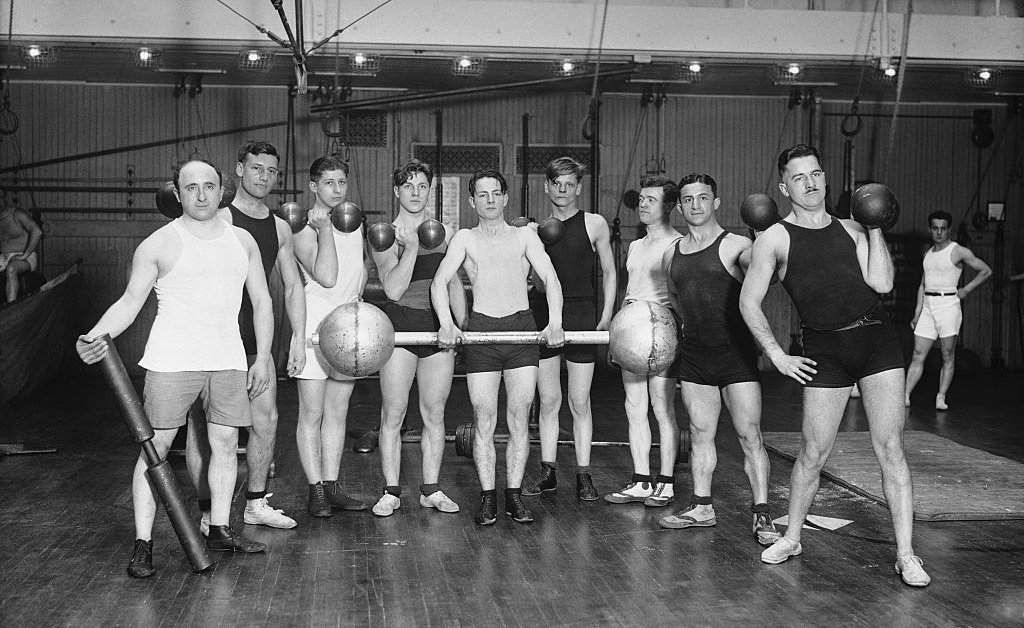
It was super interesting reading the reflections of fitness enthusiasts in the early 20th century. They said we should get rid of corsets, corsets are an assault on women’s form, and that women should be lifting weights and gaining strength. At first, you feel like this is so progressive.

Then you keep reading, and they’re saying white women should start building up their strength because we need more white babies. They’re writing during an incredible amount of immigration, soon after enslaved people have been emancipated. This is totally part of a white supremacy project. So that was a real “holy crap” moment as a historian, where deep archival research really reveals the contradictions of this moment.

Your book talks about how, at one point, America’s focus was on exercising so we could have a population that was ready to go to war. What is health and fitness culture training us to do? How has that expectation evolved over time?

During the New Deal [of the 1930s], the Civilian Conservation Corps would recruit out-of-work or impoverished, scrawny men to go work in the forest and on public works projects. One of the ways that they marketed this was “it puts muscles on your bones.”

That really picked up during the Cold War. Right after World War II, you start to have more concern about Americans getting soft, this idea that the things that made America great—like cars and TV sets—were actually taking a toll on Americans’ bodies. Presidents Eisenhower and Kennedy went on a mission to make exercise look wholesome and patriotic and focus on shifting the purpose of exercise to being a good citizen and defending your country.

In the 1980s, there’s a huge boom in the fitness industry, connected to this “work hard, play hard” mentality. I was also really moved speaking to gay men who had lived through HIV/AIDS and talked about how they exercised to display that they had a healthy body at a moment when there was so much homophobia. Some gyms became like community centers, sharing medical information, almost like mutual aid societies.

Another big turning point is 9/11. You see a boom in the CrossFit mentality of almost like militarized fitness and girding yourself and your body for a fight—not necessarily, by the way, in the 1950s/1960s way of fighting for the U.S. Army—but more like “you need to know how to perform functional fitness to protect yourself if things go wrong.” At the same time, you see [an emphasis on] wellness, self care and healing and being meditative in an increasingly traumatic and unpredictable world.

Read more: The big business of being a Peloton instructor

What era of fitness are we in now?

Gym usage is rebounding rapidly since the pandemic [lockdown ordinances], but now it’s also really efficient for a lot of people to exercise at home. What’s so unfortunate about the pandemic is how much it accelerated fitness inequality. You can go home and be on your Peloton if you can afford it, if you have the space for it, but not everyone can.

I was meeting with somebody who’s very active in the New York City pickleball world, and you have all of these adults who want to do this inclusive recreational thing, and they’re competing with children who want to go out and skateboard and do basketball. Those are wonderful things, and we don’t have the public space to accommodate them.

Did you find an exercise that people don’t do now, but they did do in a certain period of history, that’s just comical to think about?

“Reducing machines” are a really good example of an exercise machine that just went away. Well into the 1960s, women were not encouraged to do any kind of strenuous exercise, but they were of course encouraged to do whatever it took to be beautiful and slim.

So you would either lie down like on a bed or stand with a belt around you, and the machines would shake your fat. They were meant to enhance circulation but also to shake away cellulite. Reducing machines were everywhere; people would buy them for their houses. There was one called the “magic couch” that every woman wanted for Christmas.

The idea that all bodies can exert themselves and work hard—including women’s bodies— is a really positive development, and it’s one of the reasons that you don’t see those passive exercise machines anymore.
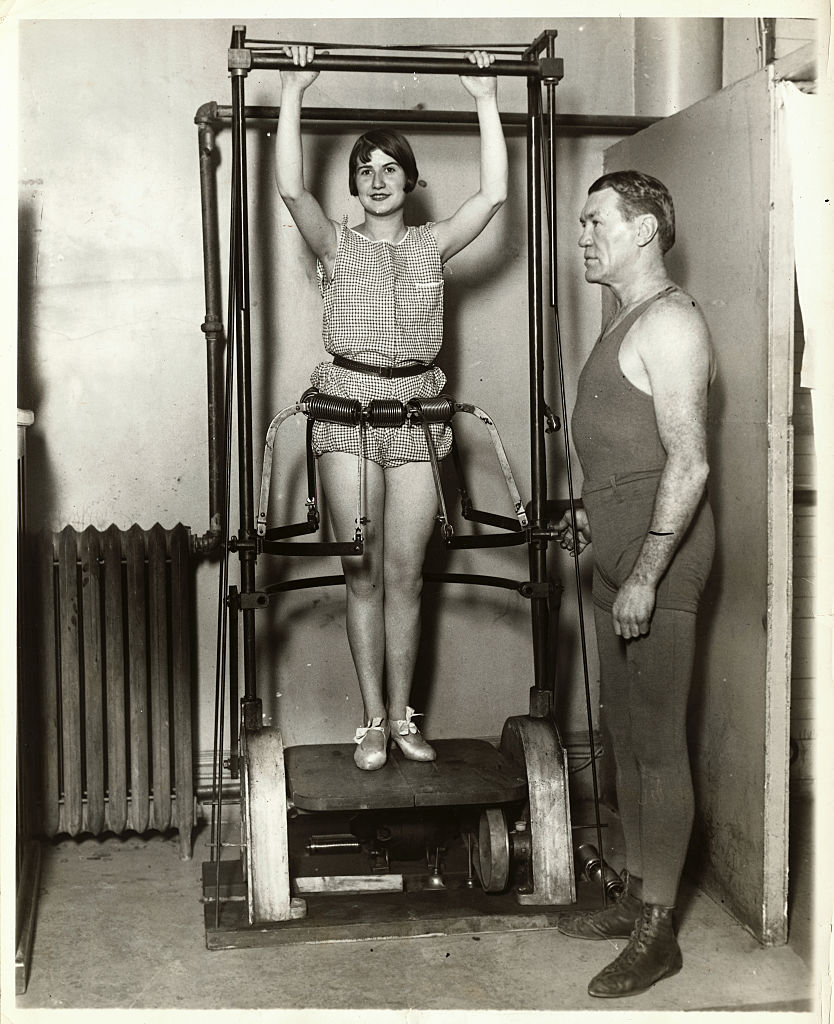
In Philadelphia, a woman works out on a machine designed to roll away fat while boxing champion "Philadelphia" Jack O'Brien looks on. (George Rinhart/Corbis—Getty Images)

In Philadelphia, a woman works out on a machine designed to roll away fat while boxing champion “Philadelphia” Jack O’Brien looks on.

George Rinhart/Corbis—Getty Images

How did running become a popular exercise in the 1970s? It’s often hailed as a great equalizer, an exercise everyone can do with hardly any gear required? Did you find that to be the case?

It became popular among environmentalists, people who were imagining what it would be like to be in a culture that was not centered around cars. The sneakers back then were pretty rudimentary—old work shoes with rubber soles.

But it’s important to point out that access was never totally equal, if you lived in a neighborhood that didn’t have safe streets or streets that were not well lit. Women were catcalled. People of color were thought to be committing a crime.

The “running is for everybody” discourse still quite often leaves out the fact that depending on where you live and the body that you live in, it can be a very different kind of experience.

Read more: 3 things you didn’t know about running

Your book has so many interesting stories about the origins of various workouts. I learned that Pilates can be traced all the way back to World War I, when its founder, Joseph Pilates was detained on the Isle of Man and created resistance contraptions out of hospital beds to help prisoners of war keep up their muscle strength. How can the influence of Pilates be seen in today’s fitness culture?

That sets the foundation for the idea that exercise isn’t an indulgent little hobby some people have; it’s actually something that can keep you healthy. Joseph Pilates came to the United States, developing this system that he first called “Contrology,” and he became really an important part of the dance and performance community. And that did a lot to raise the bar on what fitness represented because, as I talk about at length, a lot of the cultural associations with fitness were like dank gymnasiums and big muscular men heaving weights.

It sounds like Pilates made exercise seem like something that could be graceful too.

Yes, Pilates’ studio on Eighth Avenue in Manhattan was [patronized by] opera stars and ballet dancers who are working on their bodily strength, so that did a lot to sanitize and upgrade the reputation of fitness. A lot of people embraced exercise as something that could make them look like a dancer.

Read more: Here are the health benefits of Pilates
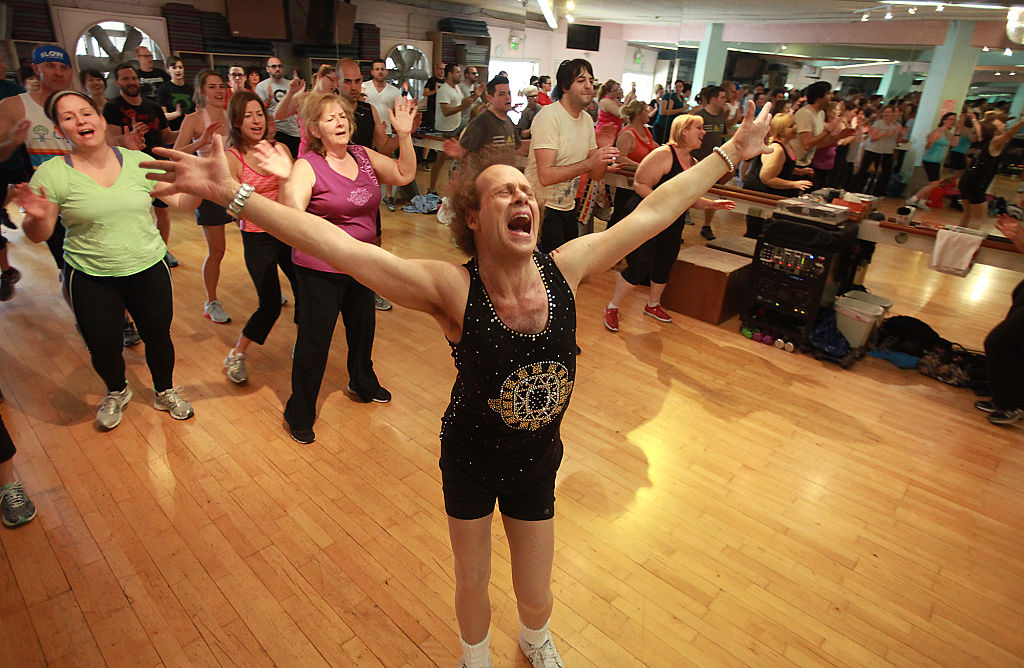
Fitness guru Richard Simmons sings alone with one the the 60s classic tunes playing during one of his classes at Slimmons Studio March 9, 2013, in Beverly Hills. (Brian van der Brug/Los Angeles Times—Getty Images)

Fitness guru Richard Simmons sings alone with one the the 60s classic tunes playing during one of his classes at Slimmons Studio March 9, 2013, in Beverly Hills.

Brian van der Brug/Los Angeles Times—Getty Images

Going into this book, the only famous fitness instructor I had heard of was Richard Simmons. How influential was he?

He’s really important in terms of shifting who was welcome in gyms. One of the reasons that he ended up starting his own studio is that he went to this very famous studio Gilda Marx, and he absolutely loved aerobics, but he was asked not to come back because women didn’t feel comfortable working out with a man who was singing and so emotive during his workout. And I think he opened a studio where everybody felt welcomed there, including fat people, who felt like they couldn’t step foot into a health club or a studio to take an aerobics class because no one looked like them there.

Today, you see quite a few fat people in the fitness industry, who are operating from a better perspective, which is that your body size does not necessarily dictate your fitness level. We should not presume that because you are fat, that you are not fit or that you want to lose weight. And I think that we probably couldn’t have had that without Richard Simmons.

What’s the future of fitness?

I would love for the future of fitness not only to be about [WiFi] connected treadmills and luxury clubs where people can go hang out and drink green juice after their workout, but rather for a collective public investment in making fitness and recreation available to everybody and much more accessible than it currently is. We do agree as a culture, for the most part, that exercise is good for you, but our policy environment has not caught up with that. We should acknowledge that that’s one of the few things that we can agree on in our culture, and then have a kind of bipartisan shared investment in better physical education, better recreation [spaces] for kids and adults.

More Must-Reads From TIME

Write to Olivia B. Waxman at olivia.waxman@time.com.

My Top Books Of 2022

For the duration of any presented year, I examine a good deal – guides for work textbooks I’m examining guides I read on vacation publications I browse since they grab my notice books I read through because I really feel, for one purpose or yet another, that I want to, or want to have study.

But that was not this calendar year. While I did read some guides for get the job done (Ninth Street Women, as effectively as plenty of Polish Historical past and Polish Jewish heritage), and I did evaluate books (Jerry Stahl’s Nein, Nein, Nein, and John Mauceri’s The War on Classical Audio), and some for enjoyment (Chris Blackwell’s Memoirs, Razorblade Tears by S. A. Crosby) and some just because (Simone Veil: A Everyday living, Hemingway’s A Farewell to Arms), I feel as although I barely read anything at all at all this calendar year.

That’s since I have invested most of 2022 examining the to start with 3000 webpages, or the very first 5 volumes of a seven volume, 4200-web page novel – In Search of Misplaced Time by Marcel Proust. Which is Swann’s Way or (Combray and Swann in Really like), The Guermantes Way, Within a Budding Grove (In The Shadow of Young Women in Flower), The Captive, The Fugitive, and Time Regained.

Despite the fact that it does annoy me that Proust has sucked up all my leisure looking through time, it has been an unparalleled encounter of some of the best creating, most incredible descriptions, and deepest insights into Art, human mother nature, and human consciousness. All that, and the novel is incredibly humorous.

When I was 20-yrs-old, I study the 1st 3 volumes for my senior thesis in French literature. At the time, I examine the Pleiade Edition (the one particular prior to the 1991 revised edition). I also sampled the English translation then called Remembrance of Factors Past as translated by Scott Moncrief but dropped it locating it missing the humor of the original.

Penguin Random Dwelling now has a six-quantity box set edition of In Search of Dropped Periods in a paperback Present day Library Edition. All the things about the edition is pleasing: the heft of the volumes, the sizing of the variety, the way the web pages lay flat when open, and of study course the translation itself, which is a delight and significantly enhanced.

So, this time, right after a gap of quite a few many years, I am examining this English version, with a group of four buddies from high faculty – adhering to an on line class of lectures and acquiring alongside one another on zoom to focus on the reading through. We browse about 75-100 pages a week and are now just finishing quantity five, The Captive.

I sense as while I should really hold out until eventually we finish the entire perform just before opining on it, but I have never read through one more writer who can have a character say one issue and believe one more in the similar sentence. Marcel (the character) is a extremely unreliable narrator and protagonist, while Marcel (the writer) is a quite competent author. He is creating as present-day a reserve as he can, no contemporary units, vices or innovations are exempt from his pen. But there is a lushness to the language – in no way have I experienced to glimpse up so numerous words.

At the same time, Proust is not a challenging read through (these kinds of as Joyce’s Ulysses). It is really readable, extremely approachable — it is just damn extensive. But, like substantially of Proust, there is great cause: context. Context is anything and Proust by introducing us to a character’s grandparent, mother or father, and pals enable us see the passage of time as it is lived second by second. When we browse of a character’s dying it impacts us because we have recognised this character in his or her primary.

There are times when I wanted to halt looking at, as Marcel went on for internet pages about some minutiae. Worse, there were times when I wondered if Marcel right now would be canceled for the way he regards ladies – and I unquestionably can recognize anyone emotion strongly adequate to do so. But then we would not have people remarkable sentences that go on and on, from clause to clause and all individuals flowery descriptions: Has everyone at any time noticed just about anything more carefully? And all the inner thoughts, sentiments, all the human hypocrisy, has yet another writer painted these types of a wide-ranging however precise accounting of human behavior? And there are the descriptions of new music, and the descriptions of Artwork, all of which are penned in the most lyrical passages – synesthesia about synesthesia.

And, as talked about before, Proust is funny. He will make enjoyment of all his figures even Marcel. No a single is risk-free in the novel from his withering gaze.

But, then yet again, I’m only some 3000 webpages. When I get to the stop, I’ll inform you what I truly assume.

Hoping to learn another language in the new year? Polyglots may hold the key to success | Language

In February, days before the Russian invasion of Ukraine, the journalist Philip Crowther went viral for a series of dispatches from Kyiv. In a video he posted to Twitter, viewed more than 25m times, Crowther reported fluently in English, Luxembourgish, Spanish, Portuguese, French and German.

To anyone who has grown up in a largely monolingual country, Crowther’s polyglot abilities may seem impressive, even impossible. Despite there being several hundred languages spoken in Australia, 2021 census data showed that 77.3{af0afab2a7197b4b77fcd3bf971aba285b2cb7aa14e17a071e3a1bf5ccadd6db} of Australians only spoke English at home.

But in Luxembourg, where Crowther was educated, speaking at least four languages is common: those who are native to the country speak Luxembourgish at home, are educated in German and French from primary school onwards, and learn English in secondary school.

Speaking multiple languages is common in European countries, and at least half the world’s population is estimated to be bilingual.

“In order to be multilingual as a native speaker, you just have to be lucky,” says Prof Ghil’ad Zuckermann, the chair of linguistics and endangered languages at the University of Adelaide. Zuckermann is himself fluent in 13 languages and can read “maybe 50”.

For those who want to pick up a new language in 2023 or are disheartened by slow progress despite longstanding Duolingo streaks, are there tips from multilingual experts that can make learning easier – or is there something innate that gives polyglots an effortless advantage?

Child’s play

When it comes to language learning, linguistics research tells us that generally the earlier it happens the better. Children learn to speak languages with less detectable foreign accents, says Mark Antoniou, an associate professor at Western Sydney University.

Linguists distinguish multiple language acquisition as being either simultaneous (as is often the case in children) or sequential (as can occur if someone migrates later in life). “As you move away from simultaneous to … someone who acquires their second language in adolescence or early adulthood, or even in middle age, we tend to see the accentedness of their speech, the gaps in their knowledge and so forth, become larger,” Antoniou says.

Perceptual attunement, the ability to discriminate between sounds of one’s native language, begins in the first year of life. Research in infants has found that Japanese six-month-olds can distinguish between r and l sounds – as in rock and lock – but the ability to differentiate them is lost by around 11 months. “In Japanese, the r and l sounds don’t tell words apart, so it’s not important for you to know that distinction,” Antoniou says.

A study of Dutch adults who had been born in Korea but adopted to the Netherlands as infants, some at as young as three to five months old, showed that – although they had effectively forgotten the Korean they had heard decades earlier – they could distinguish unfamiliar Korean consonants significantly faster than others. “Early exposure to spoken language, even in the first half-year of life, leaves traces that can facilitate later relearning”, the researchers found.

There is also evidence to suggest that, depending on the languages, people who are bilingual are more adept at learning a third language compared with monolingual individuals.

If you don’t have the good fortune of being brought up bi- or multilingual, it’s never too late to learn, even if it means you might not sound like a native speaker. There are brain benefits, for one: studies have repeatedly found that people who are bilingual tend to be diagnosed with Alzheimer’s four to five years later than those who speak only one language. A review Antoniou conducted found “research strongly suggests that bilingual experience delays the onset of neurodegenerative disease”.

Learn shamelessly

The most important factor for learning languages, Zuckermann says, is motivation: wanting to be able to speak Lithuanian to a partner’s parents, for example, or a philosopher wanting to read Nietzsche or Frege in the original German.

Another tip is to learn shamelessly. “You should not be afraid of making mistakes, otherwise you will not progress,” he says.

Zuckermann is one of a small group of people worldwide known as hyperpolyglots – those who can fluently speak upwards of 11 languages. He has published academic papers, his website lists, in “English, Israeli (reclaimed Hebrew), Italian, Yiddish, Spanish, German, Russian, Chinese, Japanese, Korean and Arabic”. Some hyperpolyglots have learned to speak foreign languages at seemingly native-level proficiency – which is how Zuckermann feels about his Italian, even though he learned it after puberty.

There are other useful language-learning traits that are less easily controllable – Zuckermann believes that musicality (he can remember arias from operas after having heard them once) and an outstanding memory are also necessary.

Are there biological features that make people innately better or worse than others at acquiring languages? The short answer, Antoniou says, is we don’t know. Hyperpolyglots are not well studied because of how rare their abilities are. But, he says, “there has to be some sort of brain difference in order to have such an affinity for learning languages”.

A postmortem analysis of the brain of Emil Krebs, a German polyglot who spoke more than 60 languages, found significant differences in the Broca’s area, a region of the brain key to language processing. Krebs, who died in 1930, reportedly learned Armenian in nine weeks.

All this might leave the average adult learner feeling slightly despondent. But Kevin Robb, a self-described “language enthusiast” in Bethania, Queensland, says there’s no great secret to learning one or many languages – that it all comes down to practice.

His approach has been to get his hands on the right materials, study for at least one hour every day “even if you don’t feel like it”, watch YouTube language videos and ask questions in online groups.

Robb doesn’t describe himself as a polyglot. “I’m really only fluent in English, Esperanto and Scots, and I can get through in Afrikaans,” he says.

But Robb has written Wikipedia articles about his hometown of Barraba, New South Wales, in Esperanto, Afrikaans, Zulu, French, Scots, literary Welsh, Swedish, Swahili, Malay, Spanish, European Portuguese and Volapük, a constructed language that predates Esperanto.

“I also learned Māori, Tok Pisin … and Indonesian as I was curious about our neighbouring countries,” he adds.

Prof Ghil’ad Zuckermann has been working with the Barngarla community in South Australia to revive their language
Prof Ghil’ad Zuckermann has been working with the Barngarla community in South Australia since 2011 to revive their language

Reviving the ‘sleeping beauties’

Zuckermann says the older he gets, the less motivated he is to learn a language “for the sake of the gain”. What now drives him – what he describes as his ikigai, a Japanese concept akin to the French raison d’être – is work in the field of language revival.

Originally from Israel, Zuckermann is applying lessons learned from the revival of Hebrew – a language not spoken as a mother tongue for some 1,700 years – to the reclamation of Aboriginal languages and cultures. Since 2011 he has been working with the Barngarla community in South Australia to revive their language, whose last native speaker died in 1964.

Of more than 330 First Nations languages spoken pre-colonisation, Zuckermann estimates that 97{af0afab2a7197b4b77fcd3bf971aba285b2cb7aa14e17a071e3a1bf5ccadd6db} of them were “killed through linguicide”, or turned into what he describes as “sleeping beauties”.

Prof Rachel Nordlinger, the director of the research unit for Indigenous language at the University of Melbourne, says multilingualism among First Nations people was common prior to colonisation. “Multilingualism was valued and supported, and still is, in Indigenous culture and world views,” she says, noting that in some communities in northern Australia, a single conversation can take place in three to four languages.

Nordlinger criticises what she sees as a “mindset of monolingualism” in government and broader Australian culture, a view shared by many of the people interviewed. “Our school systems don’t really encourage the learning of other languages in any detailed way,” Nordlinger says.

When the minister for foreign affairs, Penny Wong, spoke to Indonesians in Indonesian in June, the address was widely covered. Much fanfare was also made about the multilingualism of Sam Lim when he was elected as a Labor MP in May.

Arguably, both politicians attracted attention because their language abilities were deemed unusual – but perhaps this is changing as Australia’s parliament becomes more diverse.

“No one denies that it’s important to be able to speak English if you’re going to have all the opportunities in Australia, but it doesn’t have to be at the expense of other languages,” Nordlinger says.

“We have all these people who come to Australia with all this other language knowledge, and we could value that and … support them or Indigenous people in maintaining their other languages as well.”

Akron Public Schools will hold online classes if teachers strike

Akron Public Schools will hold online classes if teachers strike

Akron Community educational institutions is poised to present on the web instruction for pupils to learn at their houses if Akron lecturers strike in January.

Instructors and other certified specialists who are members of the Akron Schooling Affiliation union have threatened to strike at 12:01 a.m. Jan. 9. 

Courses are established to resume Jan. 6 soon after the wintertime break, so it is attainable learners will return to faculty Friday, only to have lecturers strike the following Monday. 

The Akron college board authorised resolutions at a unique conference Thursday night time in response to the Akron instructors union before in the working day issuing a 10-working day notice of its intent to strike. State law requires public personnel to give a 10-working day strike see to the Point out Worker Relations Board right before a function stoppage.

Akron Board of Education prepares for potential teachers strike

The Akron Board of Training is preparing the faculty district for a probable teachers strike, like a resolution to potentially continue classwork on the web in the event of a strike.

The Board accredited many resolutions immediately after a lengthy government session Thursday, like to grant the Superintendent the authority to: employ a “crisis response business” look for out extra substitute academics and carry on faculty remotely if it’s deemed required. This all in the circumstance of the Akron Education and learning Affiliation goes on strike if a offer can not be struck right before January 9 that is 10 days right after the union submitted a strike discover (which it submitted Thursday.)

In accordance to the resolutions, the district, in the function of a strike, could shut its properties to the standard general public although selecting personnel and acquiring gear as vital to carry on operations. The Board wrote that it’s “important to the academic and social and emotional wellbeing of the students in the Akron City Faculty District that schooling continue as a result of on-line instruction ought to the Akron Schooling Association strike.”

The disaster response agency the district would employ the service of is Huffmaster Disaster Reaction LLC. The agency has been contracted by other university districts in Ohio that faced teachers’ strikes in latest decades, and will be utilised to provide “security and personnel services” in the occasion of a get the job done stoppage.

“The Board deems it may perhaps be essential and appropriate to health supplement its safety and safety forces by retaining a agency to health supplement its current protection and stability staff with the products and services of a organization professional in delivering security to college staff and house in the party there is any college worker get the job done stoppages,” the resolution reads.

Ohio Senator Sherrod Brown experienced sent a letter of concern to the Niles Metropolis University District just after they employed the identical organization previously this calendar year to contend with a probable strike there.

“…We uncover it troubling that the Board resolved to approve a deal with Huffmaster Crisis Reaction – time and assets that could usually be invested investing in college students, educators, and university amenities,” Brown stated at the time.

The teachers’ union and faculty administration have not witnessed eye-to-eye on challenges like teacher pay, school protection and security and far more, with relations deteriorating critically in new months.

The Akron Education and learning Association yesterday alleged the university administration had expended funds on extravagant travels and dinners, and that the university district’s superintendent did not stay inside the city limits, but relatively rented a hotel place near the central workplace.

Mark Williamson, Akron Public Schools director of promoting and interaction, stated in a statement Friday that “most of the claims… if not all” in the push launch from the academics union that contained those people allegations were “patently incorrect.”

Why Some Telugu Groups in America are Opposed to Providing English Education to the Poor in Andhra?

“Kuvempu took the information that English experienced to supply though also offering a blistering critique of the language as a car of colonialism. If it were being not for English, he would have been condemned (as a Shudra) to clean up vessels in a Brahmin’s dwelling.”

— Rajendra Chenni, a chronicler of well-known Karnataka Shudrawriter and thinker, Kuvempu (1904-1994). Deccan Herald, 12/29/2022

The Telugu Association of North America (TANA), Silicon Andhra, TANA Environment Literature Platform and Siddhartha Academy have jointly arranged Environment Telugu Writers Meeting in Vijayawada on 23 and 24 December. The theme of the conference was: “Let’s secure our mother tongue! Let us make self-esteem.”

Certainly, the meeting was structured primarily to oppose English medium education in federal government schools in Andhra Pradesh, which was decreed by Y.S. Jaganmohan Reddy when he turned the Main Minister of the condition in 2019. Before that, the bad Dalit/Tribal/Shudra and Other Backward Lessons (OBC) kids could only analyze in Telugu medium educational institutions.

The main minister, however, mandated English medium schooling in all authorities faculties from the academic calendar year 2019-20. These kinds of a recreation-modifying phase in the college education program in India was resisted by a lot of Telugu leaders which includes Chandrababu Naidu and Venkaiah Naidu. A number of court cases and ideological battles experienced to be fought on this challenge by the main minister just before he succeeded. Now his training model is influencing the total place. Presently the Telangana governing administration which was earlier opposed had to come all around and released English medium in all condition governing administration universities.

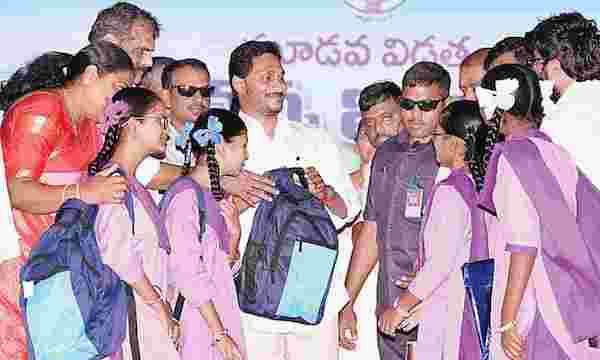
Andhra Main Minister Y.S. Jaganmohan Reddy with faculty lecturers and little ones. Top rated picture, representative impression, courtesy of the Deccan Chronicle.

The AP point out governing administration was the very first to introduce English medium school instruction from class 1 to course 10 on par with the private English medium educational institutions where the young children of the wealthy review. The AP design stabilized English medium but has kept Telugu as a subject matter compulsory each in govt and private colleges. This is a new innovative experiment to improve English amongst the bad youth and also safeguard their native language.

Fairly surprisingly, TANA leaders who live in the ‘English world’ are opposing instructing in the English language in federal government universities in India. How can people who went away from this area, and teach their youngsters and grandchildren in world-course government-operate English medium faculties in The usa, shield Telugu in Andhra Pradesh?

Numerous Non-Resident Indians (NRIs) who aid the Rashtriya Swayamsevak Sangh and Bharatiya Janata Occasion Government in Delhi, like the American Hindu Foundation, campaign for “One Nation One particular Language (Hindi)” while living in the U.S. and educating their young children in English which gives them obtain to the most effective of science and know-how and humanities. Which is hypocrisy.

Neither TANA associates nor other NRIs send their little ones back again to India to get Telugu or Hindi medium education. Most of them commit their pounds in private English medium colleges and universities in India, into which the subsistence farmers, laborers and artisans simply cannot even aspiration of having admission.

Even even though these NRIs want their kinfolk in India to get rich and have the very best positions that the non-public English schooling supplies them, or permit them to emigrate to The usa or Europe, they are opposed to Dalits/tribals and OBCs learning in English.

Not a one NRI has set up a excellent Telugu or Hindi or any other so-referred to as vernacular language university or faculty in India and educated the very poor free of charge or with minimal price tag. India for them is the motherland for producing a lot more bucks in education and learning-small business, that as well, only in English medium. It’s not social company.

These organizations and their leaders adhere to a classical Indian deceptive design that the Shudra/OBC/Dalit/Adivasis should really not be educated in a language that prepares them for excellent employment in India or gives access to the global job markets.

In India, obtain to lucrative occupations and professions is controlled by upper castes educated in private English medium educational institutions. Even some of the World Financial institution and IMF officials of Indian origin, who mostly live in America or Europe, think that English medium schooling ought to not be presented to the successful masses of India. They speciously cite the instance of African nations around the world that are finding Anglicized by leaving guiding their conventional tribal cultures.

See Also


But these very same officers do not abide by their ancestral Brahminic lifestyle by finding out in Sanskrit and pursuing their traditions. They have as an alternative studied in personal English medium schools, set their children in possibly American or British educational institutions and get pleasure from Western lifestyles.

Some of them argue that bad quality educational institutions in the govt sector with untrained lecturers do not go well with English medium instruction in India. That is not genuine because just about every graduate in India experiments English from quality six, for this reason each individual school instructor is proficient in English. Aside from, somewhere the shift has to choose put toward educational equality in language and content material. The AP Governing administration has been supplying standard training to instruct in English and supplied mirror-graphic books to students and lecturers (each textbook has one side of the website page in English and the opposite side in Telugu). These textbooks make the task of teacher and pupil simple to browse in both languages. Bilingualism is secured with this process and augurs properly for training. Inspite of all these initiatives, why are the NRIs opposed to English medium education in federal government schools and becoming a member of palms with anti-inadequate forces in India in the title of adore for the mom tongue?

It is absurd that all those kids whose parents converse and perform in English in the U.S. fake that Telugu remains their mom tongue and they want to safeguard it from the danger of bad people in India learning English! Even nevertheless these NRIs want their kinfolk in India to get wealthy and have the finest work that the personal English education and learning supplies them, or help them to emigrate to The united states or Europe, they are opposed to Dalits/tribals and OBCs researching in English. Could it be that they do not want the weak to contend with their higher-caste kinfolk?

That is the challenge. For these NRIs, the American criteria of equality are not for India. The course herd and caste mentality are deeply ingrained into their psyche. They really do not realize that language and society are not the exact. And that society improvements constantly. Numerous unused languages die and new languages arise. What is vital is human very well-getting, equality and modernization of societies.

The groups that went in search of a good daily life in international lands with the enable of English and go to India as soon as in a although to instruct morals to those who are living there, is immoral. This emigre immorality does not provide the nationwide desire of India.


Kancha Ilaiah Shepherd is an Indian creator, activist and columnist. He is a retired professor of Political Science at Osmania University in Hyderabad. His properly-recognised guides incorporate, “Why I am Not a Hindu,” “Post-Hindu India,” and “God As Political Philosopher.” He has created extensively about the romantic relationship between Spiritual Democracy and Political Democracy. His reserve “Buffalo Nationalism” is a critique of cow worship and cow nationalism of the Hindutva forces. He thinks that the dignity of labor must be integrative of spiritual philosophy to abolish caste and race inequalities. He has been campaigning for English medium instruction in government faculties for the very last a few many years.