

Tag: White
The White Supremacist Origins of Exercise in the U.S.
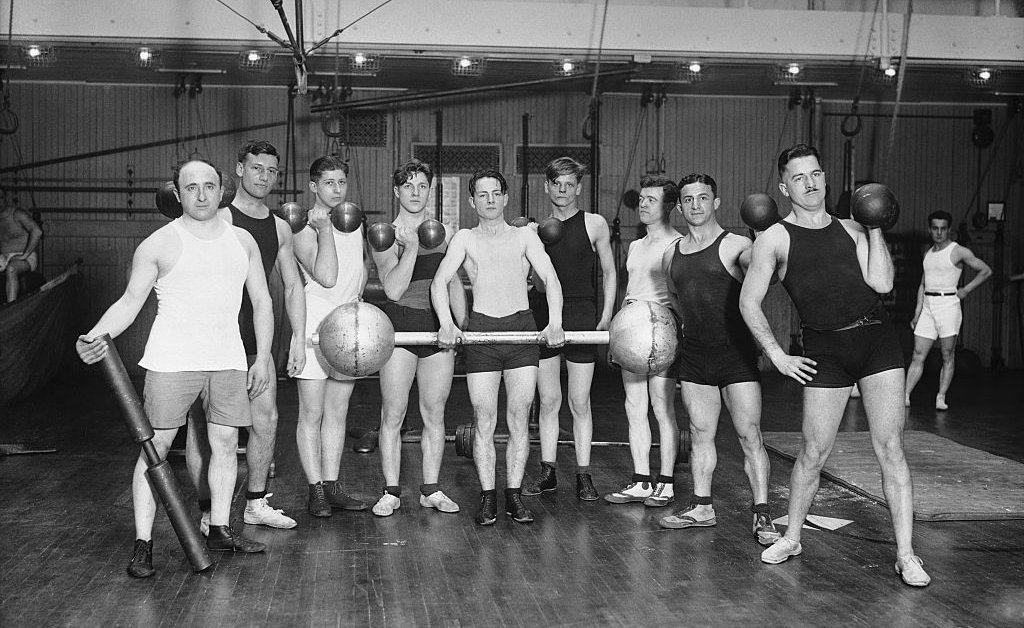
How did U.S. exercise trends go from reinforcing white supremacy to celebrating Richard Simmons? That evolution is explored in a new book by a historian of exercise, Natalia Mehlman Petrzela, author of the book Fit Nation: The Gains and Pains of America’s Exercise Obsession, out Jan. 2023.
Nowadays, at the beginning of every New Year, many Americans hit the gym to work off their holiday feasts. This momentum usually starts to fade in mid-January, according to a 2019 analysis of data on fitness tracking apps by Bloomberg. But such new year’s resolutions are pretty new—as is the concept of exercise as a way to improve bodily health.
“It’s really not until the 1980s that you start to have a consensus that everybody should be doing some form of exercise,” says Mehlman Petrzela, a professor at the New School in New York City. That’s partly the result of the women’s movement of the 1960s and 1970s, which fought for Title IX, allowing girls to play school sports. That pushed back on notions that girls and women aren’t capable of doing vigorous exercise because they’re fragile.
Perfect for reading on the treadmill or stationary bike, the below conversation with Mehlman Petrzela outlines the earliest ideas on exercise, delves into the history of various popular workouts, and the outsize influence of Richard Simmons.
Your book Fit Nation starts out by talking about how fat was something to aspire to and that was a sign of wealth and healthiness. How did Americans go from a mentality of “fat is good” to “skinny is better?”
One of the things I set out to do in this book is to look at the change in how we think about our bodies and what’s considered attractive. Until the 1920s or so, to be what would be considered today fat or bigger, was actually desirable and actually signified affluence—which is like the polar opposite of today, when so much of the obesity epidemic discourse is connected to socio-economic inequality and to be fat is often to be seen as to be poor.
How did that happen? Well, in a moment when actually there wasn’t a lot of access to caloric foods, to be fat showed that you could afford these things that were out of the reach of most people and also you could afford to rest, like you weren’t out there doing manual labor all day. As that caloric food became more accessible, and as more people were doing sedentary white-collar work and had access to cars and leisure, somebody who could resist those caloric foods, exercise, and have a thin body, was seen as more desirable.
Read more: The history behind New Year’s resolutions to exercise more
What’s the most surprising thing you learned in your research?
It was super interesting reading the reflections of fitness enthusiasts in the early 20th century. They said we should get rid of corsets, corsets are an assault on women’s form, and that women should be lifting weights and gaining strength. At first, you feel like this is so progressive.
Then you keep reading, and they’re saying white women should start building up their strength because we need more white babies. They’re writing during an incredible amount of immigration, soon after enslaved people have been emancipated. This is totally part of a white supremacy project. So that was a real “holy crap” moment as a historian, where deep archival research really reveals the contradictions of this moment.
Your book talks about how, at one point, America’s focus was on exercising so we could have a population that was ready to go to war. What is health and fitness culture training us to do? How has that expectation evolved over time?
During the New Deal [of the 1930s], the Civilian Conservation Corps would recruit out-of-work or impoverished, scrawny men to go work in the forest and on public works projects. One of the ways that they marketed this was “it puts muscles on your bones.”
That really picked up during the Cold War. Right after World War II, you start to have more concern about Americans getting soft, this idea that the things that made America great—like cars and TV sets—were actually taking a toll on Americans’ bodies. Presidents Eisenhower and Kennedy went on a mission to make exercise look wholesome and patriotic and focus on shifting the purpose of exercise to being a good citizen and defending your country.
In the 1980s, there’s a huge boom in the fitness industry, connected to this “work hard, play hard” mentality. I was also really moved speaking to gay men who had lived through HIV/AIDS and talked about how they exercised to display that they had a healthy body at a moment when there was so much homophobia. Some gyms became like community centers, sharing medical information, almost like mutual aid societies.
Another big turning point is 9/11. You see a boom in the CrossFit mentality of almost like militarized fitness and girding yourself and your body for a fight—not necessarily, by the way, in the 1950s/1960s way of fighting for the U.S. Army—but more like “you need to know how to perform functional fitness to protect yourself if things go wrong.” At the same time, you see [an emphasis on] wellness, self care and healing and being meditative in an increasingly traumatic and unpredictable world.
Read more: The big business of being a Peloton instructor
What era of fitness are we in now?
Gym usage is rebounding rapidly since the pandemic [lockdown ordinances], but now it’s also really efficient for a lot of people to exercise at home. What’s so unfortunate about the pandemic is how much it accelerated fitness inequality. You can go home and be on your Peloton if you can afford it, if you have the space for it, but not everyone can.
I was meeting with somebody who’s very active in the New York City pickleball world, and you have all of these adults who want to do this inclusive recreational thing, and they’re competing with children who want to go out and skateboard and do basketball. Those are wonderful things, and we don’t have the public space to accommodate them.
Did you find an exercise that people don’t do now, but they did do in a certain period of history, that’s just comical to think about?
“Reducing machines” are a really good example of an exercise machine that just went away. Well into the 1960s, women were not encouraged to do any kind of strenuous exercise, but they were of course encouraged to do whatever it took to be beautiful and slim.
So you would either lie down like on a bed or stand with a belt around you, and the machines would shake your fat. They were meant to enhance circulation but also to shake away cellulite. Reducing machines were everywhere; people would buy them for their houses. There was one called the “magic couch” that every woman wanted for Christmas.
The idea that all bodies can exert themselves and work hard—including women’s bodies— is a really positive development, and it’s one of the reasons that you don’t see those passive exercise machines anymore.
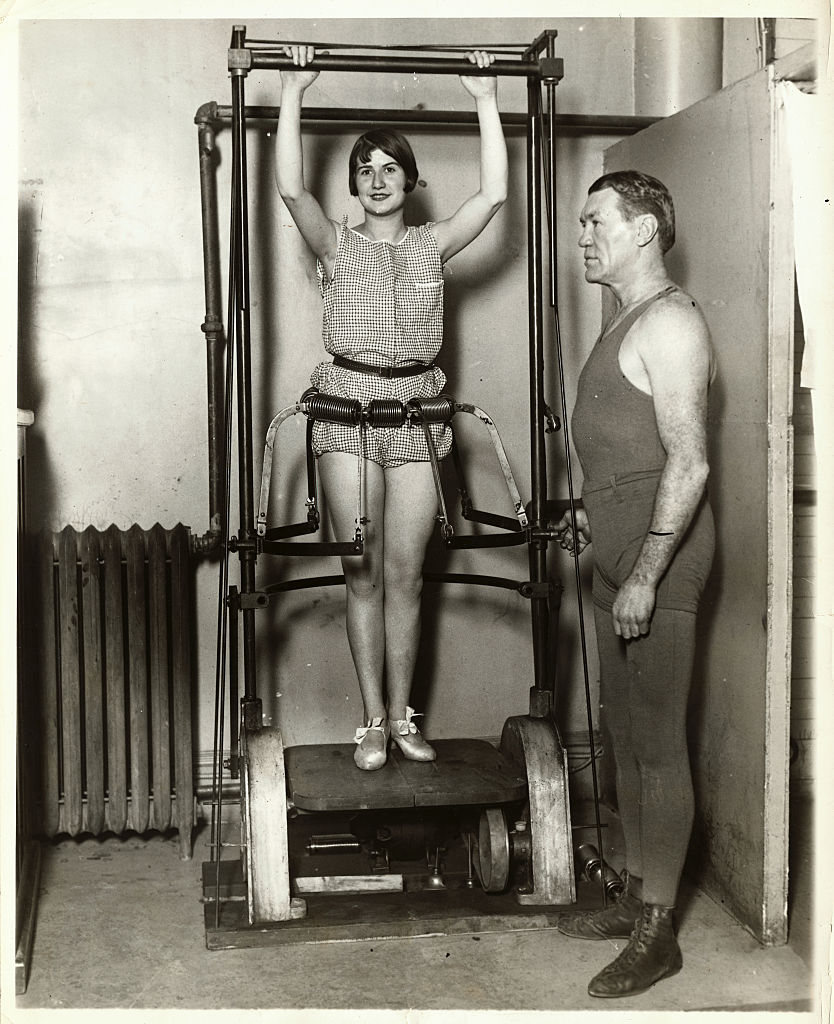
In Philadelphia, a woman works out on a machine designed to roll away fat while boxing champion “Philadelphia” Jack O’Brien looks on.
George Rinhart/Corbis—Getty Images
How did running become a popular exercise in the 1970s? It’s often hailed as a great equalizer, an exercise everyone can do with hardly any gear required? Did you find that to be the case?
It became popular among environmentalists, people who were imagining what it would be like to be in a culture that was not centered around cars. The sneakers back then were pretty rudimentary—old work shoes with rubber soles.
But it’s important to point out that access was never totally equal, if you lived in a neighborhood that didn’t have safe streets or streets that were not well lit. Women were catcalled. People of color were thought to be committing a crime.
The “running is for everybody” discourse still quite often leaves out the fact that depending on where you live and the body that you live in, it can be a very different kind of experience.
Read more: 3 things you didn’t know about running
Your book has so many interesting stories about the origins of various workouts. I learned that Pilates can be traced all the way back to World War I, when its founder, Joseph Pilates was detained on the Isle of Man and created resistance contraptions out of hospital beds to help prisoners of war keep up their muscle strength. How can the influence of Pilates be seen in today’s fitness culture?
That sets the foundation for the idea that exercise isn’t an indulgent little hobby some people have; it’s actually something that can keep you healthy. Joseph Pilates came to the United States, developing this system that he first called “Contrology,” and he became really an important part of the dance and performance community. And that did a lot to raise the bar on what fitness represented because, as I talk about at length, a lot of the cultural associations with fitness were like dank gymnasiums and big muscular men heaving weights.
It sounds like Pilates made exercise seem like something that could be graceful too.
Yes, Pilates’ studio on Eighth Avenue in Manhattan was [patronized by] opera stars and ballet dancers who are working on their bodily strength, so that did a lot to sanitize and upgrade the reputation of fitness. A lot of people embraced exercise as something that could make them look like a dancer.
Read more: Here are the health benefits of Pilates
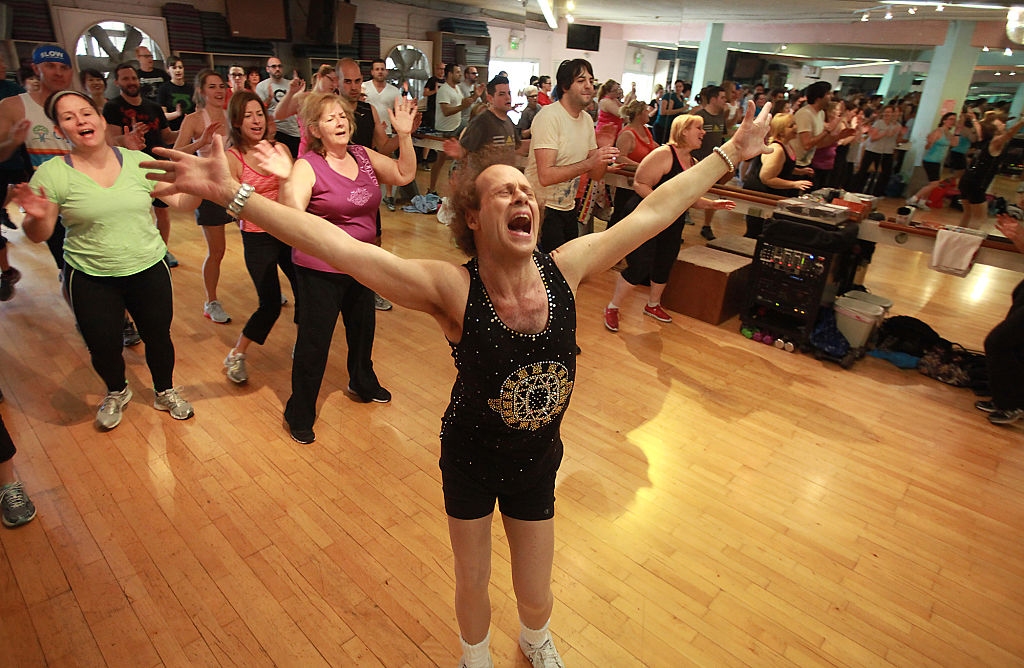
Fitness guru Richard Simmons sings alone with one the the 60s classic tunes playing during one of his classes at Slimmons Studio March 9, 2013, in Beverly Hills.
Brian van der Brug/Los Angeles Times—Getty Images
Going into this book, the only famous fitness instructor I had heard of was Richard Simmons. How influential was he?
He’s really important in terms of shifting who was welcome in gyms. One of the reasons that he ended up starting his own studio is that he went to this very famous studio Gilda Marx, and he absolutely loved aerobics, but he was asked not to come back because women didn’t feel comfortable working out with a man who was singing and so emotive during his workout. And I think he opened a studio where everybody felt welcomed there, including fat people, who felt like they couldn’t step foot into a health club or a studio to take an aerobics class because no one looked like them there.
Today, you see quite a few fat people in the fitness industry, who are operating from a better perspective, which is that your body size does not necessarily dictate your fitness level. We should not presume that because you are fat, that you are not fit or that you want to lose weight. And I think that we probably couldn’t have had that without Richard Simmons.
What’s the future of fitness?
I would love for the future of fitness not only to be about [WiFi] connected treadmills and luxury clubs where people can go hang out and drink green juice after their workout, but rather for a collective public investment in making fitness and recreation available to everybody and much more accessible than it currently is. We do agree as a culture, for the most part, that exercise is good for you, but our policy environment has not caught up with that. We should acknowledge that that’s one of the few things that we can agree on in our culture, and then have a kind of bipartisan shared investment in better physical education, better recreation [spaces] for kids and adults.
More Must-Reads From TIME
Author’s true-story tale of White House cat now a children’s book | Local News

Most children’s books are not derived from true stories.
That is accurately how the stranger-than-fiction tale goes of a Lawrence County barn cat who interrupted the country’s upcoming to start with woman and uncovered by itself dwelling in the White Property.
Christine Telesz Siddall was just one of a handful of attendees at the little celebration on her brother Rick’s farm alongside Route 168 in the vicinity of Volant on the eve of Election Day 2020. The soybean farm, and Telesz family, was thrust in the countrywide spotlight after Rick was featured on several tv news channels for throwing his assist at the rear of Joe Biden in the 2020 election four several years right after voting for Donald Trump. Rick Telesz was featured during the digital Democratic National Convention, so it came as no surprise when Dr. Jill Biden held a tiny rally in Telesz’s barn that Monday afternoon.
What was astonishing was how — and what — interrupted her speech.
A barn cat, generally skittish all-around folks, walked ideal in entrance of the potential first girl. A couple of times afterwards, Joe Biden gained Pennsylvania and the presidency. Quietly, Dr. Jill Biden received a guarantee from her spouse that she could provide a cat to the White Property. But not just any cat. She desired that cat.
Which is the basis of Siddall’s debut children’s e-book, “From the Milk Home to the White House,” a 55-website page tale that chronicles the real-lifestyle edition of how the cat originally identified as mi became the latest 4-pawed occupant of the White Dwelling. The reserve is obtainable for invest in online on Amazon, Barnes & Noble and other merchants.
The e book is illustrated by artist Ashley Plummer. Each and every web site features paragraphs in English and a translation in Spanish, with passages separated by a serious paw print from the major character.
Siddall mentioned she’s presently hit triple digit sales on Amazon and has had two ebook signings domestically.
Even so, 1st graders at Wilmington Space Elementary School obtained to hear the e-book in its entirety through a exclusive Monday function when Siddall visited 4 classrooms to study the e book, clearly show off shots of the actual cat and answer questions.
“This is a legitimate tale,” Siddall warned to 1 of the lessons. “There are no monsters or Cinderellas.”
Siddall recently moved back to the county. Following graduating from Wilmington, she attended college or university and still left the space. It was a position she highlighted for the youthful pupils.
“Anything in life is possible,” she stated. “The last time I wrote a paper was back again in higher education. I went into accounting and I by no means wrote anything ever again. I was at the function when the cat walked across the phase, and I imagined, ‘wouldn’t this be a cute story to inform.’ It is not impossible to develop into everything you want to be at any time you want be it. If you ever have a tale you imagine you would genuinely like, just jot down some notes and retain adding to it and probably 1 working day you are going to have a reserve with your name on it.”
Following listening to the tale, Siddall showed photographs of the cat in the White Property. Pupils also watched a movie from animal web site The Dodo of Willow’s to start with White Dwelling Christmas, which so far has racked up virtually 400,000 views on Facebook and a different 100,000-additionally on YouTube.
Tommi or Uncle’s Cat, as the cat was originally acknowledged, had its named modified in genuine life to Willow, a nod to Dr. Jill Biden’s hometown of Willow Grove, Pennsylvania.