
The Best Online Landscape Design Courses of 2022

The Best Online Landscape Design Courses Options

Photo: istockphoto.com

For those who love working with plants but want to take their skills to the next level, an online landscape design course may be just what they need. Landscape design schools online allow students to work at their own pace and on their own schedules, which means they won’t need to make any major sacrifices regarding current jobs or family commitments. Many of the best online landscape design courses are more affordable than formal colleges or schools but still teach the necessary skills for students to become creative and successful landscape designers. We’ve weeded through the top landscape design classes and what to consider when choosing one.

  1. BEST OVERALL: NYIAD Landscape Design Course Online
  2. RUNNER-UP: Penn Foster Landscaping Technology Career Diploma
  3. BEST BANG FOR THE BUCK: OSU Sustainable Landscape Design
  4. BEST FOR BEGINNERS: Udemy Fundamentals of Garden Design
  5. BEST ADVANCED PROGRAM: UCLA Extension Landscape Architecture

The Best Online Landscape Design Courses Options

Photo: istockphoto.com

What to Consider When Choosing One of the Best Online Landscape Design Courses

There are several factors to keep in mind to find the best online landscape design courses. These include the length and structure of the class, class curriculum, what kind of accreditation or certificate students earn, and cost.

Landscape Designer vs. Landscape Architect

Although some landscape architects are also landscape designers, there are a few key differences between the two jobs. Becoming a landscape architect requires a bachelor’s or master’s degree in landscape architecture from an accredited university. Although many landscape designers have an associate’s degree in the horticultural field, becoming a landscape designer does not require a degree or certification. Many landscape designers have learned through work experience.

Both landscape architects and designers meet with clients to work out a landscaping project’s scope, including design requests or any challenges in the landscape. Both also create designs for clients using some of the best landscape design software. Landscape architects use CADD (computer-aided design and drafting) programs to develop their plans, so mastering this software is part of their education. The use of CADD is not necessary to become a landscape designer. For larger projects, landscape designers and architects frequently make 3D models of the work to provide clients with a more in-depth understanding of the design vision.

Landscape architects work on larger or more complex projects, including public projects such as parks, campuses, or large resorts. Landscape architects must review the jobsite and obtain construction and other required permits. Landscape designers usually work on residential and smaller jobs. Landscape designers focus on details, such as specific plants, irrigation requirements, hardscaping, or other features.

Course Length, Structure, and Curriculum

Before enrolling in any online landscape design course, prospective students will want to ensure they find a course that suits their lifestyle. It’s essential to look at how long the course will take to complete, whether it is self-paced or instructor-led, and what specific topics the classes cover.

Certifications Earned

Landscape design programs online can offer a variety of certifications, from certificates of completion to diplomas and post-baccalaureate certificates. When researching which landscape design classes to take, students will want to know what credentials they will earn by completing the course. Certifications can be beneficial (and sometimes necessary) when applying for jobs in the future.

Price

With various classes, from free online landscape design courses to post-baccalaureate programs that can take years, the prices for online landscape design classes can vary significantly. Generally speaking, courses with higher levels of certification cost more. Many of the longer certificate programs will offer monthly payment plans. Most advanced or post-baccalaureate courses will also require a deposit and material fees in addition to the tuition. When determining which online landscaping classes are best, students will want to consider their long-term career goals and if they will be able to offset the program’s cost in the future.

Program Accreditation

Before a prospective student enrolls in any online landscape design course, researching the program’s accreditation can help decide which course is best. While accreditation is not a requirement for most landscape design classes, this designation will be more critical for landscape design courses that are significant investments. Courses that offer post-baccalaureate certification or degrees should be accredited by an appropriate body recognized by the U.S. Department of Education.

Our Top Picks

When looking for garden design online courses, prospective students will want to make sure the course matches their skill set, interests, schedule, and career goals. Check out our top picks for students who want to learn landscape design online.

The Best Online Landscape Design Courses Option NYIAD Landscape Design Course Online

Photo: nyiad.edu

Why It Made the Cut: NYIAD Landscape Design Course Online teaches students in-depth horticultural knowledge along with practical business skills within 8 to 12 months.

The New York Institute of Art & Design (NYIAD) Landscape Design Course Online is ideal for students who are looking to start intrepid careers as landscape designers. Students learn how to handle real-world work experiences with critical skills that pertain directly to their field. The course is led by professional landscapers, so students can learn horticultural knowledge from working experts.

Students receive one-on-one feedback on assignments and can talk to a team of advisers for career guidance. One common complaint, however, is that there can be a delay in hearing back from instructors. While the average time for course completion is 8 to 12 months, NYIAD allows students up to 18 months to finish so they can work at their own pace. Plus, students who enroll in multiple NYIAD courses receive a 25 percent discount.

Specs

  • Course length: 8 to 12 months
  • Certification earned: Certificate of completion
  • Price: $999 to $1,299
  • Program accreditation: New York State Education Department

Pros

  • Emphasis on business skills to prepare students for real-world work experiences
  • In-depth horticultural classes taught by professional landscapers
  • One-on-one feedback and access to team of advisers
  • Students granted up to 18 months to finish the course
  • 25 percent discount if students enroll in multiple NYIAD courses

Cons

  • Reported delayed instructor responsiveness

The Best Online Landscape Design Courses Option Penn Foster Landscaping Technology Career Diploma

Photo: pennfoster.edu

Why It Made the Cut: The Penn Foster Landscaping Technology Career Diploma delivers an affordable way for students to make a career out of landscape design.

The Penn Foster Landscaping Technology Career Diploma offers students an array of business and professional development coursework to help set them up for a career in landscape design. This includes modules in creating plans, plant knowledge, and business marketing.

A self-paced course that takes 6 to 10 months to complete, the program offers a diverse array of learning modules, including videos, flashcards, animations, graphics, and text to support all types of learners. Students may find the online FAQ section limited, meaning they may need to reach out to a support staff member to answer any specific questions. Penn Foster offers students three different flexible tuition payment options, including paying up front or monthly, making it one of the more accessible options for continuing education.

Specs

  • Course length: 6 to 10 months
  • Certification earned: Career diploma
  • Price: $799 to $989
  • Program accreditation: Distance Education Accrediting Commission, International Accreditors for Continuing Education and Training

Pros

  • Emphasis on business skills to prepare students for real-world work experiences
  • Comprehensive, interactive learning materials
  • 3 flexible tuition payment options

Cons

  • Somewhat limited FAQ section

The Best Online Landscape Design Courses Option OSU Sustainable Landscape Design

Photo: oregonstate.edu

Why It Made the Cut: Oregon State University’s Sustainable Landscape Design course provides students with high-quality horticultural knowledge with an emphasis on environmental responsibility.

OSU’s Sustainable Landscape Design class is one of many online gardening classes offered as part of OSU’s Master Gardener program. OSU offers a master gardener postgraduate degree, and this affordable class gives students university-level instruction without having to apply to a master’s program.

The emphasis of the class is how to make landscape design a more sustainable and environmentally responsible practice. The class is therefore rich in both horticultural and environmental knowledge, so it’s a good option for a student who already has a grasp on the design aspect of landscaping. The course is also good for those short on time, as it takes only 4 to 6 hours to complete.

Specs

  • Course length: 4 to 6 hours of instruction
  • Certification earned: Not specified
  • Price: $45
  • Program accreditation: Northwest Commission on Colleges and Universities

Pros

  • Highly accessible master gardener–level materials and information
  • Emphasis on sustainable landscaping practices
  • Relatively affordable cost

Cons

  • Minimal focus on design principles

The Best Online Landscape Design Courses Option Udemy Fundamentals of Garden Design

Photo: udemy.com

Why It Made the Cut: Udemy Fundamentals of Garden Design is a thorough beginner’s course in landscape design at an affordable price point.

Ideal for those thinking about a career in landscape design or hobbyists looking to improve their own backyards, the Udemy Fundamentals of Garden Design course offers 7 hours of instruction that can serve as a jumping-off point for additional online landscape design courses. Although the class does not get too in depth with horticultural information, it is still a well-rounded course that is great for beginners and home gardeners. Additionally, students considering whether online classes work for them will find it a fairly inexpensive option, and the $49.99 cost is frequently discounted.

Specs

  • Course length: 7 hours of instruction
  • Certification earned: Certificate of completion
  • Price: $49.99
  • Program accreditation: Not accredited

Pros

  • Beginner-friendly yet thorough guide to garden design
  • Relatively affordable cost

Cons

  • Minimal focus on horticultural information

The Best Online Landscape Design Courses Option UCLA Extension Landscape Architecture

Photo: uclaextension.edu

Why It Made the Cut: UCLA Extension Landscape Architecture made the cut for offering advanced landscape architecture courses online for those looking to become a landscape architect.

The University of California Los Angeles (UCLA) Extension is a post-baccalaureate program geared toward those with a bachelor’s degree who are seeking an online landscape design degree to become licensed landscape architects (meaning this is almost a master’s degree program). With a relatively high cost, the 3-year program includes comprehensive coursework in landscape design, sustainability, construction, environmental systems, and land and water conservation. Students can benefit from guidance from the staff of expert instructors and advisers.

Unlike many other online courses that allow anyone to enroll, the UCLA program requires prospective students to apply and be accepted to the program. This may make the course less accessible than other online options as it is geared toward those looking for professional advancement. It is ideal for students with some experience or interest in landscape design who ultimately want to become a landscape architect.

Specs

  • Course length: 3 years
  • Certification earned: Post-baccalaureate certificate
  • Price: $26,300 tuition; $300 application fee; $5,500 textbook and materials fees
  • Program accreditation: Western Association of Schools and Colleges

Pros

  • Preparation for landscape architect licensure
  • Multidisciplinary approach to course concepts
  • One-on-one feedback and access to team of advisers

Cons

  • Relatively high cost
  • Bachelor’s degree required to apply
  • Students must be accepted to program

Our Verdict

For its combination of practical business skills and a solid horticultural foundation, the NYIAD Landscape Design Course Online is our top pick for the best online landscape design course. For a greater focus on business skills taught through accessible learning modules, Penn Foster Landscaping Technology Career Diploma is another excellent option.

How We Chose the Best Online Landscape Design Courses

To determine the best online landscape design courses, we examined offerings from various online outlets. These courses spanned beginner, intermediate, and advanced skill sets to cater to as many students as possible. We considered the duration of the programs, whether classes were self-paced or teacher-led, course materials, instructors, availability, and cost.

Before You Take One of the Best Landscape Design Courses

Before enrolling in an online landscape design course, students will want to determine what a course might require, including books, software, and other materials. Students will also want to find a landscape design class aligned with their current skill set and career goals. For example, a hobbyist who wants to further their knowledge of landscape design principles will have different criteria for selecting a course than a student who wants to build a freelance career as a landscape designer.

Cost of Taking One of the Best Landscape Design Courses

The cost of online landscape design courses is influenced primarily by the level of certification students can earn. Beginner courses may take only a few hours to complete and could cost as little as $45, but these won’t offer much beyond a certificate of completion. Career-oriented courses that take 6 to 12 months to complete could cost between $800 and $1,300. Post-baccalaureate or graduate degree programs will be the most expensive, costing tens of thousands of dollars in tuition alone. However, these advanced programs may be necessary for students who are pursuing a career in landscape architecture, and students can participate in financial aid programs.

The Advantages of Taking One of the Best Landscape Design Courses

From avid gardeners who want to make over their backyard to working plant and nursery professionals looking to take the next step in their career path, online landscape design classes can be an affordable and realistic choice.

  • Convenient classes can be taken when they fit best in the student’s schedule.
  • Students don’t need to commute to campus, leaving more time for study and coursework.
  • Online courses provide access to experts and mentors in the field.
  • Students can improve their current skills and gain beneficial knowledge for future career moves.

FAQs

Every student looking for a landscape design program will start with different skill levels and areas of expertise. Still, some common questions arise when searching for landscape design certification online. Here are the answers to the most frequently asked questions.

Q. How do I become a landscape designer?

Although becoming a landscape designer does not require a degree, there are several things you can do to fast-track a career as a landscape designer. These include obtaining an associate’s degree in a related field such as botany or horticulture, finding work as a landscaper’s apprentice or plant nursery professional to gain real-world experience, taking classes in learning how to use a computer-aided design program, and joining professional groups related to the landscaping industry.

Q. What software programs do landscape designers use?

Landscape designers can use CAD (computer-aided design) programs or CADD (computer-aided design and drafting) programs. There are many different landscape design programs, from free programs online for the home gardener to professional-quality programs that cost $600 or more.

Q. Where is the highest demand for landscape architects?

According to the U.S. Bureau of Labor and Statistics, the highest demand for landscape architects is in California, followed by Florida, Colorado, New York, and North Carolina.

Q. What skills do landscape designers need?

Landscape designers need a comprehensive knowledge of plants and their environments to create sustainable designs, and they need skills to analyze how their designs will hold up under a jobsite’s light and soil conditions. They need creativity and visualization skills to make a harmonious and beautiful landscape design. Landscape designers also need to know how to effectively communicate the design and the details of how the project will be implemented, including time and cost, to the client and anyone working on the job.

How the right turned SEL into a critical race theory lightning rod : NPR

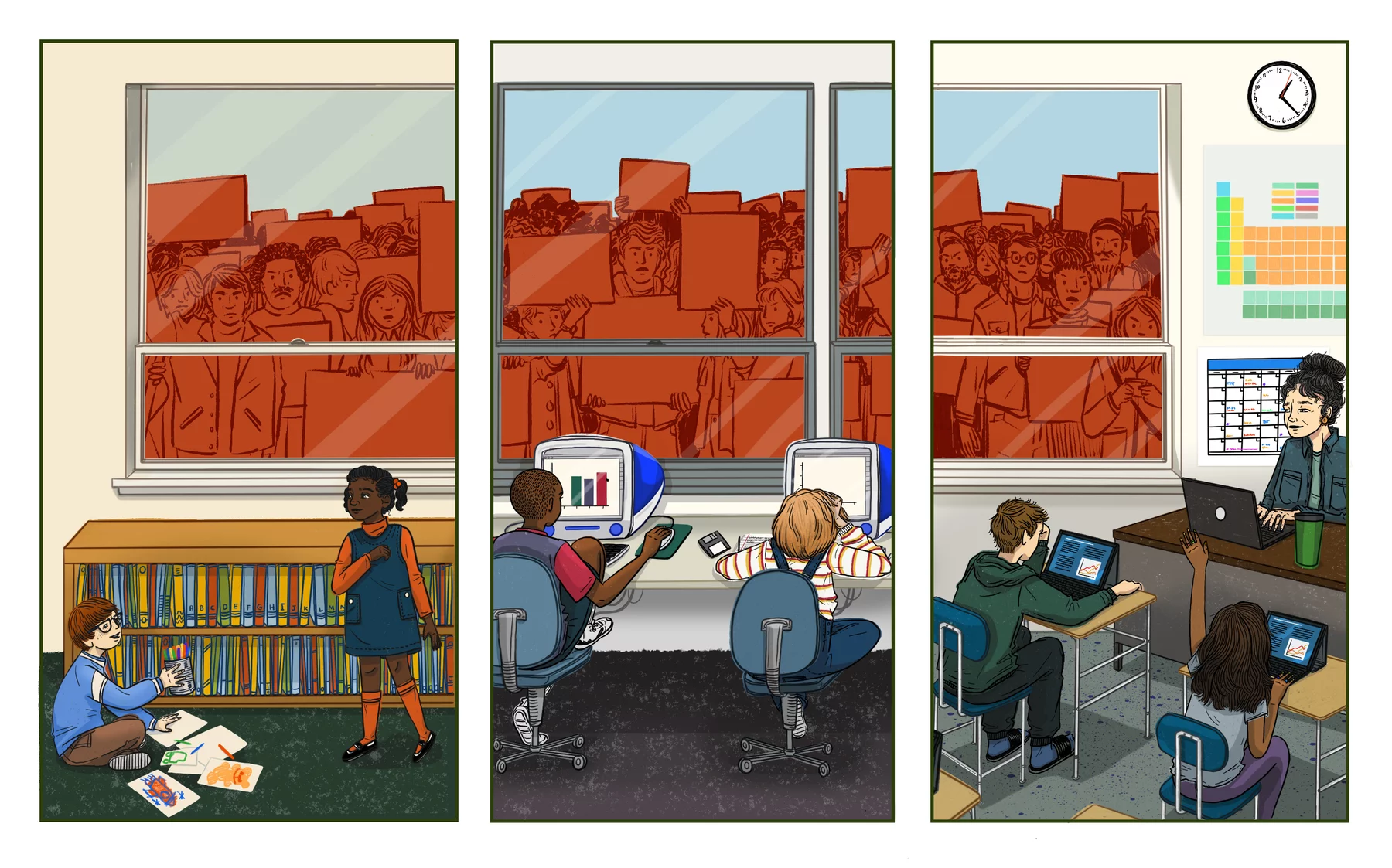
Classrooms through the decades.

It’s hard to pinpoint when exactly the questions started coming in. Angelyn Nichols, an administrator for Virginia Beach City Public Schools, thinks it was sometime in early 2021.

What she does know is that no one really expected them in the first place, and no one expected them to keep coming – week after week, and now, year after year.

That’s because the questions involved a decades-old teaching concept many educators thought was settled, uncontroversial territory: the idea that, in order to learn, students need to know how to manage themselves and get along with others.

“Principals were being asked, ‘Can you talk to me about how you use social-emotional learning in your school? Are there connections to critical race theory?” says Nichols, who coordinates professional learning for the district. “Families were asking at a PTA meeting. Parents were asking their child’s classroom teacher.”

But one of the most visible places these concerns emerged was at the school board meetings.

“Our school board meetings have been tense and they’ve gotten heated,” says Natalie Allen, the district’s chief communications and community engagement officer. “We saw multiple terms being linked to critical race theory. Social-emotional learning just seems like the latest.”

Virginia Beach is not an anomaly.

Although its core concepts have been around nearly as long as public education itself, social-emotional learning is emerging as the latest lightning rod in the battles over what gets taught in schools nationwide.

Across the country, parents and community members have protested angrily at school board meetings, administrators have distanced themselves from the term and legislators have introduced bills trying to ban it. In the last two years, NPR found evidence of disputes specifically concerning social-emotional learning in at least 25 states.

What is social-emotional learning?

Essentially, social-emotional learning teaches students how to manage their emotions, how to make good decisions, how to collaborate and how to understand themselves and others better.

It’s more common in younger grades: All 50 states have standards related to SEL in preschool, and more than half have standards in K-12.

It has existed under different names across the decades: character education, 21st century skills, noncognitive skills. In the adult world, they’re often called soft skills.

“It was just part of what a good teacher does,” says Aaliyah Samuel, president and CEO of the Collaborative for Academic, Social, and Emotional Learning, or CASEL.

Samuel says social-emotional learning can be broken down into five areas: self-awareness, self-management, social awareness, relationship skills and responsible decision-making.

“Let’s say a student is working on a really difficult algebra problem and they get so frustrated because they can’t remember what the next step is,” says Samuel. “They have to be self-aware enough to say, ‘You know what? I’m feeling frustrated. How do I handle this?’ “

A student solving a hard math problem, for example, might use all these skills to recognize and deal with their frustration and ask another student or a teacher for help. Think of any situation that happens in a school, and social-emotional skills probably come into play.

Morning meetings are a common practice in social-emotional learning.

YouTube

“All academics also have a social-emotional component,” says Lisa Xagas, an assistant superintendent for student services in Naperville, Ill. “It’s impossible to tease them apart because you can’t have academics if you don’t have social-emotional learning.”

Research shows this type of approach pays off. In 2011, researchers looked at more than 200 SEL programs across the country and saw improvements in behavior and academic achievement. A 2015 study found students deemed more socially competent in kindergarten were more likely to graduate from high school on time, complete a college degree and get a stable job in young adulthood. From an economic point of view, another 2015 study found SEL programs yield $11 for every $1 spent on them, by reducing crime, increasing earnings and contributing to better health.

Conservatives began connecting social-emotional learning to CRT

All of which is why the educators in Virginia Beach were puzzled when those questions started coming in.

“Everything related to social-emotional learning that we are putting out there is research-based and it’s in demand,” says Allen, who handles community engagement at the district. “Very often there’s been a narrative created that’s not accurate.”

In the last year, in states across the country, parents and community members have increasingly been fighting the teaching of social-emotional learning in schools – largely because social-emotional learning has become linked with another flashpoint in public education: critical race theory, or CRT.

Critical race theory, a decades-old legal framework, is the concept that racism goes far beyond the individual: It is systemic and deeply entrenched in our laws, policies and institutions. Nearly 900 school districts experienced anti-CRT protests between September of 2020 and August of last year, according to a report released this year from the Institute for Democracy, Education, and Access at the University of California, Los Angeles.

“We’ve seen a real freak-out on the right about the so-called teaching of critical race theory in schools. And usually the terms of that freak-out are white children are being taught to hate themselves and all children are being taught to hate America,” says Natalia Mehlman Petrzela, an associate professor of history at the New School in New York City and the author of Classroom Wars: Language, Sex, and the Making of Modern Political Culture.

But critical race theory itself is not something that is explicitly taught in K-12 schools.

“The defense of most educators has been: ‘I don’t even know what critical race theory is. I’ve never heard of it until you, the conservative at the school board, brought it to my attention,’ ” says Andrew Hartman, a professor and historian of educational trends at Illinois State University. “But of course, all educators now know what social-emotional learning is. It’s something much more tangible. It’s a curriculum that is officially being implemented in schools all across the country.”

A few years ago, conservatives began to connect the two concepts. A 2021 article in the Washington Examiner said conservative activists were calling social-emotional learning a “Trojan horse” for both critical race theory and transgender advocacy. In April of this year, a conservative group referred to it as a “new variant of the “CRT-virus.”

“It will be concealed as a number of different things,” another article published on the right-wing website The Federalist says. “Most common is something including ‘social justice,’ ‘equity and diversity,’ ‘multicultural education,’ or ‘social-emotional learning,’ which is the most deceptive because it doesn’t sound like it involves race at all!”

An “IndoctriNation Map” on the website of the conservative group Parents Defending Education tracked “incidents” in schools related to gender ideology, ethnic studies and social-emotional learning. The conservative Center for Renewing America includes social-emotional learning in its glossary of “CRT-related terms.”

How the SEL-CRT narrative is impacting schools

In some places, these attacks have had real consequences. In Georgia, an administrator tasked with leading a district’s diversity, equity and inclusion efforts was forced to resign before she even started, with one protester referring to social-emotional learning as “synonymous” with critical race theory.

In Wisconsin, Republican lawmakers introduced a bill last year trying to limit how educators talk about race and racism in the classroom. One of those lawmakers, Rep. Chuck Wichgers, added an addendum of terms he thought were associated with CRT, including social-emotional learning.

And when the Florida Department of Education issued specifications for this year’s social studies textbooks, it indicated: “Critical Race Theory, Social Justice, Culturally Responsive Teaching, Social and Emotional Learning, and any other unsolicited theories that may lead to student indoctrination are prohibited.”

Rick Hess, the director of education policy studies at the conservative-leaning American Enterprise Institute, says some of the angry debates about social-emotional learning are a direct reaction to the stories about SEL that conservatives are seeing on social media, Fox News and elsewhere.

“I think a lot of people wind up wedged into these debates about something like SEL, not because they necessarily have paid a lot of attention and have decided that, ‘Gosh, you know, in good faith, we really disagree,’ ” Hess says. “It’s more a gut level reaction to the other team and to be with your guys, than it is to really parse like, ‘What are we arguing about here? And is there a more constructive way to solve this?’ “

For some parents, the outrage is rooted in mistrust – particularly of organizations that provide SEL resources and recommendations to school districts.

Hess says many parents feel “this is a case of big, deep-pocketed, liberal, coastal foundations coming in, led by people who went to elite colleges who aren’t from their communities, pushing ideological agendas that they find problematic and then calling them racists and idiots when they push back.”

“If there’s anything more likely to turn skepticism into full blown rebellion, it’s hard to think of what it might be,” he added.

SEL has always had an identity component

Hess says many conservatives ultimately feel social-emotional learning spends too much time talking about identity.

But Hartman, the Illinois State University historian, says there actually is an important identity component to teaching students how to get along with others.

“It’s pretty impossible to do social and emotional learning without larger social issues coming into play. It’s not just about individuals. It’s about how an individual is situated in a society,” Hartman says. “If you’re going to be a healthy, emotional individual, you’re going to have to understand your own identity relative to society.”

CASEL is quick to emphasize that social-emotional learning is not tied to any political viewpoints. But the organization acknowledges that questions of identity and culture might come up, for example, in conversations about social awareness, one of the organization’s key SEL competencies.

“Social awareness is about developing a better understanding of people around you so that you understand different perspectives and build healthy relationships,” Samuel, the CEO, says. “For students, this might mean learning about different cultures, reading about different people’s experiences and perspectives, or studying historical figures and their strengths.”

Some SEL advocates want those conversations to be more explicit about systemic racism.

Dena Simmons, the founder of LiberatED, an organization which aims to center racial social justice in social and emotional learning, says being able to talk about social-emotional learning without talking about identity is an example of white privilege.

“You can’t have those conversations without talking about identity … Social-emotional learning is so that people can get along better. We also have to talk about why people don’t get along,” Simmons says. “If we don’t apply an anti-racist, abolitionist, anti-oppressive, anti-bias lens to social-emotional learning, it can very easily turn into white supremacy with a hug.”

Some prominent SEL programs do talk about racial justice and racism. The website for Second Step, for instance, has a section dedicated to Anti-Racism and Anti-Bias Resources. When educators don’t acknowledge that identity component, it can make things worse, Mehlman Petrzela at the New School says.

“I know it’s really hard to have these nuanced conversations, especially when often some of these attacks are scary, and they’re bad faith, and they’re distracting from teaching kids,” she says. “But I do think it’s really incumbent upon people to paint the full picture of what’s going on here. Because without that, I don’t really think we can move forward.”

The fear that teachers are indoctrinating children is not new

The actual term “social-emotional learning” has existed since at least the 1990s. In 1997, researchers at CASEL published a book titled Promoting Social and Emotional Learning: Guidelines for Educators. But social-emotional learning, in a broader sense, has existed for much longer.

“One of the great ironies of the backlash around teaching morality or values in American education through social-emotional learning today is that American schools have always been about teaching values and character,” says Mehlman Petrzela. “And for much of American history, that focus has been on pretty conservative values, quite honestly.”

In the mid-1800s, small books called McGuffey readers sought to instill morals in young readers. Around the same time, Horace Mann, an education reformer and proponent of public education, saw schools as the “great equalizer” in society.

“This is where you impart in children not only academic learning, but the sort of beauty of the American experiment that one can transcend,” Mehlman Petrzela says. “You work hard. You are industrious. You don’t lie. You are a good member of your community. Those are values.”

In the early 20th century, John Dewey advocated for the idea that schools should educate the “whole” child. By the 1950s, there was “life adjustment” education, which focused on social order and patriotism as a response to growing fears of communism. Coronet Instructional Films were shown in schools, with titles like “marriage is a partnership” and “mind your manners.”

Then the 1960s happened. Some teachers began to address topics like social justice and racial equality – and, much like we’re seeing today, those teachers faced a backlash.

The fear that teachers are trying to brainwash or indoctrinate children has been around for a while. Today, it’s present not just in the disputes over SEL and CRT, but also in the current debates around sex education, transgender rights and banned books, says Mehlman Petrzela.

“I sometimes cannot believe how much what we are experiencing right now feels so similar to what we have gone through in other moments, particularly in the 1960s and 70s,” she says. “The rhetoric is the same.”

How one school district is finding common ground with parents

But in places like Virginia Beach, educators weren’t there 50 years ago. They’re in schools now, stuck in the middle of a political fight that feels new, at a time when many students are struggling and need more support managing their emotions, not less.

Angelyn Nichols, the district’s lead for social-emotional learning, says 2020 put a heightened scrutiny on public education – one that’s been rapidly evolving. First, it was about COVID policies. Then, after the police murder of George Floyd and the subsequent protests against racism, the conversation shifted to critical race theory. Now, it has spread to any topic deemed to be related to critical race theory.

That’s when Aaron Spence, superintendent of Virginia Beach City Public Schools, wrote an op-ed for The Virginian Pilot.

“Conflating good and longstanding work — such as our work around social and emotional learning — with things that simply aren’t happening in our schools, debating who is more invested in our children, and undermining the credibility of public education with accusations of indoctrination is disappointing at best and debilitating at worst,” he wrote.

Spence asked community members to look for common ground. For Nichols, that’s been easier to find outside of the school board meetings, in one-on-one conversations with parents.

“We can sit down together and say, ‘Can you share with me what part of this is a concern for you? Which skill here do you feel is a threat, feels like indoctrination, or is of a concern for you?’ ” she says. “I’ve never exited one of those conversations where both parties didn’t say, ‘I actually think this is really important.’ “

She feels good about the progress they’ve made so far this year. In September, the school board passed a resolution that, in part, supports the continued teaching of social-emotional learning in schools.

D.C.’s Preschool Teacher Education Requirement Won’t Help Working Families

After a just about 6-yr authorized battle, the deadlines for compliance with Washington, D.C.’s controversial licensing polices for preschool teachers are nearing.

By this December, all early childhood instruction centre directors will have to have a bachelor’s diploma with at minimum 15 credits of early childhood education and learning courses. By December 2023, all preschool academics and numerous at-property day treatment companies must have attained at least an affiliate diploma with a minimum of 24 credits of early childhood schooling courses. Even assistant academics will have to get a Child Enhancement Associate credential or an affiliate diploma (in any field) by December 2023.

Critics of the requirement be aware that the new regulations will possible boost D.C. working day treatment tuition—already the best in the U.S.—and put a lot of experienced and skilled teachers out of a work.

A 2019 analyze posted by the Federal Reserve Bank of Minneapolis identified that “the welfare expenses of licensing”—the premium been given by workers who meet licensing criteria—”look to exceed the added benefits.” Study authors Morris M. Kleiner of the College of Minnesota and Evan J. Soltas of MIT identified that “shifting an profession in a state from fully unlicensed to completely certified improves state regular wages in the licensed occupation by 15 p.c, raises several hours for every employee by 3 {af0afab2a7197b4b77fcd3bf971aba285b2cb7aa14e17a071e3a1bf5ccadd6db}, and minimizes work by 29 per cent.” 

Imposing occupational licensing on a area that formerly did not call for it pushes some people today up the profits ladder whilst pushing other folks out of the field completely. Workers who previously fulfill licensing criteria when the guidelines go into outcome seem to make far more dollars, as do employees who can swiftly fulfill the requirements. Employees who can not afford to pay for the new instructional requirements—for deficiency of time, dollars, or English-language proficiency—must discover other perform. This decreases the amount of working day treatment personnel. The quantity of small children who want treatment, in the meantime, will not ebb basically due to the fact there are much less academics. And government-mandated instructor-to-youngster ratios avoid less day care workers from getting treatment of the identical amount of young children.

In essence, unless just about every present-day service provider can comply with the new licensing needs or be quickly changed by credentialed staff, the similar number of children competing for much less places will generate up costs to households who want treatment.

“D.C.’s higher education need for day care personnel is not just terrible coverage it is also unconstitutional. The college or university need violates daycare providers’ suitable to receive a living with out unreasonable governing administration interference,” wrote the Institute for Justice, a libertarian community fascination regulation company, about its lawsuit complicated the regulations. “D.C. is imposing actual burdens on working day care workers and mom and dad.”

Supporters of the laws have picked to focus on the purported benefits of hugely-credentialed preschool lecturers, seemingly dismissing worries more than costs—both to mother and father, and to existing academics who will not meet the specifications.

Kathy Hollowell-Makle, executive director of the District of Columbia Affiliation for the Instruction of Young Kids (DCAEYC), wrote just lately for The Washington Post that “studies constantly present that youthful little ones obtaining higher-high quality early education and learning create expansive vocabulary, have more robust language skills, and rating much better in math and science school-readiness assessments.”

“This science is why every child—not only people whose mom and dad can pay for it—should have equitable obtain to a knowledgeable, skilled, nurturing, rather compensated early educator,” she argued.

But even if Hollowell-Makle is accurate that superior-credentialed preschool teachers lead to larger academic attainment for toddlers and youthful little ones, she hardly acknowledges the tradeoffs. “Delivering on high quality has costs—but the gains are public, and the investments should be, way too,” she writes.

“Working day treatment vendors like Ilumi get worried about the time and revenue necessary to get hold of a college schooling even though operating full time,” wrote the Institute for Justice, profiling a person this sort of worker who will be hurt by the new credentialing demands. “Several are older women who have several years of experience caring for kids but no knowledge composing a phrase paper on Moby Dick. More youthful people may well have their possess people to consider care of.”

As these new restrictions go into result, skilled and proficient working day care workers—especially these who need to perform to live—will be forced out of the market and absent from the family members who rely on them for boy or girl care, and mother and father will pay back additional for fewer alternatives. 

Cal Poly, SLO, professor questions value of online education

View AND COMMENTARY

Editorials and other Belief information supply views on issues vital to our local community and are unbiased from the operate of our newsroom reporters.

Cal

Higher education college students prosper with the interactions that arrive with classroom discovering, as opposed to on the net education and learning, writes Cal Poly professor.

Bigstock

The 2021-22 tutorial 12 months at Cal Poly ended in much the same way as it began: with the students and me sporting masks, and lots of of my colleagues selecting digital school rooms alternatively of in-individual training. This year, fortunately, is shaping up to be pretty distinct.

With the COVID era experience like it is eventually (ideally) in the rear-check out mirror, we are in a posture to search again and start to appraise the past two decades of greater education and learning.

I hope we can commence by recognizing the admirable spirit of take care of demonstrated by Cal Poly: my instructing colleagues heroically shifted their instructing modalities and designed the best on the web version of their classes they could the learners adapted astonishingly perfectly to new discovering environments the administration over-all taken care of the shifting sands of COVID with thoughtfulness, ingenuity and usefulness.

Nevertheless, looking again, we should really now also conclude that on-line education and learning compromises the instructional plans of good quality establishments. Can we now acknowledge that our experiment in widespread on line instruction has mainly failed?

Prevalent on the web instruction has failed not simply because of the very good intention of educators, but due to the fact of the mother nature of the medium: When schooling is just an additional online product competing for the interest of younger folks, the fact is that Hollywood, global influencers and even specialist advertising and marketing will draw far more eyes than lectures. It may well be sad to some but most individuals would somewhat view the hit net sequence “Drunk History” than get real historical past courses. Actuality Television is packaged by producers to be significantly additional titillating than the review of actuality in physics or philosophy classes.

Some “infotainment” sources like TED talks or the “Daily Show” may possibly garner an viewers, but we have to recall that our regular professor was trained at a investigate college, not the halls of Disney or Common Studios. The final result is that when professor films go viral, it is ordinarily not due to the fact they are exhibiting stellar examples of pedagogic usefulness. The intricate process of nurturing students to mature holistically to understand and help condition our environment will by no means be obtained by way of a browser tab, primarily when YouTube and TikTok are the adjacent tabs.

Really do not get me improper: There is lots of student desire for additional on the net classes, but largely for the incorrect good reasons. Although a several college students cherish the adaptability to equilibrium perform and college, lots of extra learners have relayed that they want on the internet solutions for the reason that there is a diminished workload, a lot easier grading benchmarks and they can get credit history for classes — typically basic training courses — with out “really possessing to consider the course.” This sort of sentiments suggest a corrosive transactional comprehension of their university expertise whereby they occur to want a diploma much more than an instruction.

Quite a few of my fellow faculty also want to go on teaching online, but once more, mainly for the mistaken reasons. A lot of colleagues have confided in me that they just do not want to commute to the business, they notice that “pushing play” on their prerecorded lecture frees up a lot more time for their exploration and not becoming in the classroom boundaries their interactions with challenging pupils. Additional than one particular school member has confided in me that they forget they are even teaching that quarter when the course is on the net. In the finish, the requires on time and mental effort and hard work are just not the exact same for an on the internet training course, on possibly the scholar or faculty aspect.

Prior to the pandemic, I used to feel that on the web instructing was the foreseeable future and I even took a series of trainings on how to be an successful on the web educator to be ahead of the curve. I nevertheless assume it has an crucial position in the general mix of instructional offerings for society, akin to local community faculties and technical universities.

However, for traditionally residential establishments like Cal Poly, I now assume it should really only be a market providing, this sort of as when learners are away from campus in the course of summers or for internships, when on the net classes can let them to remain connected to their home campus. There are also school and learners with overall health troubles that may make in-particular person education dangerous. However, we at Cal Poly are, in the conclude, largely a residential college and the added benefits of that model can’t be duplicated on-line.

As I notice what is ideal about Cal Poly, it would seem that the most indelible times in a student’s education and learning entail private interactions with school that are extremely hard to mediate through a display screen: when a professor introduces a new thought in the classroom, reads the students’ reactions and improvises a even further clarification so that the class glides collectively from confused to inspired when a university student will come to place of work several hours and we assist them imagine a new educational long run when a school club adviser expands finding out into the surrounding group by main their pupils as a result of huge sequoia groves, sharing a boat trip to examine the sea, or touring the architecture of Los Angeles.

We will have to admit that what makes Cal Poly terrific takes place largely in particular person and the best value of a Cal Poly education can’t be attained from a length. Now, as our masks are off and the campus bustles with the smiling faces of incoming students, I see that much more than at any time.

Contributing columnist Stephen Lloyd-Moffett is a professor of religious scientific studies at Cal Poly, San Luis Obispo.

Similar stories from San Luis Obispo Tribune

This new Philly PE instructor is serious about wellness

How do academics captivate their pupils? In this article, in a element we simply call How I Educate, we inquire wonderful educators how they approach their jobs.

Philadelphia Superior University for Girls’ actual physical schooling teacher Alicia Mannino is familiar with that men and women believe that her students get to enjoy all day.

Sure, her course is a good deal of entertaining — there’s music, there is dancing — but it’s also so a lot far more. “I have a curriculum, not just sports,” Mannino told Chalkbeat. “I train movement techniques, health and fitness, and wellness, not just game titles. And it’s Physical Instruction, not ‘gym course.’” 

Mannino, who has taught for 13 years, thinks physical schooling is the foundation of a nutritious way of life — the birthplace of wellness and the most effective aspect of a student’s day. (A new Form The united states analyze confirmed that most significant faculty learners have a beneficial check out of wellbeing and PE classes.)

This is Mannino’s 1st yr at Women High, in the Olney area of Philadelphia, but the Bucks County indigenous taught formerly at Feltonville School of Arts and Sciences and, prior to that, at Eugenio Maria de Hostos Charter College, a bilingual K-8 university in Huntington Park.

Increasing up, Mannino was a triple-sport athlete by the time she was a senior in superior college, successful initially team All-Catholic in equally soccer and lacrosse. She also played on nationally ranked travel soccer and baseball groups. Mannino, who went on to get her diploma at Rowan College, stated she “lived and breathed level of competition.” 

“Going from athlete to trainer, I get to make the most of my finest physical skills and enjoy all day,” she reported. “Yes, there is an abundance of details and awareness received from a terrific PE software, and at periods, I’m absolutely fatigued, but I can not reiterate this ample, I get to be a big kid all working day.”

In addition to training PE, Mannino runs Girls High’s Homosexual Straight Alliance club, or GSA. The organization offers college students in the LGBTQ+ community a harmless area that facilities optimistic interactions, equality, and peer acceptance. 

“Identifying as lesbian myself, the students sense much more protected since I can relate my earlier experiences to factors they may perhaps be heading via,” she explained. “Homophobia exists everywhere, unfortunately. Quite a few of my pupils are scared to come out/recognize as what they want simply because it’s continue to not culturally accepted.”

From the initial day at Feltonville College of Arts and Sciences, Mannino shown how a lot she truly cares about each and every pupil, claimed John Piniat, the principal there. 

Additional one more former colleague, trainer Blair Downie: “She cares deeply about inclusion of college students with disabilities and has designed faculty-amount plans to enhance possibilities for students in self-contained specific schooling lessons to devote additional time with their friends.” 

Mannino spoke not long ago with Chalkbeat. 

This interview has been flippantly edited for length and clarity.

Why is engagement so vital for the classroom, and what are some means you continue to keep pupils engaged?

This is going to audio actual previous faculty, but I try to retain know-how out of the gymnasium as considerably as achievable. Now, continue to keep with me in this article for the reason that I know you’re likely rolling your eyes. Social media is everywhere! Most learners have access to a cell cell phone, which qualified prospects to YouTube, Instagram, TikTok, etcetera. As a physical educator, there are a lot of aims, but if I experienced to slender it down, the intention is to get up and go. Put the phones down, let’s get some face-to-face social interaction.

Many of the games [we play] are based mostly on seasonal sporting activities these as soccer in the tumble, basketball in the wintertime, but there are also so lots of areas to a entire PE program. We engage in cooperative game titles that incorporate teamwork, optimistic communication, problem-resolving capabilities, and a lot additional. These are very important to learn and increase into a good member of the neighborhood. There’s also a sense of becoming a huge child at coronary heart. I play, dance, get the “tea” every day, and it permits for positive associations to grow. When I show them that I am fascinated in the online games and that I give it my all, they adhere to my guide. When you exercise what you preach each individual day, it’s contagious for the college students not to latch on and get psyched to wander into my fitness center each working day.

How have you made use of your own encounters to guidance the learners in your classroom and/or school local community?

This issue has two sides that I will need to address. A person, my personalized ordeals and upbringing are of the middle course — a a lot more privileged outlook than what our learners virtually see on a working day-to-day foundation. So, I try to pay attention to what is occurring to them instead than sharing my privileged upbringing. There are always heading to be classes in everyday living that we have experienced that we relay to our college students for the reason that it’s just natural for educators to share parts of on their own. The second aspect is that I share my encounters in a positive way. I make confident my learners know that I am not ideal and that my experiences in daily life are only advised to them to give them details to make conclusions in their day-to-day daily life. I’m below for them — gimme the “tea,” notify me what is likely on. When you hold a classroom where by the learners simply call it a “vibe” you know you are undertaking something proper.

What has been your largest hurdle in returning to in-individual understanding?

To be honest, I am so glad that we are again to in-human being mastering. Whilst digital learning was vital thanks to the pandemic, being ready to perform video games and have social conversation beyond breakout rooms is where by I want to be and remain.

What are some of the things you figured out from training learners with exclusive demands that other instructors can take into the classroom?

A single of the issues that I am most very pleased of is known as gymnasium buddies. Every year, we would choose 1 group of students, normally an eighth quality class, and we invite them to sign up for our adapted class to use socialization involving each [typical learners] and unique ed students. The principal motive Gymnasium Buddies began was to make a constructive environment exactly where college students can get to [know] a single a different. A group of chosen eighth graders would go away their lunch time period when a week to interact with learners of various disabilities. We think that this socialization really helped out our college community because now our learners are exchanging social media accounts, gamer names, large-fiving in the hallway, and disrupting detrimental behaviors from other learners towards the college students with disabilities. I also emphasize the district’s no-bullying plan. I allow it be acknowledged in the beginning of the college calendar year that most people is equal, and nobody here is far better than any one else, no issue how gifted you are in athletics.

What is the finest suggestions that you can give to new instructors?

We consider our “work” is the job we go to or the area we get a look at from. No. Your perform is the really unique issue that you add to this environment. Your eyesight, your mild, your appreciate, what you share, what you create, how you make folks come to feel, and so forth. That, my mates, is certainly our work.

Bureau Chief Johann Calhoun handles K-12 colleges and early childhood education and learning in Philadelphia. He oversees Chalkbeat Philadelphia’s training coverage. Speak to Johann at jcalhoun@chalkbeat.org.

Librarians and lawmakers fighting for better e-book access

Librarians and their legislative allies are pushing publishers of electronic textbooks to decreased their prices and unwind licensing phrases, an work that could make it less complicated for tens of millions of library people to borrow the more and more well-liked electronic versions of textbooks.

Supporters say the e-ebook lending laws in quite a few states would permit libraries to give far more electronic content and shorten wait around lists for popular titles. About the lengthy phrase, the steps may possibly shore up libraries’ main mission in an ever more electronic surroundings.

“The present design is discouraging for libraries and archives whose provider mission is thoroughly different from the capitalist targets of a for-profit firm,” claimed Kyle K. Courtney, the copyright adviser for Harvard University and a founder of Library Futures, an advocacy group pushing for the charges. “We have dealt with publishers and rights-holders for generations, but it’s by no means been as negative as it is now.”

Considering the fact that the early 2010s, libraries and publishers have clashed over the phrases and expenses of e-guide licenses, which grant libraries authorization to mortgage electronic textbooks. This kind of licenses now usually expire soon after a selected amount of money of time or number of financial loans. Libraries also ought to fork out a number of moments the go over selling price of equal print versions.

Publishers argue that the markups and other limits secure authors’ mental property rights and incentivize businesses to invest in their function. As the price tag of e-reserve licenses has ongoing to rise, on the other hand, librarians and their advocates in at least 9 states have pushed for laws that would involve publishers—especially the “Big Five” that generate the overpowering the vast majority of buyer books—to provide libraries a lot more “reasonable” licensing terms.

Point out lawmakers have offered this kind of expenses bipartisan aid, but a number of steps have faltered just before states could put into practice them. New York Governor Kathy Hochul vetoed her state’s e-e book bill in late December, citing copyright fears. In June, a Maryland choose dealt the movement a 2nd blow, ruling that federal legislation preempts states’ attempts to control e-e-book licenses.

Undeterred, librarians and lawmakers in states which includes Maryland, Massachusetts, and New York say they are preparing a new legislative strategy ahead of upcoming year’s session. The new charges search for to evade the stumbling blocks that scuttled the laws in Maryland and New York.

Climbing Costs, Restrictive Conditions

Librarians’ newest legislative thrust arrives just after two breakneck decades for digital financial loans. This sort of checkouts (which include e-publications, audiobooks, and electronic magazines) exceeded fifty percent a billion in 2021, in accordance to OverDrive, the most significant distributor of electronic library content—up 55{af0afab2a7197b4b77fcd3bf971aba285b2cb7aa14e17a071e3a1bf5ccadd6db} from two several years just before.

In response, a lot of U.S. libraries have rapidly expanded their electronic collections and shifted paying out to e-publications and electronic audiobooks. Libraries hardly ever “own” e-publications, on the other hand. Rather, they license the appropriate to mortgage them out—a product more like shopping for software than procuring at a bookstore.

Below this arrangement, publishers can established expiration dates on e-reserve licenses, limit the variety of times an e-ebook can be borrowed, hold off income to libraries, or refuse them obtain entirely. Nowadays, it is frequent for e-guide licenses from major publishers to expire soon after two several years or 26 borrows, and to charge amongst $60 and $80 for every license, in accordance to Michele Kimpton, the international senior director of the nonprofit library team LYRASIS.

In 2019 testimony to Congress, the American Library Association emphasised the disparity between buyer and library e-book costs, making use of the 2014 bestseller All the Gentle We Are not able to See as an case in point. Whilst buyers paid out $12.99 for a digital model, the identical e book expense libraries about $52 for two many years, and nearly $520 for 20 decades.

“E-textbooks used to be on libraries’ electronic cabinets permanently, but now you’re paying out $60 for a title each individual two yrs,” reported Kimpton. “That definitely is not favorable for libraries, but that is kind of exactly where we are proper now.”

In addition to straining confined budgets, which given that the early 2000s have remained about flat in most sites, librarians say latest licensing styles have hollowed out their electronic back catalogs and skewed their present-day collections. Forced to devote a lot more funds on less guides, librarians inevitably focus on bestsellers, titles by massive-title authors and new installations in well-known series, reported Michael Blackwell, the director of St. Mary’s County Library in rural Maryland.

That overlooks guides by new and rising authors, midlist books and some older guides with expiring licenses. Patrons normally continue to hold out weeks or months to borrow popular titles.

“We think several individuals throughout the state are currently being deprived,” explained Blackwell, who also qualified prospects the global library coalition ReadersFirst. “You should not have to have to have a credit card to be an informed citizen.”

“Something Has to Be Figured Out”

Regulating e-e-book licenses has proved challenging, even so. In the earlier two many years, at least nine states—including Connecticut, Illinois, Massachusetts, Maryland, Missouri, New York, Ohio, Rhode Island, and Tennessee—have regarded as payments that would call for publishers to license e-publications to libraries at “reasonable” charges and terms, typically leaving the word “reasonable” to foreseeable future interpretation.

Past yr, lawmakers in Maryland voted unanimously to approve the e-e-book invoice that would have barred publishers from delaying e-book gross sales to libraries, among other provisions. In New York Point out, only just one of the legislature’s 211 voting associates opposed the monthly bill to build civil penalties for publishers whose licensing conditions unfairly prohibit e-e-book entry.

The problem has frequently been nonpartisan, explained Alan Inouye, the senior director for general public plan and governing administration relations at the American Library Affiliation. On the political remaining, e-ebook licensing is a make a difference of equity and equal access to information on the suitable, lawmakers have sometimes framed expensive and restrictive licenses as a poor use of public bucks.

But federal regulation does not permit states to restrict the distinctive rights of copyright holders, reported Sandra Aistars, the director of the Arts and Leisure Advocacy Clinic at George Mason University’s Antonin Scalia Regulation College. Publishers are “totally free” to set distinctive rates and phrases for distinct markets, allowing for them to experiment in the market and “more granularly, fulfill shopper need,” she additional.

Publishers and their supporters also have argued that the business can reasonably differentiate between libraries and individuals mainly because they obtain diverse items. Whilst shoppers buy particular person access to an e-reserve, libraries purchase the correct to disseminate it to the general public.

Very last December in New York State, Hochul vetoed the e-book monthly bill after extreme lobbying from the arts and entertainment industries. She pointed out that federal copyright law provides authors exceptional control to make your mind up how they share their do the job. That same thirty day period, the Affiliation of American Publishers filed match from Maryland’s e-guide regulation on very similar grounds. In June, a district courtroom decide dominated that federal copyright regulation preempts Maryland from regulating e-e book licenses.

“Libraries are an critical aspect of the copyright ecosystem as licensed distributors,” explained Terrence Hart, the basic counsel for the Association of American Publishers, in a assertion. “There won’t be something to distribute if states wipe out the incentives and protections of authors to license and exploit their special rights to their is effective.”

Advocates and lawmakers in a number of states now say they are planning to introduce revamped e-book expenditures that can stand up to authorized scrutiny—though federal legislation nonetheless would preempt any condition regulation that infringes on copyright, Hart mentioned. A single design, created by Library Futures, contends that states can regulate e-e book terms beneath agreement and customer protection regulations.

Lawmakers in Massachusetts already have worked with Library Futures to amend their e-guide invoice, claimed Condition Rep. Ruth Balser, a Democrat who cosponsored an previously edition final 12 months. That measure did not go out of committee, Balser reported, mainly because legislators first hoped to see how the Association of American Publishers lawsuit performed out in Maryland.

Advocates in Maryland, in the meantime, are preparing a possible monthly bill that would ban community libraries from engaging in “unfair” contracts, possibly slicing big publishers off from the state’s library market.

Lawmakers and library teams in New York State also have started conversations on how they can “tweak” the invoice Hochul vetoed, stated Point out Assembly Member Josh Jensen, a Republican cosponsor of New York’s failed e-reserve invoice. As a teen, Jensen labored in a regional library reshelving publications.

“I was annoyed, of course,” Jensen said of the governor’s veto. “But I believe something has to be figured out. We’re not seeking to dictate conditions here—we’re just indicating there has to be fair conditions and very good faith. It is a really frequent-perception argument.”