Biden administration gutting online education with new ‘harmful’ guidance, warn experts, lawmakers

The Biden administration will now be able to crack down on private companies that contract with colleges and universities to help the schools run their online education programs, raising alarm bells among experts and lawmakers who warned the federal government could stifle remote learning for students.

The Education Department issued guidance last month saying online program managers (OPMs), which are outside contractors that recruit students for and operate schools’ online academic programs, are officially considered third-party servicers, or entities involved with the administration of “any aspect” of an institution’s federal student financial aid.

As a result, these companies can be subjected to stricter federal oversight in a manner that, critics argue, will hurt not only the schools and contractors, but also ultimately the students they serve.

One of the most prominent critics of the department’s new guidance is Rep. Virginia Foxx, R-N.C., chairwoman of the House Committee on Education and the Workforce.
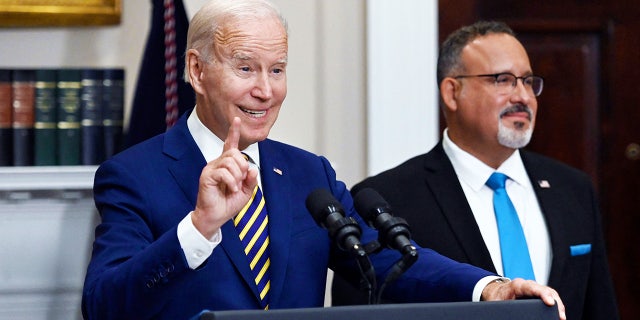
President Biden with Education Secretary Miguel Cardona, right, on Aug. 24, 2022 in the Roosevelt Room of the White House in Washington, D.C.

President Biden with Education Secretary Miguel Cardona, right, on Aug. 24, 2022 in the Roosevelt Room of the White House in Washington, D.C. (OLIVIER DOULIERY/AFP via Getty Images)

GOP SENATORS ACCUSE EDUCATION DEPARTMENT OF ALLOWING ‘TAXPAYER-FUNDED ANTISEMITISM’ ON COLLEGE CAMPUSES

“The growth of technology and its applications in providing students with a well-rounded education is exciting and should be commended,” Foxx told Fox News Digital. “More options for students mean more opportunities for success. For the department to conflate access to online education with rising federal student loan debt diminishes that fact and ultimately hurts the partnerships between institutions, innovators, and the students they serve.”

“The department seems to be more interested in controlling the actions of private companies and creating unnecessary headaches for institutions than it is ensuring students have every tool to succeed academically,” Foxx continued. “I urge the Biden administration to reverse course on this harmful guidance.”

OPMs have long been the target of congressional Democrats and consumer groups, which believe the companies can, through their contractual arrangements, drive up the price of higher education and draw students to low-value academic programs.

Sen. Elizabeth Warren, D-Mass, for example, has raised “concerns about the impact of OPM partnerships on rising student debt loads.”

Under Secretary of Education James Kvaal echoed that sentiment in a statement when the department released its new guidance.

A girl participating in online education training class with teacher and other students using laptop at home.

A girl participating in online education training class with teacher and other students using laptop at home. (iStock)

NEW ONLINE PLATFORM HELPS CONNECT PARENTS WITH TEACHERS OF THEIR CHOICE

“Online education has the potential to meet the needs of many students and lower costs,” he said. “But we are concerned about the growth in loan debt and want to ensure students get value for their money.”

However, many colleges and universities do not have the in-house funding and expertise to develop the online programs they need and need outside help, according to experts familiar with the issue.

OPMs are not the only ones affected by the Education Department’s rules, which critics argue will have a broader negative impact than government officials may realize.

Local police departments helping to compile and analyze campus crime statistics and hospitals providing clinical experiences and “the related educational programing for nurses and other medical professionals” are among the outside entities helping schools through contractual agreements that are being considered third-party servicers, according to the American Council on Education.

The council recently wrote a letter to Education Secretary Miguel Cardona, outlining some of the problems it had with the department’s guidance.
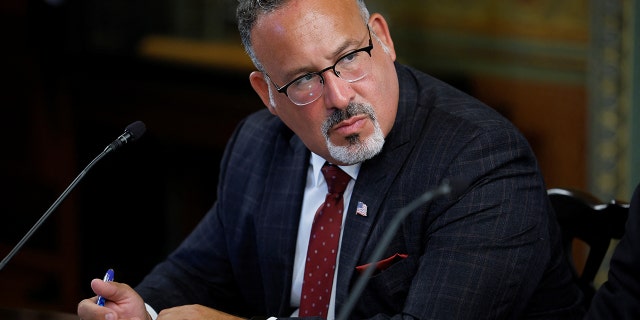
Secretary of Education Miguel Cardona in the Eisenhower Executive Office Building in Washington, D.C., Aug. 8, 2022. 

Secretary of Education Miguel Cardona in the Eisenhower Executive Office Building in Washington, D.C., Aug. 8, 2022.  (REUTERS/Evelyn Hockstein)

BIDEN’S EDUCATION SECRETARY LOBBIES COLLEGES TO DROP OUT OF US NEWS RANKING IN NAME OF EQUITY

“The broadened definition of a [third-party servicer] appears to cover entities that are beyond the common understanding of that term,” the letter states. “Our hope, if given appropriate time to comment, is to provide the department with a fuller picture of the variety of important institutional arrangements that exist so it may better understand the guidance’s impact … We believe the department would benefit from a deeper understanding of the potential that the guidance could trigger an unintended disruption of services to students currently provided by institutions through these entities.”

The letter was co-signed by 46 other higher education interest groups and associations, including accreditors.

Other experts see the department’s actions as not merely misguided but intentional overreach.

“The Department of Education’s crusade against for-profit colleges is now ensnaring a wide range of service providers,” Adam Kissel, visiting fellow at the Heritage Foundation, told Fox News Digital. “This is a classic case of overregulation by overzealous bureaucrats. Every new rule or interpretation like this makes it harder for colleges to serve their students.”

Whatever the department’s motivation, what is clear is the new guidance will present a host of new hurdles for both schools and companies.

A woman working form home with a laptop.

A woman working form home with a laptop. (iStock)

PRESIDENT BIDEN’S STUDENT DEBT RELIEF IS ‘COMFORTABLY WITHIN’ LAW, DOJ ARGUES TO SCOTUS

One challenge, according to legal experts, is that third-party servicers are legally required to sign a contract with their educational partner to be “jointly and severally liable” to the Education Department for any federal violations.

“Third-party OPMs have been able to hide behind really crafty language in their contracts that keeps them from being responsible for any violations,” Stephanie Hall, a senior fellow at the Center for American Progress, told Inside Higher Ed. “It places all the responsibility on the institution.”

Critics have countered that, beyond creating a major new legal hurdle to overcome, the liability requirements could hurt smaller companies, which unlike bigger players, may be unwilling or unable to indemnify their campus partners. Duane Morris, a law firm that works with colleges, has also noted that while a purpose of the guidance may be to hold OPMs liable, the reverse would also hold true; the school would be liable for any violation committed by the third-party servicer.

Another challenge is that third-party servicers are subject to regular audits, which would require these companies to make all their contracts available to federal regulators.

As a result, OPMs and educational institutions will need to take the extra time and effort to carefully redo all their contracts, and some may not even want to continue their partnerships, according to Tony Guida, an attorney at Duane Morris who focuses on education issues.

A tour group makes a stop at the Sterling Memorial Library on the Yale University campus in New Haven, Connecticut, June 12, 2015.

A tour group makes a stop at the Sterling Memorial Library on the Yale University campus in New Haven, Connecticut, June 12, 2015. (Photographer: Craig Warga/Bloomberg via Getty Images)

MARYMOUNT UNIVERSITY STUDENTS LAUNCH PROTESTS AFTER SCHOOL AXES MAJORS LIKE MATH, ENGLISH, RELIGIOUS STUDIES

“OPMs will have to be much more intentional about services they provide,” Guida told Fox News Digital. “With more liability, some companies won’t want to take the risk.”

All these changes would be disruptive to the service of providing online education, critics argue, and have a downstream negative effect on student learning and the quality of higher education.

However, in a statement to Fox New Digital, the Education Department defended its guidance, arguing its simply meant to ensure all parties are complying with federal law.

“The updated third-party servicer guidance is intended to provide much needed clarity and transparency on existing requirements regarding companies that work with colleges around the administration of federal student aid,” a department spokesperson said. “It will help ensure these companies are in compliance with federal rules and regulations so that students can make the best possible decisions about their education.”

“The department is seeking public comment on this guidance, and we will carefully review all comments received,” the spokesperson added. “In the meantime, we will work with colleges to ensure the requirements are clear and that they have ample time to meet reporting deadlines.”
The Department of Education Building.

The Department of Education Building. (iStock)

BIDEN EDUCATION OFFICIAL CLAIMS DEMOCRACY, FATPHOBIA BASED ON WHITE SUPREMACY

Perhaps most importantly, however, these voices argue expanding who falls under the umbrella of third-party servicers also increases the control of the federal government.

“If you’re a regulated entity, the Education Department has broad investigative powers over you,” said Guida. “They can request documents, other things of that nature that would make operating much more difficult. And if third-party servicers don’t comply, this guidance could be weaponized against them.”

Supporters of the department’s guidance counter that the current situation is too opaque.

“That will provide important transparency into what’s going on,” Robert Shireman, senior fellow at the Century Foundation, told Inside Higher Ed. “The Department of Education and then the rest of us will learn more about the contracts that institutions have, and there will be greater scrutiny and accountability for the OPM contractors if they are involved in recruiting students.”

A key issue for the Education Department and those critical of OPMs is how these companies share revenue with academic institutions. In many cases, the company receives a share of the schools’ tuition revenue. However, contractors are increasingly moving away from the revenue-sharing model, instead charging fixed fees for specific services. Some observers claim these companies are having the effect of increasing school tuition rates and profiting from it.
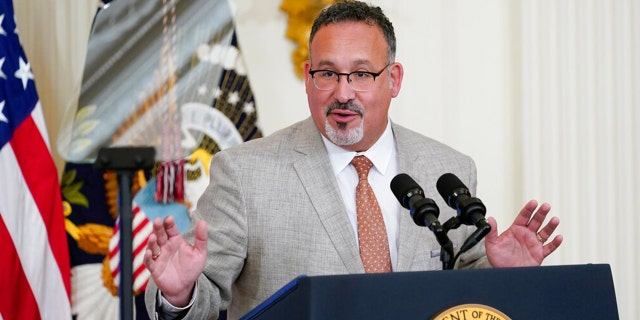
Education Secretary Miguel Cardona speaks during the 2022 National and State Teachers of the Year event in the East Room of the White House in Washington, April 27, 2022.

Education Secretary Miguel Cardona speaks during the 2022 National and State Teachers of the Year event in the East Room of the White House in Washington, April 27, 2022. (AP Photo/Susan Walsh, File)

RANDI WEINGARTEN CLAIMS CHILDREN ‘DO BETTER IN SCHOOLS UNDER TEACHERS UNIONS’

However, others see such arguments — and the department’s new guidance — as ultimately an effort to combat efforts to profit in the education space.

“With the new guidance released last month, the Biden administration seems to be following in the footsteps of President Obama in trying to extinguish private sector, profit seeking participation in higher education,” Beth Akers, senior fellow at the American Enterprise Institute, told Fox News Digital. “There seems to be an attitude that there is no place for profit seeking in higher education. It’s a nice idea to think that all service providers in education should be motivated by benevolence, but profit is what often motivates major innovation — something desperately needed in higher education.”

“Higher education,” continued Akers, “is a realm that has been remarkably stagnant. Instead of trying to stamp out profit seeking and the innovation that would come with it, the Department of Education should focus instead on ousting poorly performing institutions and programs of study from the federal dole by cutting off student aid (loans and grants) from colleges whose graduates fail to out-earn workers with just a high school diploma.”

CLICK HERE FOR THE FOX NEWS APP

The department initially gave colleges and universities until May 1 to report details of their agreements to the government and 30 days to submit comments on the changes. Following widespread outcry, however, the department said that in response to “confusion,” the guidance would not take effect until Sept. 1, rather than immediately as of last month. It also pushed back the end date of the public comment period through March 29.

“This seems to be a solution in search of a problem rather than the other way around. The department hasn’t identified what harm it’s trying to prevent,” said Guida. “It appears to be a broad regulatory grab.”
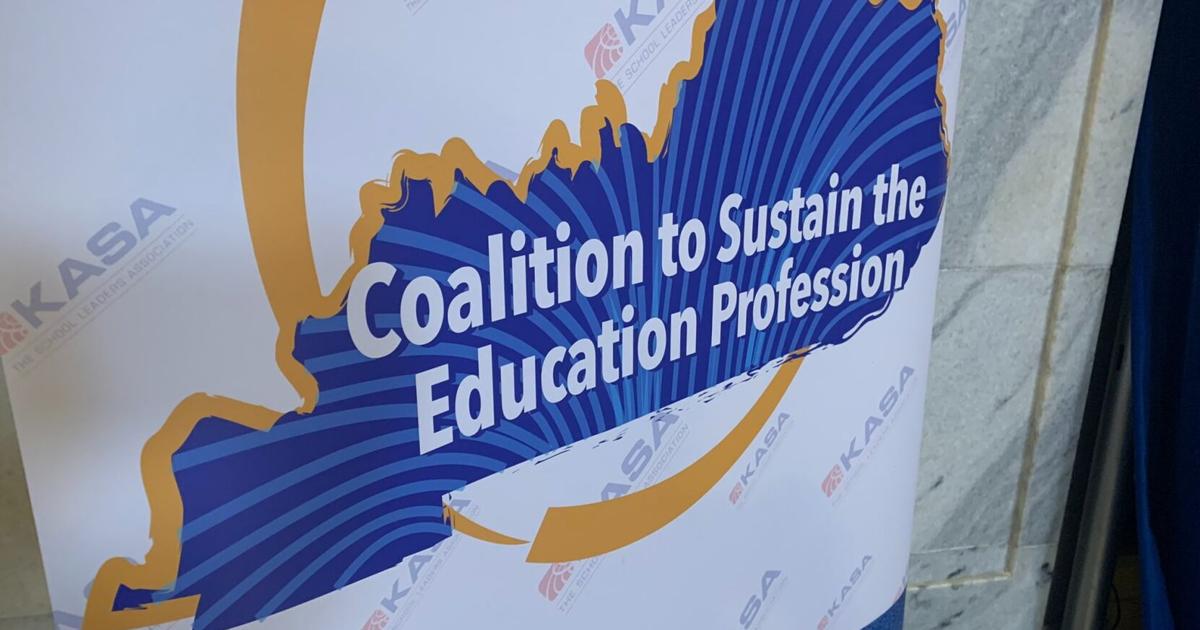

Coalition of Kentucky educators present lawmakers with plan to reduce teacher shortage | Education

FRANKFORT, Ky. (WDRB) — A coalition of Kentucky educators presented to state lawmakers its strategies to handle the state’s instructor lack.

The Kentucky Affiliation of Faculty Directors produced the Coalition to Maintain the Schooling Profession past fall. The 125 volunteers break up into 9 sub-groups and arrived up with above 30 recommendations to simplicity Kentucky’s instructor scarcity. Nine of those people suggestions have been shared Tuesday with the House Instruction Committee.

All those suggestions incorporate:

  1. Conduct a complete examine of public education (wage and advantage analysis and perception of the teaching occupation)
  2. Resolution to create a navigable program of alternate teacher certification 
  3. Internet portal of resources for teacher recruitment (which includes a statewide software)
  4. Resolution to address various certification issues—teacher testing, admission to trainer instruction courses, state-to-state reciprocity, and varying grade stages of certification. 
  5. Make clear satisfactory educator behaviors and present crystal clear and ideal penalties for violations
  6. Fund a internet marketing campaign to spotlight the worth of education and learning and job
  7. Fund a product instructor recruitment and induction program. Mandate the establishment of a Tenure Review Committee for academics inducted into the instruction occupation below that program 
  8. Fund GoTeachKY and the Ambassador application to each faculty district 
  9. Fund 1 undergrad teacher education and learning scholarship for every college district & $500 for each 7 days stipend for student teaching

This legislative session is not a budget 12 months, nonetheless, KASA said the vast majority of the proposed initiatives would not demand funding.

“Whether or not we get that attained in a funds year, I do not know,” said Point out Rep. James Tipton (R-District 53) who chairs the Household Training Committee. “But even if we do not, individuals are factors we want to choose a serious seem at in 2024.”

Bullitt County Faculties Superintendent Jesse Bacon and Central Hardin Superior College Principal Tim Isaacs are associates of the Coalition and facilitated Tuesday’s presentation to lawmakers.

Hardin County Schools Superintendent Teresa Morgan, one of the co-chairs on the coalition encouraging direct the recommendations, claimed shell out raises to battle teacher burnout need to be top rated priority, noting that her district has viewed additional than 80 resignations considering the fact that the begin of the university year. 

“It is really for the reason that of the strain that is in education,” Morgan mentioned. “The sum of time it requires to be organized in the classroom just about every working day is extremely tense. And so we really just hope that our legislators will pay back notice to people concerns and acquire action.”

There has been some Republican pushback to phone calls for raises, but Morgan reported the proposal desires to be seen as nonpartisan to much better enable resolve the lack.

“This seriously isn’t a Republican issue. It really is not a Democrat problem,” Morgan said. “It is a commonwealth of Kentucky challenge that warrants the consideration of anyone who values the schooling of around 600,000 college students. Ninety percent of Kentucky students go to community faculties. So this truly is a statewide concern.”

Morgan said Hardin County teachers gained a 2{af0afab2a7197b4b77fcd3bf971aba285b2cb7aa14e17a071e3a1bf5ccadd6db} elevate final calendar year, thanks to state funding from very last session, and some Republican lawmakers reported the funding from the previous session really should be ample.

Kentucky Office of Schooling Commissioner Jason Glass also introduced to lawmakers Tuesday. He instructed there ought to be three most important spots of aim: pay, help and regard.

“We didn’t get into this difficulty overnight, and resolving it is going to require a centered and multi-yr hard work if we want to see genuine results,” Glass stated. “We have to be cautious of rapid fixes and modest-scale solutions which glimpse great on paper but will not produce the magnitude of impact we need to make a dent in this huge challenge.”

Glass said above the final couple of decades, Kentucky has arrived at a “critical shortage” level in much more parts like elementary education and social scientific tests, which traditionally have had high figures of candidates. He also raised problem above the number of emergency certificates nearly tripling due to the fact 2017.

In 2017-2018, Instruction Skilled Specifications Board granted 383 one-calendar year emergency certificates. This calendar year, 1,156 emergency certificates had been accepted.

House Education Committee Republican Rep. James Tipton said he does prepare to file laws either this week or early following 7 days connected to alleviating the trainer scarcity, but it is really not distinct still what that will entail.

Similar Tales:

Copyright 2023 WDRB Media. All Legal rights Reserved.

Librarians and lawmakers fighting for better e-book access

Librarians and their legislative allies are pushing publishers of electronic textbooks to decreased their prices and unwind licensing phrases, an work that could make it less complicated for tens of millions of library people to borrow the more and more well-liked electronic versions of textbooks.

Supporters say the e-ebook lending laws in quite a few states would permit libraries to give far more electronic content and shorten wait around lists for popular titles. About the lengthy phrase, the steps may possibly shore up libraries’ main mission in an ever more electronic surroundings.

“The present design is discouraging for libraries and archives whose provider mission is thoroughly different from the capitalist targets of a for-profit firm,” claimed Kyle K. Courtney, the copyright adviser for Harvard University and a founder of Library Futures, an advocacy group pushing for the charges. “We have dealt with publishers and rights-holders for generations, but it’s by no means been as negative as it is now.”

Considering the fact that the early 2010s, libraries and publishers have clashed over the phrases and expenses of e-guide licenses, which grant libraries authorization to mortgage electronic textbooks. This kind of licenses now usually expire soon after a selected amount of money of time or number of financial loans. Libraries also ought to fork out a number of moments the go over selling price of equal print versions.

Publishers argue that the markups and other limits secure authors’ mental property rights and incentivize businesses to invest in their function. As the price tag of e-reserve licenses has ongoing to rise, on the other hand, librarians and their advocates in at least 9 states have pushed for laws that would involve publishers—especially the “Big Five” that generate the overpowering the vast majority of buyer books—to provide libraries a lot more “reasonable” licensing terms.

Point out lawmakers have offered this kind of expenses bipartisan aid, but a number of steps have faltered just before states could put into practice them. New York Governor Kathy Hochul vetoed her state’s e-e book bill in late December, citing copyright fears. In June, a Maryland choose dealt the movement a 2nd blow, ruling that federal legislation preempts states’ attempts to control e-e-book licenses.

Undeterred, librarians and lawmakers in states which includes Maryland, Massachusetts, and New York say they are preparing a new legislative strategy ahead of upcoming year’s session. The new charges search for to evade the stumbling blocks that scuttled the laws in Maryland and New York.

Climbing Costs, Restrictive Conditions

Librarians’ newest legislative thrust arrives just after two breakneck decades for digital financial loans. This sort of checkouts (which include e-publications, audiobooks, and electronic magazines) exceeded fifty percent a billion in 2021, in accordance to OverDrive, the most significant distributor of electronic library content—up 55{af0afab2a7197b4b77fcd3bf971aba285b2cb7aa14e17a071e3a1bf5ccadd6db} from two several years just before.

In response, a lot of U.S. libraries have rapidly expanded their electronic collections and shifted paying out to e-publications and electronic audiobooks. Libraries hardly ever “own” e-publications, on the other hand. Rather, they license the appropriate to mortgage them out—a product more like shopping for software than procuring at a bookstore.

Below this arrangement, publishers can established expiration dates on e-reserve licenses, limit the variety of times an e-ebook can be borrowed, hold off income to libraries, or refuse them obtain entirely. Nowadays, it is frequent for e-guide licenses from major publishers to expire soon after two several years or 26 borrows, and to charge amongst $60 and $80 for every license, in accordance to Michele Kimpton, the international senior director of the nonprofit library team LYRASIS.

In 2019 testimony to Congress, the American Library Association emphasised the disparity between buyer and library e-book costs, making use of the 2014 bestseller All the Gentle We Are not able to See as an case in point. Whilst buyers paid out $12.99 for a digital model, the identical e book expense libraries about $52 for two many years, and nearly $520 for 20 decades.

“E-textbooks used to be on libraries’ electronic cabinets permanently, but now you’re paying out $60 for a title each individual two yrs,” reported Kimpton. “That definitely is not favorable for libraries, but that is kind of exactly where we are proper now.”

In addition to straining confined budgets, which given that the early 2000s have remained about flat in most sites, librarians say latest licensing styles have hollowed out their electronic back catalogs and skewed their present-day collections. Forced to devote a lot more funds on less guides, librarians inevitably focus on bestsellers, titles by massive-title authors and new installations in well-known series, reported Michael Blackwell, the director of St. Mary’s County Library in rural Maryland.

That overlooks guides by new and rising authors, midlist books and some older guides with expiring licenses. Patrons normally continue to hold out weeks or months to borrow popular titles.

“We think several individuals throughout the state are currently being deprived,” explained Blackwell, who also qualified prospects the global library coalition ReadersFirst. “You should not have to have to have a credit card to be an informed citizen.”

“Something Has to Be Figured Out”

Regulating e-e-book licenses has proved challenging, even so. In the earlier two many years, at least nine states—including Connecticut, Illinois, Massachusetts, Maryland, Missouri, New York, Ohio, Rhode Island, and Tennessee—have regarded as payments that would call for publishers to license e-publications to libraries at “reasonable” charges and terms, typically leaving the word “reasonable” to foreseeable future interpretation.

Past yr, lawmakers in Maryland voted unanimously to approve the e-e-book invoice that would have barred publishers from delaying e-book gross sales to libraries, among other provisions. In New York Point out, only just one of the legislature’s 211 voting associates opposed the monthly bill to build civil penalties for publishers whose licensing conditions unfairly prohibit e-e-book entry.

The problem has frequently been nonpartisan, explained Alan Inouye, the senior director for general public plan and governing administration relations at the American Library Affiliation. On the political remaining, e-ebook licensing is a make a difference of equity and equal access to information on the suitable, lawmakers have sometimes framed expensive and restrictive licenses as a poor use of public bucks.

But federal regulation does not permit states to restrict the distinctive rights of copyright holders, reported Sandra Aistars, the director of the Arts and Leisure Advocacy Clinic at George Mason University’s Antonin Scalia Regulation College. Publishers are “totally free” to set distinctive rates and phrases for distinct markets, allowing for them to experiment in the market and “more granularly, fulfill shopper need,” she additional.

Publishers and their supporters also have argued that the business can reasonably differentiate between libraries and individuals mainly because they obtain diverse items. Whilst shoppers buy particular person access to an e-reserve, libraries purchase the correct to disseminate it to the general public.

Very last December in New York State, Hochul vetoed the e-book monthly bill after extreme lobbying from the arts and entertainment industries. She pointed out that federal copyright law provides authors exceptional control to make your mind up how they share their do the job. That same thirty day period, the Affiliation of American Publishers filed match from Maryland’s e-guide regulation on very similar grounds. In June, a district courtroom decide dominated that federal copyright regulation preempts Maryland from regulating e-e book licenses.

“Libraries are an critical aspect of the copyright ecosystem as licensed distributors,” explained Terrence Hart, the basic counsel for the Association of American Publishers, in a assertion. “There won’t be something to distribute if states wipe out the incentives and protections of authors to license and exploit their special rights to their is effective.”

Advocates and lawmakers in a number of states now say they are planning to introduce revamped e-book expenditures that can stand up to authorized scrutiny—though federal legislation nonetheless would preempt any condition regulation that infringes on copyright, Hart mentioned. A single design, created by Library Futures, contends that states can regulate e-e book terms beneath agreement and customer protection regulations.

Lawmakers in Massachusetts already have worked with Library Futures to amend their e-guide invoice, claimed Condition Rep. Ruth Balser, a Democrat who cosponsored an previously edition final 12 months. That measure did not go out of committee, Balser reported, mainly because legislators first hoped to see how the Association of American Publishers lawsuit performed out in Maryland.

Advocates in Maryland, in the meantime, are preparing a possible monthly bill that would ban community libraries from engaging in “unfair” contracts, possibly slicing big publishers off from the state’s library market.

Lawmakers and library teams in New York State also have started conversations on how they can “tweak” the invoice Hochul vetoed, stated Point out Assembly Member Josh Jensen, a Republican cosponsor of New York’s failed e-reserve invoice. As a teen, Jensen labored in a regional library reshelving publications.

“I was annoyed, of course,” Jensen said of the governor’s veto. “But I believe something has to be figured out. We’re not seeking to dictate conditions here—we’re just indicating there has to be fair conditions and very good faith. It is a really frequent-perception argument.”