At UMaine, back on campus but still online for many classes

Students walk past Williams Hall at the University of Maine in Orono in between classes on Feb. 15. While K-12 schools and private colleges have gone back to the old way of educating students, public universities have stuck with online learning. Gregory Rec/Staff Photographer

ORONO — University of Maine senior Zachary Signorello prefers to take his college classes in person. It’s harder to motivate himself and connect with peers and professors in online classes, he said.

But in both the fall and spring semesters of this academic year, the 21-year-old found himself taking some of his classes by himself in front of his computer rather than in a classroom surrounded by peers. While many professors have returned to traditional classrooms and lecture halls, there weren’t any in-person offerings for some of the economics courses he needs as part of his major, he said.

Rebecca Babb-Brott, on the other hand, prefers the remote classes. The 59-year-old set out to finish her bachelor’s degree when both her children left the house, and is enrolled in the school’s online program for students like her who want to finish their degrees without significantly interrupting their lives.

“It gives you the flexibility to continue with your everyday life while also getting your education,” she said.

Although the phase of the COVID-19 pandemic that forced a sudden shift to online learning is over and students in Maine and around the nation have returned to college campuses, online classes haven’t gone away.

While K-12 schools and private nonprofit colleges have since gone back to the old way of educating students, public universities have stuck with online learning. The UMaine System has significantly decreased in-person course offerings and increased online classes, allowing individual faculty members and their department heads to decide whether to teach their courses in a classroom, online or with a mix of both. The system doesn’t appear to have any plans to reverse the shift.

Zachary Signorello, a student at the University of Maine in Orono, said he prefers in-person classes but had to take some remote courses in the fall and spring semesters of this academic year. Gregory Rec/Staff Photographer

The increase in online learning has both fans and critics.

Many students say they like having the choice because it allows them to create more-flexible schedules. Others say they don’t think they learn as much in online classes compared with in-person ones.

Experts in education and psychology, professors and school administrators have equally varied views on the potential benefits and detriments of online learning in higher education and what its future should be.

Some say the increased flexibility and accessibility that comes with virtual classes opens the door to students who wouldn’t otherwise be able to get a post-secondary degree and that the technology we have today should be used to increase access to higher education. Others say it’s hard to provide the same quality of education and holistic college experience when students are online instead of in classrooms, lecture halls and labs. Many say both things are true.

Data and research clearly show that online learning pales in comparison to in-person instruction for most K-12 students. But the issue is more nuanced when it comes to higher education. While many studies have found that higher-education students perform worse in online classes compared with in-person ones, others have found that online course offerings help students graduate in four years. One study found that although smaller classes were better conducted in person, students in large undergraduate classes benefited from an online format.

Universities in the UMaine system have offered some virtual classes for decades. But like public universities around the country, they have significantly increased online class offerings and decreased in-person ones in recent years.

Five years ago, around 75{af0afab2a7197b4b77fcd3bf971aba285b2cb7aa14e17a071e3a1bf5ccadd6db} of UMaine System classes were offered in person and 25{af0afab2a7197b4b77fcd3bf971aba285b2cb7aa14e17a071e3a1bf5ccadd6db} were offered online. Now the in-person share is 60{af0afab2a7197b4b77fcd3bf971aba285b2cb7aa14e17a071e3a1bf5ccadd6db} and the remote share is 40{af0afab2a7197b4b77fcd3bf971aba285b2cb7aa14e17a071e3a1bf5ccadd6db}.

The UMaine System never made a coordinated decision to maintain increased online learning post-pandemic. Rather, the pandemic forced rapid and drastic change, and some of those changes stuck.

“Many of our faculty who taught classes online for the first time during COVID became accustomed to it, enjoyed it and built their schedules around online delivery,” said Jeff St. John, the system’s Interim Vice Chancellor for Academic Affairs. 

The system’s remote work policy, written in the fall of 2020, explicitly says that remote work is “generally not an option for positions involving a high level of student, employee, or public contact.” However, the system’s acting vice chancellor for strategic initiatives, Carolyn Dorsey, said that policy does not apply to faculty even though such an exemption is not written anywhere in the policy.

Dorsey said it’s up to each university in the system to create remote work policies for faculty. However, there don’t appear to be any such written policies at the campus level.

As a result, the decision to teach online or in person lies with individual faculty members and their department heads.

St. John said that whether virtual or face to face, all system courses provide high-quality instruction. “We don’t deliver courses in any modality unless we are confident in the quality of the course in that modality for those students,” St. John said.

But some students said they don’t feel they take as much away from online classes as they do from in-person ones. And experts and educators say they worry that students taking online courses could miss out on parts of the college experience that occur largely outside of the classroom and suffer negative mental health impacts related to isolation.

Sophomore Chloe Boyes lives on campus in a dorm for honors college students at UMaine Orono, where she is studying social work. She’s taking one of four classes online this semester, even though she would rather take only in-person classes. The online class is required for her major, she said, and taking it online was the only option.

“Especially studying social work, I like to take classes in person,” she said. “I like to be able to actually raise my hand and ask questions.”

Boyes said she doesn’t think online classes provide the same quality of education.

“It feels like there’s less instruction and more independent work,” she said.

When taking in-person classes, the 19-year-old enjoys chatting with professors before and after class, she said. “A lot of the social work professors have experience in the field, so you can talk to them about that,” she said.

It’s harder with online classes to have those organic conversations and build relationships with her professors. “It feels like I’m just paying for the credit,” she said, “not the experience.”

Experts say Boyes’ situation highlights some concerns regarding online learning.

Because social relationships are so important in motivating students, it’s hard to create online classrooms as stimulating and inspiring as in-person courses, said Hunter Gehlbach, a professor at the Johns Hopkins School of Education who focuses on educational psychology. 

“To create that energizing effect that can permeate the whole classroom and reach all the students, (which) is part of the magic of in-person education, is hard to replicate online,” Gehlbach said.

Some faculty members agree that students who take online classes can miss out on certain elements unique to in-person learning.

Jim McClymer, a UMaine physics professor who teaches entirely in person, said being physically on campus gives students the opportunity to spend free time talking about big ideas and thinking creatively as they try to find their way in the world.

“With remote learning you take classes, get credits and graduate,” McClymer said. “But college should be so much more than that.”

At the same time, McClymer said he understands that quintessential college experience isn’t an option or a desire for everyone and that online learning can provide access to students who can’t drop everything to focus on their education.

Many students, including some who are paying to live on or near campus, say they favor remote classes. Some said they choose to take classes online so they can better manage their schedules with work or because they think online classes are easier.

“I work, so it is a lot easier for me to take online classes where I can manage my own schedule,” said Jack Thompson, a student at the University of Maine in Orono. Gregory Rec/Staff Photographer

UMaine senior Jack Thompson said taking online classes makes it easier to handle a full course load and hold his job at a nearby golf course.

“I work, so it is a lot easier for me to take online classes where I can manage my own schedule,” he said. “I can do work at my own pace and end up with a lot more free time.”

Thompson, who lives just off campus, is taking three of four classes online, all asynchronously, which means he can log on to watch lectures or complete assignments on his own time. In synchronous online formats, students log on at the same time as their classmates and professor.

Sandra Caron, a professor of family relations and human sexuality who has been teaching online courses since 2000, said she thinks virtual courses are a great way to learn for many students. Online courses can encourage students to dip their toes into higher education from the comfort of their own homes and allow the university to reach people who can’t drive to Orono or any of the system’s other schools.

“If you’re limited to in-person classes, you’re limited to people who can easily commute and can find time for education around other obligations,” Caron said.

Institutes of higher education around the country have swapped out brick-and-mortar instruction for a mix of in-person, entirely online and hybrid options.

Before the pandemic, 19{af0afab2a7197b4b77fcd3bf971aba285b2cb7aa14e17a071e3a1bf5ccadd6db} of undergraduate students were enrolled in exclusively online courses, 31{af0afab2a7197b4b77fcd3bf971aba285b2cb7aa14e17a071e3a1bf5ccadd6db} of students were enrolled in at least one distance education course and 50{af0afab2a7197b4b77fcd3bf971aba285b2cb7aa14e17a071e3a1bf5ccadd6db} of students were enrolled in all in-person courses, according to the National Center for Education Statistics.

In the 2021-22 school year, the latest year for which data is available, 30{af0afab2a7197b4b77fcd3bf971aba285b2cb7aa14e17a071e3a1bf5ccadd6db} of students were enrolled in all online classes, 29{af0afab2a7197b4b77fcd3bf971aba285b2cb7aa14e17a071e3a1bf5ccadd6db} were enrolled in at least one distance course and 41{af0afab2a7197b4b77fcd3bf971aba285b2cb7aa14e17a071e3a1bf5ccadd6db} were taking entirely in-person courses, the NCES reported.

This shift comes against the backdrop of a difficult moment for higher education in the United States. Undergraduate enrollment has been declining for over a decade, a trend that was exacerbated by the pandemic and the strong job market and which has left schools, including those in the UMaine System, struggling financially.

In this challenging post-pandemic environment, online classes may be seen as a financial lifeline, allowing schools to recruit students from around the country and boost enrollment without having to convince students to move thousands of miles and take on as significant of a financial burden. The UMaine System enrolls students who live as far away as California.

UMaine System board Chair Trish Riley said online learning ensures students can access all of the system’s resources by providing increased flexibility and allowing students to take classes offered across campuses.

Experts say online learning can be an important solution to declining enrollment and subsequent financial challenges.

“We need to think creatively about how to bring education to students who are not flocking to our doors right now,” said Nathan Daun-Barnett, a professor of educational leadership and policy who focuses on the economics of education, organizational change, access and equity at the University of Buffalo.

Students walk across the Mall at the University of Maine in Orono earlier this month. Today, 60{af0afab2a7197b4b77fcd3bf971aba285b2cb7aa14e17a071e3a1bf5ccadd6db} of UMaine System classes are in person and 40{af0afab2a7197b4b77fcd3bf971aba285b2cb7aa14e17a071e3a1bf5ccadd6db} are remote. Gregory Rec/Staff Photographer

However, Daun-Barnett and other higher education finance experts said online learning isn’t a sure financial win for institutions set up to teach in traditional settings, as they already have in-person infrastructure they have to pay to maintain at the same time they invest in creating effective online courses. It makes sense right now, said Daun-Barnett, because enrollments are declining and schools need to make up that revenue. But if interest in higher education starts to increase again, online learning might not be a winning strategy.

The UMaine System’s shift to online learning stands in stark contrast to the trend among private nonprofit colleges, which have largely reverted back to traditional classroom instruction since the pandemic. Bates, Bowdoin and Colby colleges, for example, have all returned to providing exclusively in-person instruction. 

Private colleges nationwide, and especially elite private colleges, have largely gone back to in-person education because face-to-face learning is a crucial part of their institutional identity, said Stephen Aguilar, a University of Southern California professor who specializes in educational psychology. Such elite private colleges, unlike public universities, continue to be successful with in-person learning and have no incentive to change the model.

Bowdoin College in Brunswick, for example, advertises itself as an institution of conversation and questioning that “thrives in classrooms, lecture halls, laboratories, studios, dining halls, playing fields, and dormitory rooms.”

Even before the pandemic accelerated the trend, the University of Maine System saw a future in digital learning.

Peter Schilling, UMaine Orono’s executive director of innovation in teaching and learning, is working on creative methods for top-of-the-line virtual learning opportunities. He’s been doing so since 2015, working with hundreds of faculty a year to elevate their classes with technology and to create effective and engaging materials for in-person and virtual courses, he said.

Schilling, who also teaches in a program that is entirely online, said it’s possible to create effective online courses that provide flexible schedules and help students come together to articulate their ideas and hear different viewpoints.

And, he said, he sees a bright future for remote learning. The pandemic may simply have accelerated it.


Use the form below to reset your password. When you’ve submitted your account email, we will send an email with a reset code.

« Previous

Additional physical education classes may lower pediatric obesity prevalence in schools

February 22, 2023

3 min read

Disclosures:
The authors report no relevant financial disclosures.


We were unable to process your request. Please try again later. If you continue to have this issue please contact customerservice@slackinc.com.

Adding more physical education classes in grades one to nine could help lower the prevalence of obesity among school-aged children, according to a study published in Obesity.

From 2011 to 2018, Slovenia enacted a nationwide program named Healthy Lifestyle that added two to three additional physical education classes per week for students in more than 200 schools in the country. The researchers found that students who participated in the additional classes had a larger reduction in BMI than nonparticipants, and the BMI decrease grew as students participated in the intervention for a longer time.

Additional physical education classes may lower pediatric obesity prevalence in schools

“There are two important messages,” Gregor Starc, PhD, assistant professor in the faculty of sport at University of Ljubljana in Slovenia, told Healio. “The first one is that school-based interventions to increase physical activity can be effective in reducing obesity prevalence, but such interventions should be longer than two years. The second — in our regard the more important message — is that introducing one hour of high-quality school physical education every day could reverse the childhood obesity epidemic.”

Researchers analyzed findings from Healthy Lifestyle, a program that allocated two additional physical education classes per week for students in grades one to six and three additional classes for students in grades seven to nine. The additional classes meant that participants attended a physical education class during every school day. There were 216 schools in Slovenia that opted to participate in the program. All students at participating schools were invited to take part in the intervention as an elective course. Height, weight and triceps skinfold measurements were obtained from the Slovenian national fitness surveillance system. Children in the 85th to 94th percentile for age- and sex-specific BMI were considered to have overweight, and those in the 95th percentile or higher were defined as having obesity. Researchers compared data from intervention participants with a control group of children who attended participating schools but did not take part in the intervention.

BMI reductions grow with longer intervention participation

There were 29,152 children in the intervention group and 34,473 children in the control group at baseline. The overall prevalence of obesity in the 216 participating schools declined after the intervention began for schools that joined before or after 2016. Due to delays and reduced financing in 2016, schools joining that year did not have a change in obesity prevalence, according to the researchers.

In a generalized estimating equations analysis, the intervention group had an increasingly lower mean BMI compared with the control group. The difference in BMI between the intervention and control groups peaked at 3 years for girls with normal weight (beta = 0.937; 95{af0afab2a7197b4b77fcd3bf971aba285b2cb7aa14e17a071e3a1bf5ccadd6db} CI, 0.845-1.029) and girls with obesity (beta = 1.417; 95{af0afab2a7197b4b77fcd3bf971aba285b2cb7aa14e17a071e3a1bf5ccadd6db} CI, 0.959-1.875) and at 4 years for girls with overweight (beta = 1.151; 95{af0afab2a7197b4b77fcd3bf971aba285b2cb7aa14e17a071e3a1bf5ccadd6db} CI, 0.785-1.517). Among boys, the difference in BMI change between intervention and control participants plateaued at 3 years for those with normal weight (beta = 0.851; 95{af0afab2a7197b4b77fcd3bf971aba285b2cb7aa14e17a071e3a1bf5ccadd6db} CI, 0.766-0.935), overweight (beta = 0.766; 95{af0afab2a7197b4b77fcd3bf971aba285b2cb7aa14e17a071e3a1bf5ccadd6db} CI, 0.542-0.989) and obesity (beta = 0.889; 95{af0afab2a7197b4b77fcd3bf971aba285b2cb7aa14e17a071e3a1bf5ccadd6db} CI, 0.461-1.316).

Starc said the findings were not surprising as the decision to implement the intervention was based on previous research testing out how many physical education lessons per week were needed to improve physical fitness in children.

“We tested different combinations and it turned out that the only combination that reliably works is having five lessons of 45-minute physical education per week, implemented by specialist physical education teachers,” Starc said. “Combinations with fewer lessons and classroom teachers with less competencies in PE teaching were much less effective.”

Intervention linked to obesity reversal at 3 years or longer

Researchers assessed the transition of 4,063 children with obesity at baseline to overweight or normal weight by the number of years participants were enrolled in the intervention. Girls with obesity participating in the intervention for 2 years (Cramer’s V coefficient = 0.072; P = .016), 3 years (Cramer’s V coefficient = 0.12; P = .002), 4 years (Cramer’s V coefficient = 0.122; P = .024) or 5 years (Cramer’s V coefficient = 0.154; P = .033) were more likely to transition to overweight or normal weight than girls with obesity in the control group. For boys with obesity, only those participating in the intervention for 3 years (Cramer’s V coefficient = 0.092; P = .011) or 5 years (Cramer’s V coefficient = 0.157; P = .027) were more likely to lower their BMI to overweight or normal weight than those in the control group. The number of children needed to treat to reverse one obesity case declined as duration of the intervention increased, with the lowest number needed to treat being 17 for girls and 12 for boys at 5 years.

“The number needed to treat for obesity reversal decreased as the intervention duration increased, emphasizing the need for long-term physical activity programs,” the researchers wrote. “Policymakers and funding bodies should be aware that obesity is a chronic condition that needs to be dealt with over a longer timeframe and that easy solutions and immediate effects are neither realistic nor sustainable.”

Starc said it is crucial for similar interventions to be studies and adapted in other countries to validate the findings.

For more information:

Gregor Starc, PhD, can be reached at gregor.starc@fsp.uni-lj.si.

Free online, in-person classes to take

Check on line for certain events and occasions which differ by branch. Cobb County General public Library, cobbcounty.org/library DeKalb County Community Library, dekalblibrary.org Fulton County Library Technique, fulcolibrary.org Gwinnett County Community Library, gwinnettpl.org

For adult learners

Coursera. Produce a free Coursera account and just take one of 2,600 on the web classes taught by instructors at esteemed domestic and international universities and providers. Discover about maternal and newborn care at Yale College and purposes in engineering mechanics at Georgia Tech, or consider a phone at Emory University. The website will allow customers to decide on the issue issue, timeframe and instructional institution, creating it quick to customise. coursera.org

Harvard University. Here’s your probability to attend an Ivy League college for no cost. The private analysis college in Massachusetts created a site listing its free of charge training course choices which include Introduction to Household Engagement in Instruction, Negotiating Income and a basic rules of architecture training course identified as The Architectural Creativity. There are extra than 100 self-paced classes currently accessible ranging from 1 to 10 weeks. Programs are hosted via Edx.com, an instructional platform that posts the syllabus, stipulations and discovering objectives. You’ll see that courses from Harvard are dubbed HarvardX and offered as audit courses for a confined time, ordinarily many months. pll.harvard.edu

Edx. In addition to Harvard University programs, Edx provides almost 3,000 programs from institutions like Georgetown University, University of California at Berkeley, College of Chicago, Rice University, Stanford University, College of Toronto, New York College and Atlanta’s possess Georgia Tech. edx.org

LinkedIn Mastering. Indication up for a a single-thirty day period trial to entry small business, innovative and technological innovation programs taught by industry professionals. Quality job income data and get the job done insights are also readily available through the trial interval. Contributors can choose from classes these as Composing with Impression, Content material Development: Tactic and Resources and Information Science Foundations. Classes fluctuate from two-minute films to in-depth, multi-hour lessons. All are out there as audio‑only and offer offline viewing so contributors can pick what works finest for their program. linkedin.com/studying

Learn InDesign for Free: 15 Online Courses & Classes to Try in 2023

Adobe InDesign is a publishing and page layout designing software developed by Adobe Inc. and was released in 1999. It is widely used to create brochures, magazines, newspapers, posters, flyers, presentations, books, and eBooks. In addition, it is used to publish content in conjunction with Adobe Digital Publishing Suite for various devices.

It is comprehensive software and is especially helpful for graphic designers and production artists. The software is available for Windows and macOS operating systems in 24 languages.

InDesign is an extensive software developed mainly for the presentation of different work and for creating templates. It is the industry standard editing software for developing long-form multipage documents. It has various features, including creating frames and shapes, aligning objects with grids and guides, manipulating objects, organizing things, importing and formatting texts, spell checking, importing images, and master pages.

This software compiles information and presents it professionally. This is a crucial software skill for beginners in print and digital publications. Learning InDesign is a simple linear learning curve that does not require much technical knowledge. It is an intuitive program that needs an eye for composition to create exciting content formats.

Following is a list of InDesign courses that can help any beginner understand the software’s fundamentals.

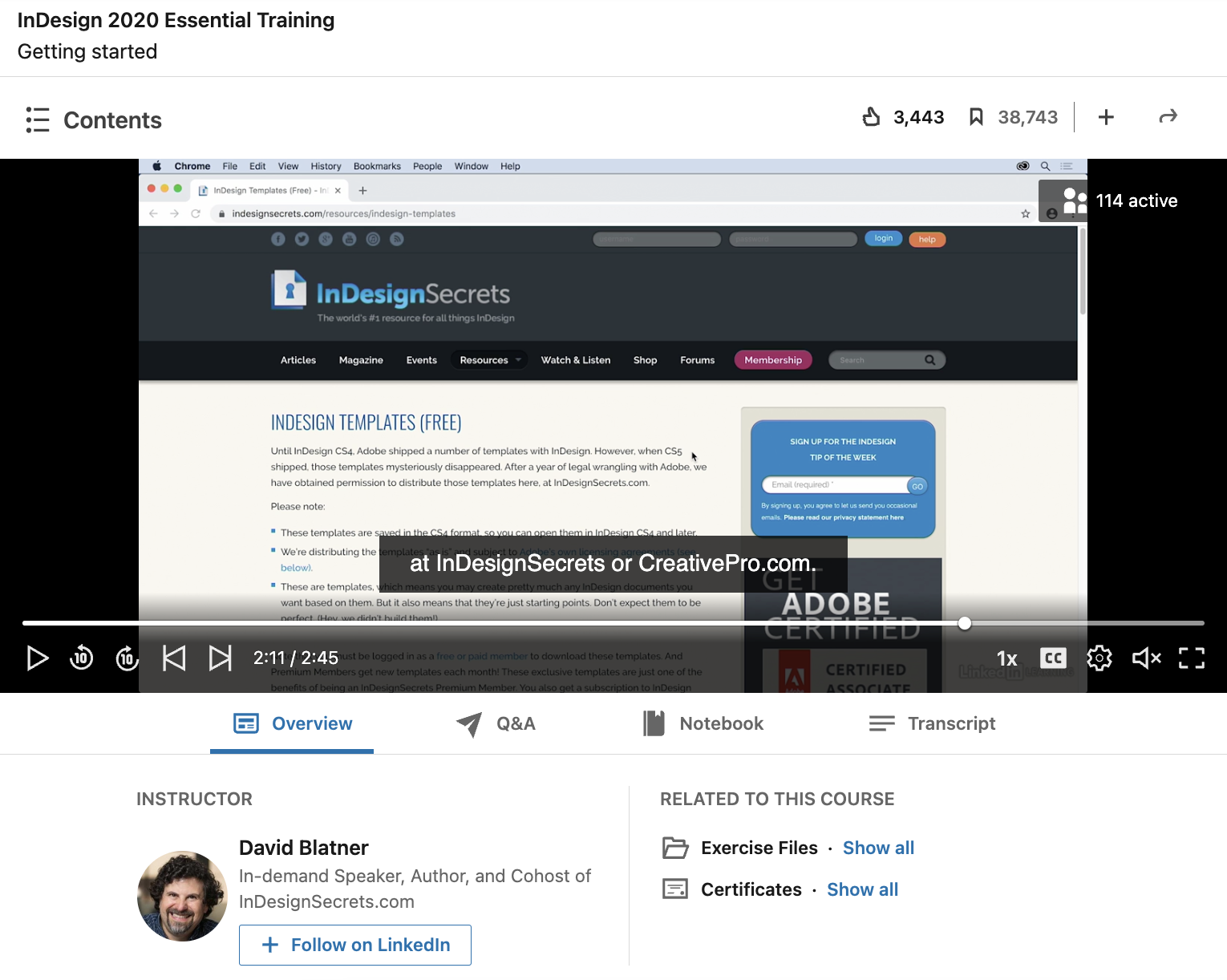
1. InDesign Essential Training [LinkedIn Learning]

InDesign Essential Training

InDesign is one of the most in-demand publishing tools in today’s industry. David Blanter, who is an expert designer and one of the co-founders of InDesign Magazine and Creative Pro Network, teaches this course. The course demystifies complex and technical concepts of the software for any beginner to understand.

According to LinkedIn, the course is a beginner-level course with a total run time of 5 hours. The course teaches the basics of the software, including making multi-page documents, learning about text frames and graphics, manipulating pages, importing texts, changing color and transparency, managing layers, making tables, and so on.

At the end of the course, a certificate of completion is provided that can be added to the resume to add to one’s skill tree.

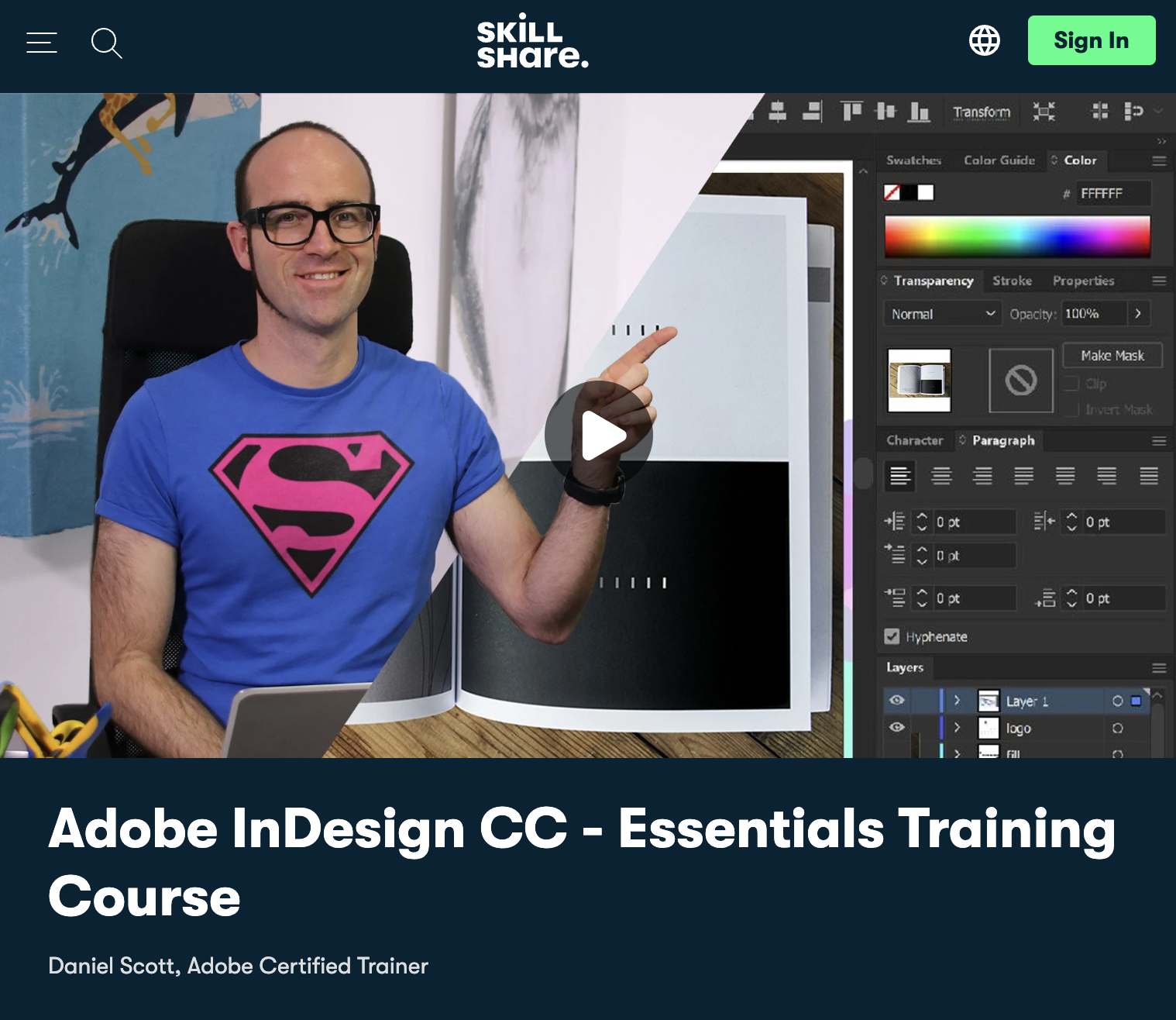
2. Adobe InDesign CC – Essentials Training Course [Skillshare]

Adobe InDesign CC – Essentials Training Course

This course helps a beginner understand the different choices related to texts, layouts, and images within the software. The instructor Daniel Scott is an adobe certified graphic designer and has an experience of more than 15 years.

The course has a total of 6 hours and 47 minutes runtime. The course comprises many principles required to design elegant publications, choose personal and corporate colors, use fonts, manipulate images in multiple ways, color backgrounds, resize, rotate, RGB, and many more.

3. Book Design Basics: Styling Novel Interiors with InDesign [Skillshare]

Book Design Basics Styling Novel Interiors with InDesign

This is an intermediate-level course and provides a detailed understanding of designing the interiors of a novel or book sequentially. The course has a run time of 1 hour 30 minutes and teaches about the philosophy and vocabulary of book design.

It also gives detailed information about critical settings, style conventions, type choices, master pages, sections, exporting, pagers, headers, and so on. The course is taught by Neil Swaab, a freelance illustrator and book designer. He has worked with notable clients like Google and Harper Collins and is recognized by the Society of Illustrators and American Illustration.

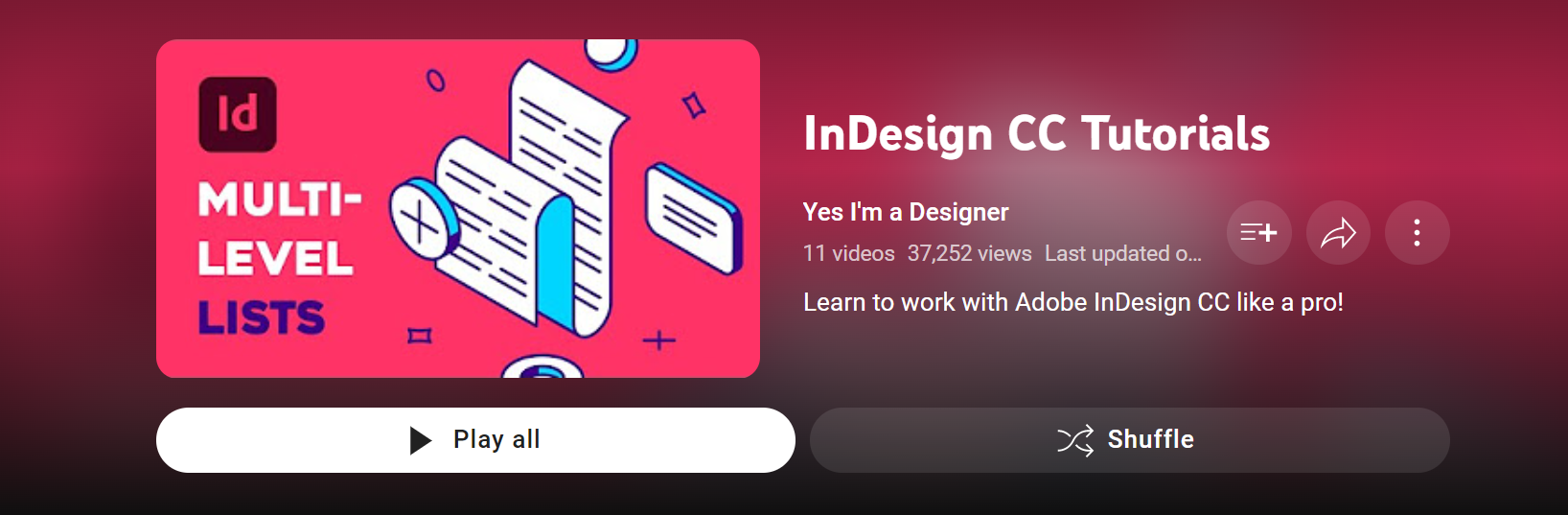
4. InDesign CC Tutorials [YouTube]

InDesign CC Tutorials

This beginner-level online course teaches all the features and principles of Adobe InDesign, helping a beginner start working professionally. This course even covers some of the advanced InDesign tools which can help improve a project’s workflow.

The course has 11 videos and comprises many key InDesign concepts and skills. These include working with text frames, manipulating images, setting up master pages, formatting texts, exporting projects, and so on. It is a comprehensive course and clarifies all the basics of working with InDesign CC.

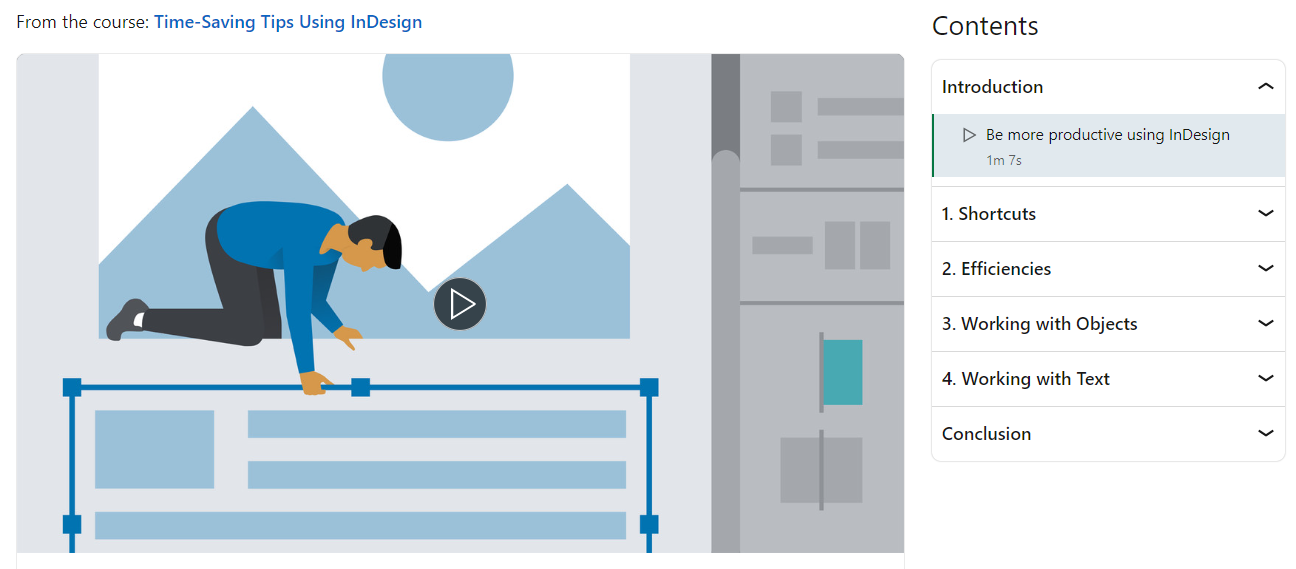
5. Time-Saving Tips Using InDesign [LinkedIn Learning]

Time-Saving Tips Using InDesign

Learning an efficient workflow to save project time is crucial in this field. This online course teaches all the methods and shortcuts required for the same. The course has a runtime of 2 hours and 30 minutes. It will teach you several tips and tricks to reduce the time spent doing repetitive tasks in InDesign. These include keyboard and tool shortcuts, stroke and fill option keys, using Gridify, frame fitting options, quick apply, and many more.

Chad Chelius, who was an Adobe Certified Instructor, teaches the course. He has an experience of more than 20 yearswith Adobe products.

At the end of the course, you will get a completion certificate and a chance to work on a project related to what you have learned throughout the course.

6. Adobe InDesign CC –Advanced Training  [Skillshare]

Adobe InDesign CC –Advanced Training

This is an extension to the essentials course provided by Daniel Scott. This is a helpful course for people who want an extensive skill set in InDesign to improve their workflow and productivity.

This course has 8 hours and 11 minutes and has 73 video lessons. It covers advanced concepts like master styles, advanced fonts, interactive documents, advanced CC features, exporting, prepress, printing tricks, workflow tactics, and many more to help anyone master the software.

7. Basic InDesign: Layouts, Types, and Images [Skillshare]

Basic InDesign Layouts, Types, and Images

This course introduces you to the basics of InDesign by examining the various design principles utilizing the three core features of InDesign – layouts, types, and images. Anne Ditmeyer, who has also provided five other courses on Skillshare, guides this course.

The course consists of 12 lessons spread over 2 hours. First, it teaches about the fundamentals of working with layouts, types, and images in InDesign. Then, it deals with topics like the basic setup of a document, inserting images, setting up master pages, and using paragraph and character styles.

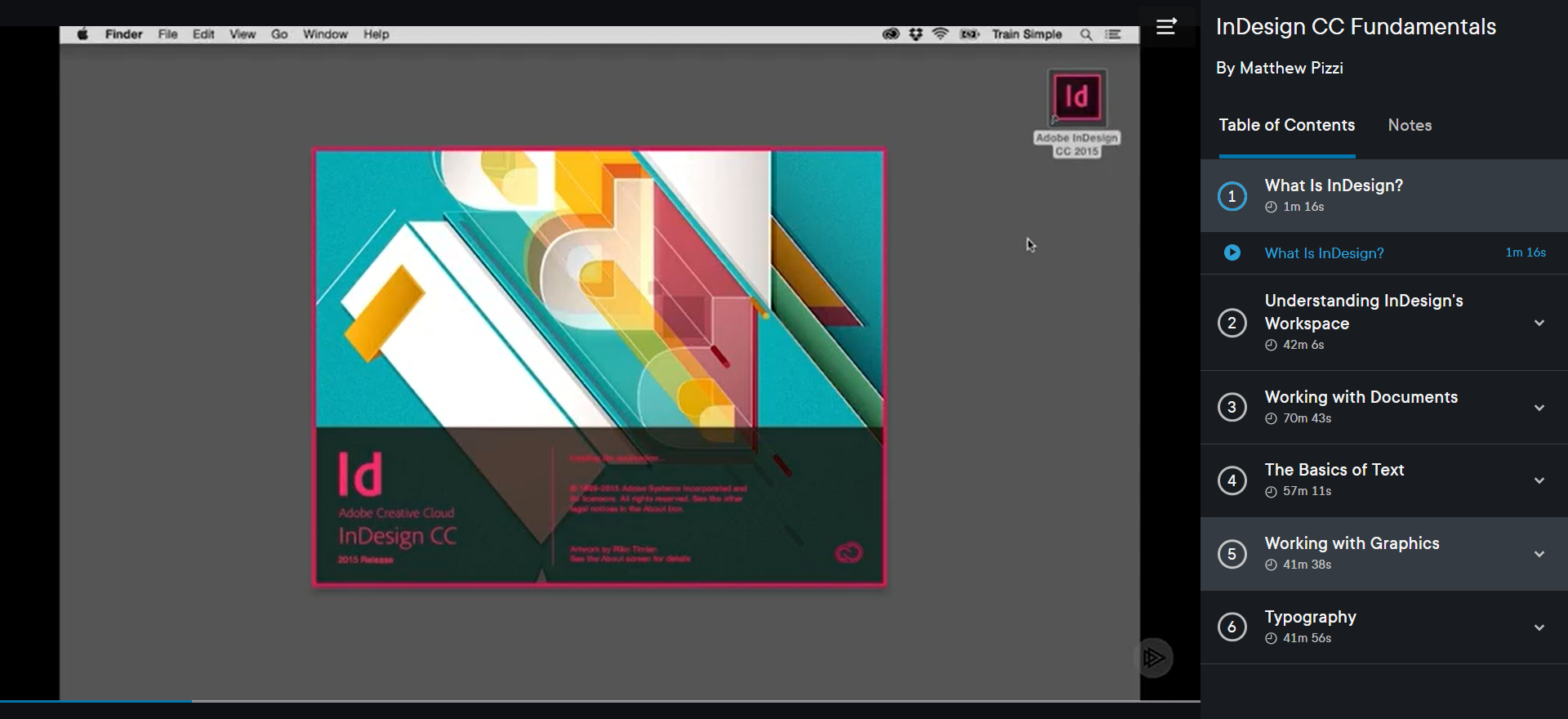
8. InDesign CC Fundamentals [Pluralsight]

InDesign CC Fundamentals

Matthew Pizzi teaches this course. He is an Adobe Certified Trainer with almost 15+ years’  of experience as a designer. The course has a runtime of 4 hours and 15 minutes. It takes a progressive approach and begins with familiarizing you with the workspace and interface of the software.

It goes on to teach fundamentals like ruler guides and page tools, formatting texts to make them look elegant, putting up graphics, and understanding how they interact with each other.

9. Brochure Design using Adobe InDesign [Udemy]

Brochure Design using Adobe InDesign

Instructors at MKCL India teach this course. First, it teaches about designing a brochure. A brochure is made of folding paper containing information about a specific topic. It has a rating of 4.2 stars on Udemy.

Learning about making a brochure can also help design posters, flyers, magazines, newspapers, etc. This course helps to understand the physical aspects of printing and publications.

10. Adobe InDesign made Easy – A Beginners Guide to InDesign [Udemy]

Adobe InDesign made Easy – A Beginners Guide to InDesign

This course starts with the basics of the software and teaches in-depth about the workspace of the software. It takes an in-depth dive into layout, frames, drawings, texts, character formats, paragraphs, and so on.

At the end of the course, one will learn about all the fundamentals of InDesign. The course is simplified for everyone to understand. It takes a systematic approach and consists of 105 lectures, with a run time of 11 hours. It is an extensive course helpful for all beginners.

11. InDesign for Beginners [YouTube]

InDesign for Beginners

This course is for absolute beginners and does not require any prior knowledge of the software. The course gives practical examples and tasks simultaneously, helping you to practice.

At the end of the course, you can design a four-page brochure, learning the tools and techniques necessary to create and print it professionally. You will also learn to work with color and use corporate colors.

12. Adobe InDesign Complete Course [YouTube]

Adobe InDesign Complete Course

This course is suitable for beginners as it is in a playlist format, which is much easier to grasp. In addition, the course takes a progressive learning method, from setting up a document to undertaking various graphical functions.

It is a slow-paced go-at-your-speed course, which is helpful for most beginners. It even talks about paper and document sizes widely used in the industry.

13. Magazine Cover Design in InDesign [YouTube]

Magazine Cover Design in InDesign

Laura Keung teaches this course in collaboration with Envato Tuts. It has a run time of 56 minutes and covers all the fundamentals of InDesign using the example of a magazine cover. The most important aspect of magazine design is creating an eye-catching cover.

The course covers the anatomy of a magazine cover and how templates are used to get faster results. Beginners will get the experience of designing fashion and sports magazines from the beginning to end.

14. Learn Adobe InDesign | 13 Episode Free Course [YouTube]

Learn Adobe InDesign | 13 Episode Free Course

This course is structured into three main sections – Preparation, Implementation, and Finalization. It consists of 13 videoscovering topics such as setting up a document, understanding the program’s working, using texts, preparing and importing images, and exporting the document into a printable format.

It is a well-structured video series and is helpful for beginners. This course covers the basics of the software and explores several tools and techniques beneficial to kickstart one’s InDesign journey.

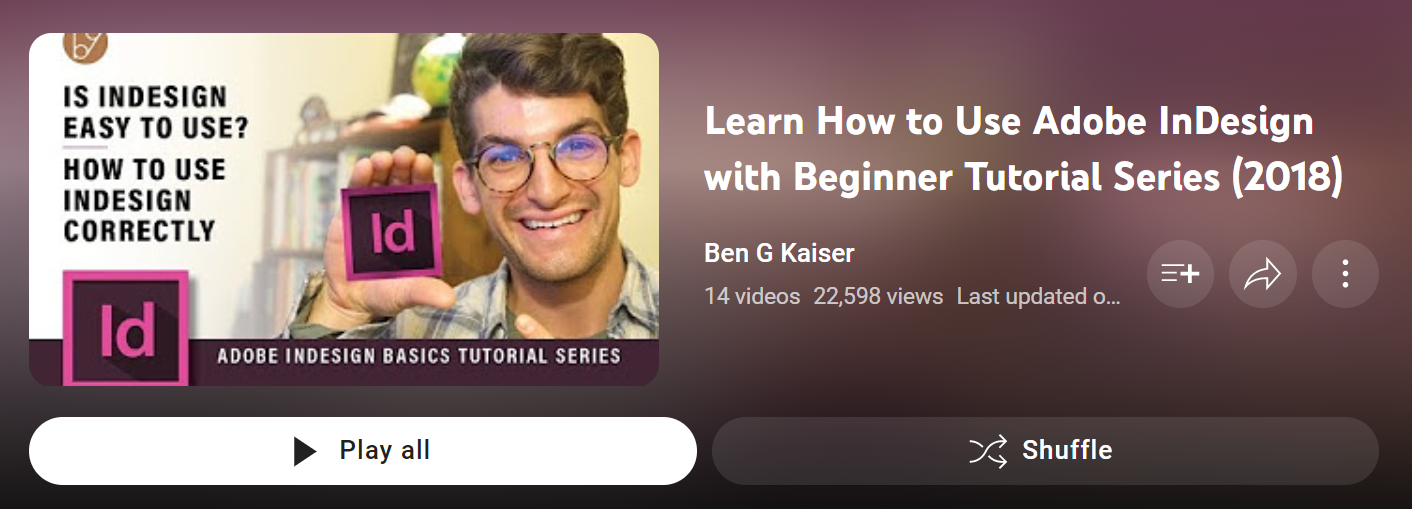
15. Learn How to use Adobe InDesign with Beginner Tutorial Series [YouTube]

Learn How to use Adobe InDesign with Beginner Tutorial Series

This course consists of 14 episodes and takes a deep dive into the details of InDesign. It teaches beginners about workflow and how it can improve their designs using various principles.

The course is in a playlist format, and you may choose any place to start depending on your prior knowledge of the software.

Conclusion

InDesign is a leading software in the industry. It is a convenient software that helps create powerful formats for magazines, newsprints, books, and other publications. It is connected to Adobe Suite, which makes it easy to interlink with other Adobe software.

InDesign is a great skill that can be added to any resume to enter the world of design and publications. Good learning about InDesign can improve one’s presentation skills. This is particularly helpful in creating storylines and presenting them in an interesting format.

A good hand in InDesign will give you an edge in the industry and will help them progress further in your career. All the above courses have a common underlying feature. It provides a good understanding of composition, which is a helpful skill in the world of visual design. Therefore, learning InDesign in 2023 is a great choice for any beginner.

Legislature removes disincentive for community colleges’ online classes | Local News

SHERIDAN — Distance schooling and in-human being classes will before long be dealt with equally when it comes to how the condition reimburses community schools for the courses it presents.

The laws was between the to start with slate of charges signed by Gov. Mark Gordon in the course of the recent session of the Wyoming Legislature.

Will Restrictions on Teaching ‘Controversial’ Issues Target Science Classes?

In their efforts to regulate how academics can examine troubles of politics and identity in the classroom, Republican condition legislators have so significantly targeted mostly on social reports and record instruction. Now, a couple of lawmakers are eyeing science.

In Texas, a monthly bill that would mandate teaching a “positive” model of U.S. history and ban functions that “condone civil disorder” also contains language prolonged employed by advocates on the spiritual ideal to prevent the educating of evolution as scientific actuality.

In Oklahoma, a lawmaker who released a invoice requiring that academics be authorized to assist learners in critiquing “existing scientific theories” informed area information outlets that this and other proposals would ensure pupils “learn factual information fairly than fashionable wokeness.”

Neither legislator responded to requests for comment.

Costs that use this sort of language—mandating colleges to educate the “strengths and weaknesses” of scientific theories—aren’t new, reported Glenn Branch, the deputy director of the National Middle for Science Schooling, a team that advocates for training evolution and local climate science and tracks connected laws.

They are component of a decades-long press by conservative activists to require that colleges downplay or qualify the scientific consensus on evolution. These costs pop up in a handful of state legislatures most years, he mentioned, and they frequently are unsuccessful to go.

But now, some legislators are linking these science instructional mandates to the ongoing movement to prohibit how instructors talk about race and gender in universities.

There’s a common thread in all of these proposals, claimed Erika Shugart, the executive director of the Countrywide Science Training Association.

“Issues that had been just not controversial for a lengthy time have instantly grow to be controversial,” she mentioned. “And it’s not coming from the educators or the lecturers, it’s coming from politicians.”

Tracing the one-way links concerning anti-evolution rules and the latest moment

About the previous two yrs, schools have fielded an onslaught of problems about how instructors focus on race and gender in the classroom.

Republican politicians and conservative activists declare that academics focus also significantly on the unfavorable elements of America’s previous and current, and are training white college students to truly feel responsible and ashamed. They’ve pushed to clear away guides with LGBTQ storylines and ban conversations of gender and sexuality.

Given that January 2021, lawmakers in 44 states have released payments or other guidelines that would limit how teachers can focus on racism and sexism, according to an Schooling Week examination. Eighteen states have imposed these bans.

Map: Where by Important Race Principle Is Under Attack

The map under displays which states have introduced charges or taken other methods that would limit teaching vital race theory or restrict how teachers can go over racism and sexism.
It will be current as new facts turns into readily available.

Simply click here for additional info on the steps and versions from point out to state.

The motion, for the most element, has been centered on the novels learners examine and the heritage they learn—not science instruction. But this minute bears some similarities to the cultural firestorm over evolution that swept colleges in the 1920s, claimed Adam Laats, a record professor in the department of educating, learning, and educational management at Binghamton University in New York.

Equally, he claimed, are a backlash to anxieties about societal adjust.

In the 1920s, many states adopted legislation banning the training of evolution, with lawmakers and other political leaders citing fears that it would subvert religious educating and corrupt the morals of American young children.

The most popular of these was Tennessee’s Butler Act, which was challenged in 1925 in The Point out of Tennessee v. John Thomas Scopes—more typically recognized as the Scopes Monkey Demo. But it was not until finally 1968 that the Supreme Court docket declared anti-evolution legislation unconstitutional, a violation of the 1st Modification, which prevents the govt from passing laws “respecting an establishment of religion.”

Due to the fact then, the language in proposed laws on this challenge has transformed. Rather of explicitly banning the instructing of evolution, or advertising the teaching of creationism, expenditures require that lecturers have academic flexibility to critique scientific consensus or teach strengths and weaknesses of founded scientific theories.

Other costs have proposed that lecturers only be authorized to present scientific info, and not scientific theories—an try to prohibit the training of evolution or weather modify, Branch claimed. (A single such monthly bill introduced this session in Montana was not long ago tabled.)

The phrasing implies that a scientific concept is a “mere guess or hunch,” he stated. But a “theory” in science is distinctive from the typical utilization of the word—it refers to an recognized scientific principle primarily based on a long time of empirical investigation.

This elliptical language is designed to prevent jogging afoul of prior Supreme Court docket rulings, Department explained.

“Laws and procedures like this have uniformly been declared to be unconstitutional, mainly because there is constantly been a detectable religious motive,” he claimed. “If you want to get a monthly bill like that in excess of, it’s not in your interest to acknowledge that is the motivation.”

Anti-evolution expenditures do not tend to pass—but could however have a chilling effect

In 2012, Tennessee lawmakers passed a regulation that would allow for teachers to existing the “scientific strengths and scientific weaknesses of current scientific theories.” A 2006 Mississippi law offers lecturers the appropriate to discuss and response scholar issues on “origin of lifestyle.” And in 2008, Louisiana mandated that colleges foster “critical thinking skills” and “open and aim discussion” of evolution, the origins of existence, world wide warming, and human cloning.

Still, the broad the greater part of these forms of expenditures really don’t make it into legislation, said Laats. “They do not have a tendency to operate, or pass, or do substantially,” he stated.

And though it’s possible that some of these new science-similar expenditures could move, Branch claimed, he thinks it is not likely that there will be an explosion in laws on the subject to parallel how Republicans have qualified particular novels and social reports matters.

Nonetheless, local issues to science components rooted in so-identified as curriculum transparency legal guidelines have occurred. And the existing political climate has produced science educators extra wary, claimed Shugart of the Countrywide Science Training Affiliation.

Along with a few other countrywide instructing associations, the NSTA signed a 2022 assertion against tries by legislators and regional school boards to prohibit what resources instructors can use and what they can say in the classroom. The assertion precisely references “the elimination of educating about evolution and local weather change” as a current risk.

“When condition legislators are … making folks concern for their work if they ‘teach the improper point,’ that only chills the atmosphere more for educators,” Shugart claimed.