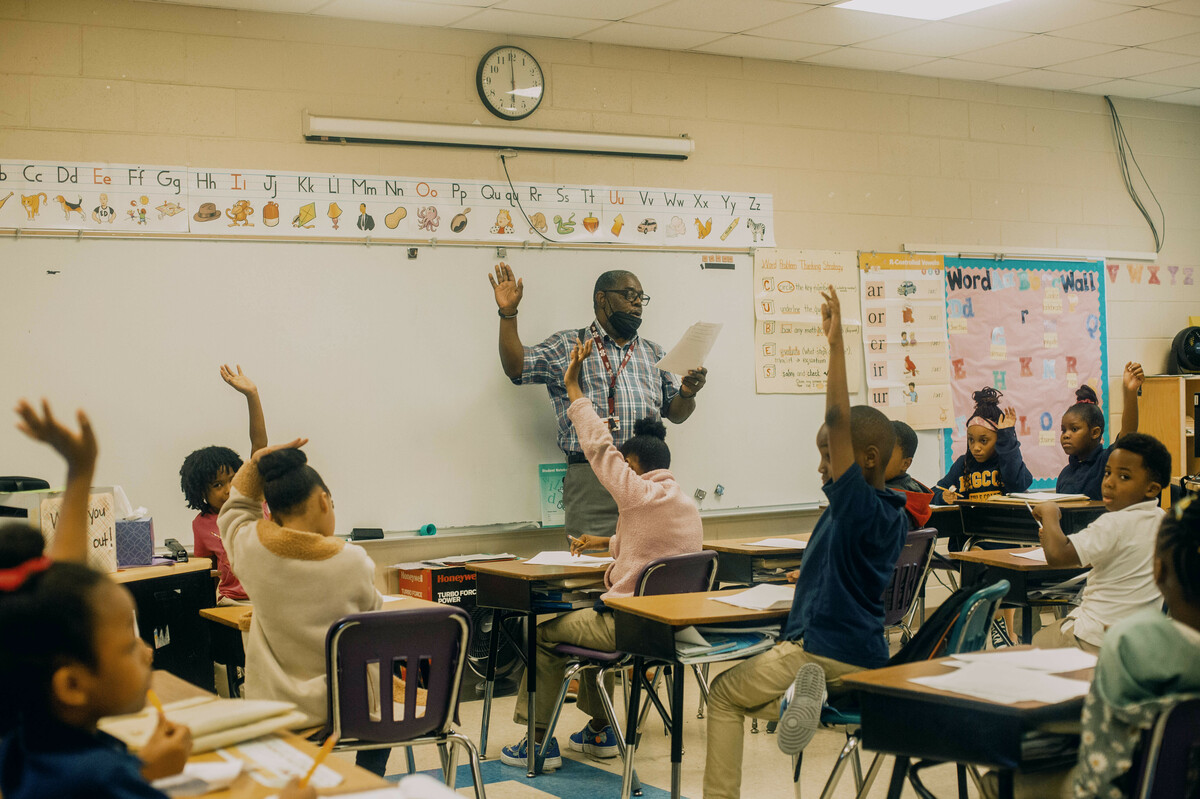
First-grade teacher Kimberly Pate, 52, worked for nearly two decades as a classroom assistant. Through the Mississippi Teacher Residency, she’ll earn a master’s degree plus dual certification in elementary and special education, all at no cost. “How could you pass that up?” she laughs.
Imani Khayyam for NPR
hide caption
toggle caption
Imani Khayyam for NPR
First-grade teacher Kimberly Pate, 52, worked for nearly two decades as a classroom assistant. Through the Mississippi Teacher Residency, she’ll earn a master’s degree plus dual certification in elementary and special education, all at no cost. “How could you pass that up?” she laughs.
Imani Khayyam for NPR
Wearing an effortless smile and a crisp, gray suit with a cloth lapel flower, Tommy Nalls Jr. projects confidence. Which is the point. In a ballroom full of job candidates, no one wants to dance with a desperate partner. And, as badly as his district needs teachers, Nalls doesn’t want just anyone.
“They have to have this certain grit, that certain fight,” says Nalls, director of recruitment for Jackson Public Schools, in Mississippi’s capital city. “That dog in ’em,’ so to speak.”
On this sun-kissed morning in March, he’s a couple hours north of Jackson, in a ballroom on the campus of Mississippi State University, at a job fair full of soon-to-graduate teachers and school district recruiters from all over the state, and even out-of-state, competing to hire them.
Many districts across the country are grappling with teacher shortages large and small. Limited federal data show, as of October 2022, 45{af0afab2a7197b4b77fcd3bf971aba285b2cb7aa14e17a071e3a1bf5ccadd6db} of public schools had at least one teacher vacancy; that’s after the school year had already begun. And schools that serve high-poverty neighborhoods and/or a “high-minority student body” were more likely to have vacancies.
Tommy Nalls Jr. at a teacher job fair in Starkville, Miss. The head of recruitment for Jackson Public Schools says he’s proud of his district’s rise in state rankings, from an F-rated district to a C.
Cory Turner/NPR
hide caption
toggle caption
Cory Turner/NPR
For several months, NPR has been exploring the forces at work behind these local teacher shortages. Interviews with more than 70 experts and educators across the country, including teachers both aspiring and retiring, offer several explanations: For nearly a decade, fewer people have been going to school to become teachers; pay remains low in many places; and, with unemployment also low, some could-be teachers have chosen more lucrative work elsewhere. Researchers and educators also point to a cultural undertow pulling at the profession: a long decline in Americans’ esteem for teaching.
Educators shared stories of students learning Spanish from computers, and superintendents doing double duty as substitute teachers. But they also shared stories of creative, committed efforts – from San Antonio to Hooper Bay, Alaska – to grow a new generation of teachers, while doing more to make sure veteran teachers want to stay.
Jackson’s story is instructive, if not unique. On average, Nalls says, the district loses 1 in 5 teachers every year. Salaries there start at just $44,000, and, back at the job fair, Nalls has to compete with a suburban Texas district, a few tables over, advertising $58,000.
Jackson’s shortage is also exacerbated by a years-long water crisis and poverty, which can follow students to school in the form of trauma, disruptive behavior and lower test scores. In Mississippi, districts are publicly rated on student performance – a rating novice educators are well aware of. Just a few years ago, Jackson was an F-rated district, and this job fair has plenty of districts with higher salaries and technicolor banners trumpeting their A ratings.
It takes 20 minutes for the first teacher candidate to pause at Nalls’ table.
“I’m looking for a good work environment,” says Kierra Carr, who plans to become an elementary school teacher. “And I just want to have fun with the students, basically.”
“You hadn’t considered ever coming to work and teach in Jackson?” Nalls asks playfully, low-pressure. “Why not?! We’ve got some of the best elementary schools in the state!”
Carr leaves her name and email on Nalls’ interest list, while admitting she has reservations about teaching in Jackson: “It’s kind of scary. I think that’s why most people stray away from teaching there because of what’s been said on the news a lot.”
Nalls leans into these headwinds with patient optimism. Jackson is on the rise, he points out, earning a C rating from the state last year. And he’s proud to make that pitch to the eight candidates he interviews at the fair and the half dozen more who leave their contact information.
“They’re not beating the table down trying to get to Jackson,” Nalls says toward the end of the fair. “But we’re working on that part of it.”
It’s hard to know the size of the problem
“Teacher shortages are poorly understood.” That’s according to a paper published last summer. The reason they’re poorly understood? A profound “lack of data” at the federal- and state-level.
So the paper’s researchers built their own dataset by combing through news reports and the websites of state departments of education. Their conclusion, what they consider a “conservative” estimate of teacher shortages nationwide: at least 36,000 vacant positions and many times more jobs being filled by underqualified teachers. One of those researchers, Tuan Nguyen, shares his data at the easy-to-remember teachershortages.com.
A nationally representative survey, by the RAND Corporation, found that “teacher turnover increased 4 percentage points above prepandemic levels, reaching 10 percent nationally at the end of the 2021–2022 school year.”
It’s important to think of school staffing challenges not as one, national shortage, but as innumerable, hyper-local shortages. Because nationally, “we have more teachers on a numeric basis than we did before the pandemic, and we have fewer students” due to enrollment drops, says Chad Aldeman, a researcher who studies teacher shortages.
“Contrary to popular talking points, there is no generic shortage of teachers,” reads one deep-dive into the available data. “The biggest issue districts face in staffing schools with qualified teachers is… a chronic and perpetual misalignment of teacher supply and demand.”
Some kinds of teachers are consistently in short supply. Jackson Public Schools need special education, science and math teachers. But so does every other district at the job fair.
The misalignment of supply and demand is also geographic and economic, though.
There’s an inequity around teacher shortages
“Some schools are harder to staff,” Aldeman says.
Jennifer Carter earned her master’s degree in December through the Mississippi Teacher Residency. She’s now a special education teacher by day and drives a bus before and after school to make extra money.
Imani Khayyam for NPR
hide caption
toggle caption
Imani Khayyam for NPR
Jennifer Carter earned her master’s degree in December through the Mississippi Teacher Residency. She’s now a special education teacher by day and drives a bus before and after school to make extra money.
Imani Khayyam for NPR
Many districts “have dozens of teachers applying for the same positions,” Tuan Nguyen explains. “But in a nearby district that is more economically-disadvantaged or has a higher proportion of minority students, they have difficulty attracting teachers.”
In Jackson, the median income of school district households is under $39,000, and 95{af0afab2a7197b4b77fcd3bf971aba285b2cb7aa14e17a071e3a1bf5ccadd6db} of students are Black, after generations of white flight from the district.
It turns out, shortages are a lot like school districts themselves. They often begin and end at arbitrary lines that have more to do with privilege and zip code than the needs of children.
At the job fair, Nalls meets a few candidates who, though they’re from the Jackson area, say they’re more interested in teaching in nearby, more affluent suburban schools.
“It’s the kids that need the most that are getting the least,” says Margarita Bianco, who studies teacher recruitment at the University of Colorado Denver. “And it’s perpetuating an already horrific problem in terms of an opportunity gap between kids of color and their white, more affluent peers.”
Pay and the cost of college also play a role
Given that economically-disadvantaged districts like Jackson are generally hit harder by shortages, the answer to why has to start with money. According to federal data, teachers in the U.S. earned an average of $66,397 in 2021-22. But there are a few wrinkles in that number.
First, it hides enormous variation in school funding and teacher pay from state to state. The average salary in Connecticut, $81,185, may be a comfortable wage, but the average in Mississippi was just $47,162. Keep in mind, that’s not the average starting salary; that’s the average for all public elementary and secondary school teachers in the state.
Salaries can also vary wildly from district to district.
“If I moved down to the district in which I live and taught there, I would probably get a $10,000 pay raise just from switching districts,” says Renee, a veteran high school English teacher in rural Ohio who asked that we not use her last name for fear of reprisal from her district. “We lose a lot of teachers in my district after one, two, three, four years, because if they’re single, especially, it’s not enough money to have even just an apartment by themselves.”
What’s more, after adjusting for inflation, the average teacher’s salary has stagnated since 1990. According to research from the Economic Policy Institute, that means teachers also earned 23.5{af0afab2a7197b4b77fcd3bf971aba285b2cb7aa14e17a071e3a1bf5ccadd6db} less than comparable college graduates in 2021. Even after factoring in other benefits, teacher compensation still lagged other college grads by roughly 14{af0afab2a7197b4b77fcd3bf971aba285b2cb7aa14e17a071e3a1bf5ccadd6db}.
“I’m more educated than my husband,” says Renee in rural Ohio. “I have two master’s degrees and a bachelor’s degree, and I earn way less than he does.”
Renee echoed something NPR heard from many teachers – that she’s tired of hearing school leaders and politicians talk of teaching as “a calling,” while pay remains so low.
Pastor Dwayne Williams, aka Mister D, started as a substitute teacher, but fell in love with the work and eventually enrolled in the Mississippi Teacher Residency program. Now the 61-year-old is teaching second-graders. “You may not change everybody,” Williams says, “but you can change somebody.”
Imani Khayyam for NPR
hide caption
toggle caption
Imani Khayyam for NPR
Pastor Dwayne Williams, aka Mister D, started as a substitute teacher, but fell in love with the work and eventually enrolled in the Mississippi Teacher Residency program. Now the 61-year-old is teaching second-graders. “You may not change everybody,” Williams says, “but you can change somebody.”
Imani Khayyam for NPR
Yes, she says, “it’s a calling. But it also should be a career.”
There’s also the front-end cost of becoming a teacher. Most places still require at least 4 years of college, and federal data show that, while teacher pay has been stagnant since 1990, the inflation-adjusted cost of college has nearly doubled, from about $15,000 a year in 1990 to $29,000 in 2020.
Making matters worse, federal loan forgiveness programs meant to help teachers shed college debts have made headlines for doing the opposite. The rising cost of college is forcing an uncomfortable cost-benefit analysis on aspiring teachers. Ominously, between 2010 and 2018, enrollment in traditional teacher preparation programs dropped by roughly a third.
One important caveat to that decline, and an early sign of good news, is that since 2018 “the data suggest that things are getting better, not worse,” says researcher Chad Aldeman.
The prestige associated with teaching isn’t what it used to be
Pay, specialty and zip code matter a lot when it comes to local teacher shortages, but Matthew Kraft, who studies teacher hiring and training at Brown University, says subtler, no less important forces are also at work – about how we perceive teaching.
Meaning, do we, as a culture, think teaching is prestigious? Is it a worthwhile pursuit that rewards hard work and earns the respect of peers? Are teachers happy they chose teaching?
“We were stunned by what we found,” says Kraft of the aptly-titled paper “The Rise and Fall of the Teaching Profession.”
Kraft and his colleague studied more than a dozen datasets in an effort to gauge the health of the teaching profession over time. They looked at a nationally-representative poll of high school seniors and multiple job satisfaction surveys of educators themselves.
“Across every single indicator we measure, our findings show that the overall wellbeing of the teaching profession today is at or near historically low levels,” they write.
Perceptions of teacher prestige have fallen in the last decade, they write, “to be at or near the lowest levels recorded over the last half century.”
So too has interest in teaching fallen among high school seniors and college freshmen: “50{af0afab2a7197b4b77fcd3bf971aba285b2cb7aa14e17a071e3a1bf5ccadd6db} since the 1990s, and 38{af0afab2a7197b4b77fcd3bf971aba285b2cb7aa14e17a071e3a1bf5ccadd6db} since 2010, reaching the lowest level in the last 50 years.”
So that’s generations of could-be teachers choosing other paths. What about those who do choose teaching?
“Teachers’ job satisfaction is also at the lowest level in five decades, with the percent of teachers who feel the stress of their job is worth it dropping from 81{af0afab2a7197b4b77fcd3bf971aba285b2cb7aa14e17a071e3a1bf5ccadd6db} to 42{af0afab2a7197b4b77fcd3bf971aba285b2cb7aa14e17a071e3a1bf5ccadd6db} in the last 15 years.”
And that drop is not simply the result of pandemic stress, the researchers write. “Most of these declines occurred steadily throughout the last decade suggesting they are a function of larger, long-standing structural issues with the profession. In our view, these findings should be cause for serious national concern.”
In NPR interviews, former and current teachers offered story after story that echoed these broader findings – that teaching through the pandemic was incredibly difficult, but that many challenges had begun long before COVID-19.
“We have definitely hit a new low,” says Sandy Brumbaum, an elementary school teacher and literacy coach in the California Bay Area, who says teachers have felt micromanaged and disrespected by political efforts at the national, state and district level for years. “When politicians and parents get involved and say, ‘You can’t teach this, and you can’t teach that.’ Like, you’re judged and you’re shamed for how you’re teaching. I think that is demeaning.“
In rural Kansas, Chelsey Juenemann has been teaching middle school language arts for most of her 20-year career, but, in November, she told her superintendent she’d be leaving at the end of the school year.
“The view of education, the view of teachers has changed,” Juenemann worries. “There’s not a lot of respect for education and educators. And it just takes it out of you after a while.”
Teachers were once thought of as “heroes,” Juenemann says, echoing generations of polling. “These heroes that make such a difference in children’s lives. And I don’t feel like education and educators are viewed that way anymore.”
“Fix the teacher shortage? Well, how about you have supported teachers,” says Christina Trosper of Knox County, Ky., who’s in her 21st year of teaching. Trosper says, as a high school social studies teacher, the politics around what she can teach have become toxic. “I’ve struggled. I have been ostracized. I have been straight up harassed. I have had death threats.”
But Trosper says she won’t stop teaching. “I f***ing love it. I love it. It is my passion.”
Marie, an elementary school teacher for 10 years in Milwaukee, resigned in summer 2020. She says she loved working with children; it was the lesson-planning on nights and weekends, low pay, tension with some parents and lack of support from school leaders that led her to leave. Marie didn’t want to use her full name because she still sometimes works as a substitute teacher in the district.
“I cried so hard writing that resignation letter,” she says. “I mourned the loss of that part of me and what could have been. And I was really heartbroken because it didn’t have to be like this. Like, education could be good. It could be a good profession. But it just wasn’t for me.”
How some districts are trying to convince people teaching is for them
There is still plenty states and districts can do to better support current teachers and invest in the next generation of educators.
Elementary school teacher Jonah Thomas, 22, is new to the classroom. Later this spring, he’ll earn his master’s in education through the Mississippi Teacher Residency.
Imani Khayyam for NPR
hide caption
toggle caption
Imani Khayyam for NPR
Elementary school teacher Jonah Thomas, 22, is new to the classroom. Later this spring, he’ll earn his master’s in education through the Mississippi Teacher Residency.
Imani Khayyam for NPR
One option stems from a national movement around Grow Your Own (GYO) programs, in which teacher candidates are cultivated from the local community. The hope is a community member will be more personally invested in the school system, and more likely to stick around.
Drawing teachers from the community also makes it easier for students to see themselves and their life experiences reflected in their teachers.
According to New America, at least 35 states have some sort of GYO policy on the books and/or fund a GYO program. Among those states is Mississippi, where Kimberly Pate now teaches first grade.
Pate, 52, worked for nearly two decades in Jackson’s schools as a classroom assistant.
The pay was “peanuts,” Pate says, “so I was working literally two full time jobs to make ends meet.” With four children of her own, she couldn’t afford to go back to college, to become a fully-licensed teacher. That is, until she was offered a slot in the Mississippi Teacher Residency.
The pitch was hard to believe: In one year, she’d get a fully-paid-for master’s degree from nearby Jackson State University and a better salary. She’d be assigned an experienced mentor at the school where she works (in her case, the assistant principal) to support her. Plus, Pate could keep working full-time while being a student – so she could support her family.
“If it wasn’t a full salary, I don’t think I would be able to do it,” says Pate, who will earn her master’s, plus dual certification in elementary and special education, later this spring. “It’s like, how could you pass that up?”
In return for all of that, Jackson gets a few things. A fully licensed elementary and special education teacher, both in short supply there. Also, a promise from Pate that she will keep teaching in the city for at least three years.
The Mississippi Department of Education is focusing its Grow Your Own efforts in 42 districts across the state that have had the hardest time finding and keeping staff. The Mississippi Teacher Residency stands out for its generosity.
“It’s really a no-cost pathway. I mean, it is a Cadillac package,” says Courtney Van Cleve, who heads teacher talent acquisition for the Mississippi Department of Education. “We cover everything: tuition, books, testing fees.”
Originally paid for by a grant from the W.K. Kellogg Foundation, the Residency is now funded with federal dollars, through the Elementary and Secondary School Emergency Relief (ESSER) Fund.
Not only does the program cover the full costs of a master’s degree while allowing candidates to continue working full-time, it is also explicitly intended to diversify the teacher workforce. According to the state, 70{af0afab2a7197b4b77fcd3bf971aba285b2cb7aa14e17a071e3a1bf5ccadd6db} of the program’s residents identify as teachers of color.
“Fewer than 1 in 5 teachers are people of color, but more than half of U.S. students are young people of color,” wrote U.S. Education Secretary Miguel Cardona in a recent op-ed. “We know that our students benefit from being taught by teachers of all backgrounds.”
In Jackson, that means using the Residency program to continue to train and retain teachers of color, including Pate and Jonah Thomas, 22, whose classroom is just down the hall from Pate’s.
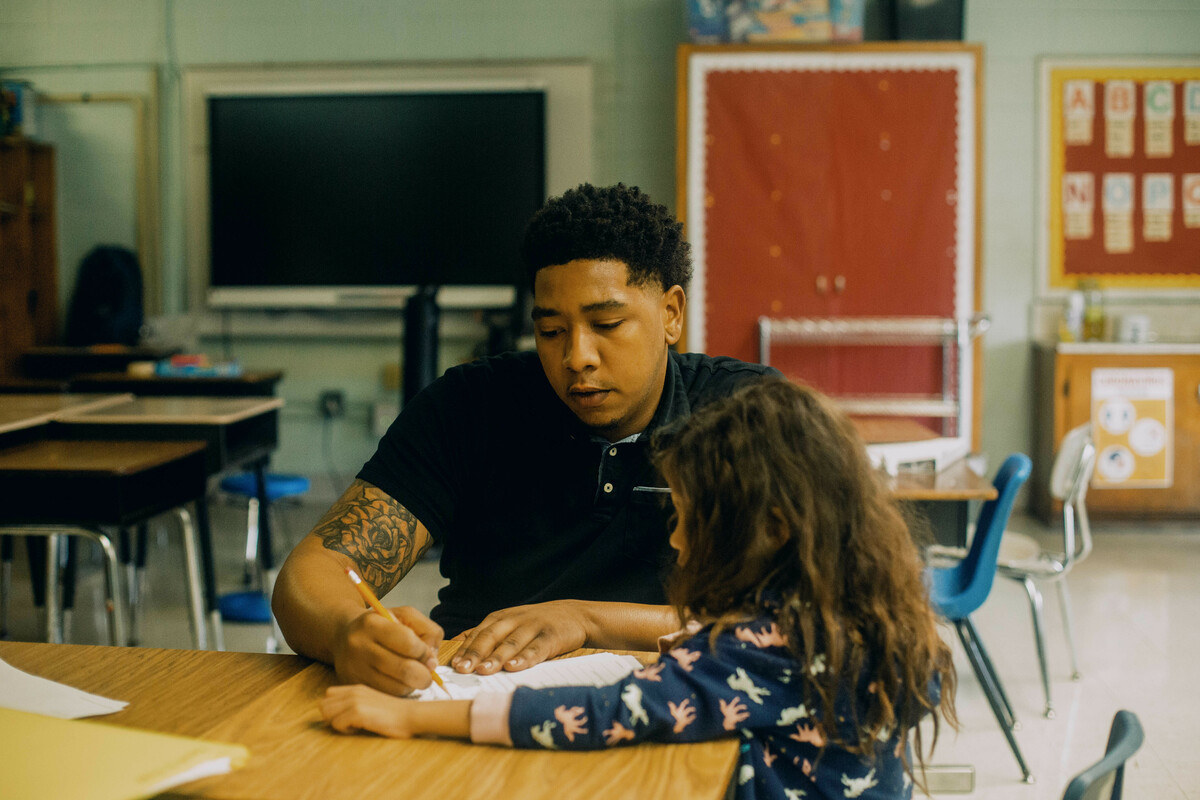
A student in Pate’s class works on a phonics lesson.
Imani Khayyam for NPR
hide caption
toggle caption
Imani Khayyam for NPR
“You don’t see too many black male teachers in elementary [school],” says Thomas, who daps up a group of boys at the cafeteria door as he walks to class. “Their father may not be here or their parents may not be getting along, so they’re not seeing their father.”
Thomas says, “I’m here for them. And I can talk to [them] about anything that [they] may be going through.”
Thomas wears a crisp black shirt, the sleeves just short enough to show his brother’s name, Jonathan, tattooed on his right arm. He’s an example of how GYO programs use incentives to reach college grads who might not have even considered teaching. He studied economics in college.
“I was still looking for accounting jobs,” Thomas says, when he heard about the Mississippi Teacher Residency. “If it weren’t for this program, I wouldn’t even be a teacher.”
But he was enticed by the idea, having seen first-hand the power of great teaching.
“I watched my mom teach growing up as a little boy. She treated other kids like they were her kids. Like, I remember being jealous sometimes,” Thomas laughs.
He says taking master’s-level classes while also working in the classroom has been exhausting, but kind of amazing. “Everything that we learned we can apply it to our classroom. Like, we’d have classes sometimes where we may learn Wednesday something we can come to school and apply Thursday.”
Eighteen full-fledged Jackson teachers have already come out of the Residency program, and about as many are on their way.
Kimberly Pate says, if it weren’t for the Mississippi Teacher Residency, she likely wouldn’t be where she is now either, in her own classroom, facing a room full of eager first-graders.
Working on a reading lesson, the children smile on the edge of their chairs, sounding out P-ai-n-t.
It’s hard work, reading. But they know they have Ms. Pate, and she isn’t going anywhere.
Edited by: Nicole Cohen
Visual design and development by: LA Johnson and Ashley Ahn
Research by: Jonaki Mehta
Audio stories produced by: Lauren Migaki
Audio stories edited by: Steven Drummond and Nicole Cohen