How games can make behavioural science better

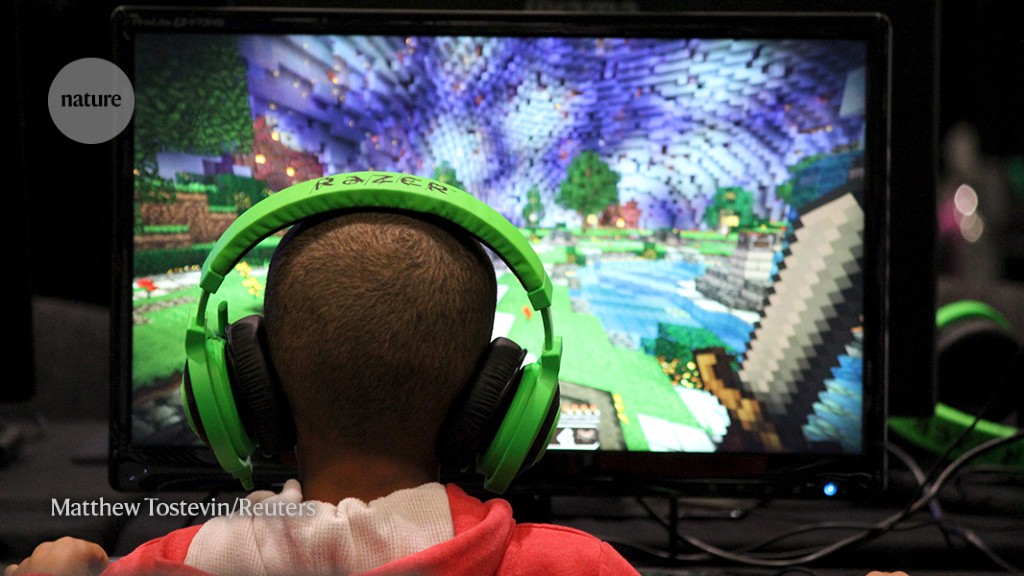
A child with headphones on in front of a monitor, plays the video game Minecraft at the Minecon convention in London, 2015.

Researchers have added puzzles to the game Minecraft to help study behaviour.Credit: Matthew Tostevin/Reuters

When US cognitive scientist Joshua Hartshorne was investigating how people around the world learn English, he needed to get tens of thousands of people to take a language test. He designed ‘Which English?’, a grammar game that presented a series of tough word problems and then guessed where in the world the player learnt the language. Participants shared their results — whether accurate or not — on social media, creating a snowball effect for recruitment. The findings, based on data from almost 670,000 people, revealed that there is a ‘critical period’ for second-language learning that extends into adolescence1.

This sort of ‘gamification’ is becoming a powerful research tool across fields that study humans, including psychology, neuroscience, economics and behavioural economics. By making research fun, the approach can help experiments to reach thousands or millions of participants. For instance, experiments embedded in a video game demonstrated that the layout of the city where a child lives shapes their future navigational ability2. Data from a digital word search showed that people who are skilled at the game do not necessarily give better advice to those trying to learn it3. And a dilemma game involving millions of people revealed that most individuals have reliable moral intuition4.

Gamification can help to avoid the pitfalls of conventional laboratory-based experiments by allowing researchers to study diverse populations, to conduct more-sophisticated experiments and to observe human behaviour in naturalistic environments. It can improve statistical power and reproducibility, making research more robust. Technical advances are making gamification cheaper and more straightforward, and the COVID-19 pandemic has forced many labs to move their human experiments online. But despite these changes, most have not yet embraced the opportunities gamification affords.

To reach the full potential of this approach, researchers must dispel misconceptions, develop new gamification technologies, improve access to existing ones and apply the methods to productive research questions. We are researchers in psychology, linguistics, developmental science, data science and music who have run our own gamified experiments. We think it’s time for science to get serious about games.

Games theory

Gamification motivates people to participate in experiments by incorporating point-scoring, competition, feedback about performance and the opportunity to learn about oneself through play (see ‘Take part in gamified research’). In early forays in 2005 and 2008, cognitive neuropsychologist Laura Germine, now at Harvard Medical School in Boston, Massachusetts, adapted psychological assessments and placed them on her citizen-science website, TestMyBrain.org. Her work showed that self-selected samples can produce high-quality data even when participants are unsupervised and unpaid5. As gamification has developed, it has united developmental psychology with computer science, web development and user-experience research to create exciting, immersive encounters for participants.

Take part in gamified research

Gamification motivates people to participate in experiments through competition, fun and the opportunity to learn about ourselves. Here are some games to try out:

Which English? A viral grammar test that tries to identify which “world English” someone speaks, as part of language research.

Are you a Super-Listener? A citizen-science experiment in which participants try to detect musical harmonies in scrambled tones.

Glyph: An online gaming applet to explore the shape of letters in the world’s writing systems.

Moral Machine: A platform for gathering a human perspective on moral decisions made by machine intelligence.

Visual Vocab: An online assessment of vocabulary knowledge across the lifespan.

Gamification can include transforming experiments into bespoke games, embedding experiments in existing games and extracting data from ongoing ones. The popular game Wordle — in a sense, the world’s largest psycholinguistics experiment — has already inspired investigations on topics such as optimization problems in active learning6 and the contexts in which people cheat7.

Participants in conventional lab-based studies of human behaviour are often few in number and WEIRD (that is, from Western, educated, industrialized, rich and democratic societies). This leads to results that are statistically imprecise or irreproducible, or that cannot be generalized to other groups.

The massive data sets enabled by gamified science can help to address questions about reproducibility and generalizability. For example, small studies had shown that a person’s experience of speaking a tonal language — one that uses pitch, or tones, to distinguish between words, as in Mandarin — alters their ability to perceive musical pitch. However, such work had been conducted largely in Mandarin or Cantonese. To explore tonal languages that are less commonly studied, Jingxuan Liu, now a graduate student at Columbia University in New York City, and one of us (S.A.M.) used data from a popular web-based quiz, ‘Test your Musical IQ’, to replicate these findings in half a million speakers of such languages, including Ewe, spoken in West Africa, and Burmese, used in Myanmar8.

Issues of reproducibility and generalizability are particularly acute for scientists who work with hard-to-reach study populations, such as children. Gamified experiments have the potential to encourage participation from children in settings such as schools or museums, rather than requiring a special trip to a lab, which only some families have the time for or interest in doing. For example, one of us (B.L.) installed a ‘Let’s Draw!’ kiosk at the Children’s Discovery Museum of San Jose in California. Children visiting the museum were asked to draw various things — such as a watch or a tiger — and then play games trying to recognize each other’s drawings. Over the next 18 months, the kiosk collected more than 37,000 drawings from some 8,000 children aged between 2 and 10, creating the world’s largest corpus of children’s drawings and showing how object recognition changes with age9.

The yellow-walled drawing station at San Jose Children’s Discovery Museum, with chairs and a desk and a computer.

A kiosk at the Children’s Discovery Museum of San Jose, California, collected drawings from thousands of two- to ten-year-olds to reveal how drawing changes systematically with age.Credit: Bria Long

Games played in the lab can also improve the robustness of data. Two of us (A.B.-L. and D.G.W.), working with psycholinguist Joe Toscano at Villanova University in Pennsylvania, wanted to study how people communicate through prosody — the patterns of intonation, pausing and rhythm that convey what information is important, as well as sarcasm and humour. The stilted conversations that participants usually produced in the lab limited these acoustic cues, and previous results on prosody were inconsistent. We designed puzzles in the game Minecraft that players had to solve by communicating while absorbed with playing. This produced more-natural dialogue and higher-quality data, showing that participants used speech intonation and duration to convey subtle information, such as whether a word was new to the conversation10.

Compared with lab-based research, online gamified experiments make it easier and cheaper to recruit diverse participants, including those from groups that are under-represented in scientific research. In a study published last year, a gamified experiment on infant-directed speech and song recruited hundreds of people who self-identified across three gender categories and a wide range of household incomes and ethnicities in the United States11. More broadly, translating a gamified experiment and distributing it globally on the Internet can help to reduce the deeply English-centric nature of behavioural-science research12.

The barriers to gamification are receding. Coding an experiment to run online used to require a lab to maintain and develop custom code. But the past few years have seen an explosion in free, open-source tools in mainstream programming languages, such as JavaScript and Python. One of the most common tools for basic human experiments on the Internet, the JavaScript library jsPsych13, was launched in 2012 by Josh de Leeuw, a cognitive scientist at Vassar College in Poughkeepsie, New York. It has been used in nearly 1,000 published papers, according to Google Scholar.

The jsPsych tool provides a means for researchers to show their participants stimuli (text, images, audio, video); to ask questions about them; to collect responses in various ways (multiple choice, free text, clicking or tapping an image); and to output data in a structured format. Most importantly, de Leeuw maintains an active user forum and GitHub repository where researchers can discuss questions and collaborate on its codebase. This and similar tools — such as lab.js, Open Sesame and psychTestR — make it straightforward for researchers to start creating behavioural experiments online (see ‘Get into gamification’).

Get into gamification

Using simple tools and making small tweaks to a gamified experiment’s design can vastly increase engagement and expand the number of participants.

• Take advantage of front-end tools. Software including jsPsych, psychTestR, lab.js and OpenSesame provides an entry point to web development and gamification. Common frameworks for data collection — such as displaying a series of images and measuring the time taken to press a button — are available by default through plug-ins. A researcher gamifying a lab-based experiment needs only this, a computer and an idea.

• Think about back-end tools. Larger-scale experiments require cloud infrastructure that can distribute them, handle data collection and scale dynamically, so that the whole thing doesn’t fall apart if your experiment goes viral. Customizable options such as Pushkin are available, although they currently require more technical expertise than do front-end tools.

• Provide an incentive. This could be points, scores or percentile ranks that allow participants to see how well they did, or to learn something about themselves. Pay participants a fair wage for long or onerous tasks.

• Keep it short. Try to restrict online games to less than 10 minutes. Some gamified experiments are even quicker.

• Help it snowball on social media. Make it easy for participants to share their results on social media — especially as an image or graph. This attracts more participants.

• Use a hook. Try adding a storyline or other form of visible progress to keep participants engaged. In one experiment on auditory perception, participants win points as they complete listening tasks to help a bird avatar stay aloft. Nearly 200,000 people have participated so far.

• Visuals matter. Putting a little effort into choosing free graphics or paying to design visuals can help to engage participants.

• Run a pilot. Before going public with your experiment, try it out on friends and collaborators. They’ll be able to tell you what works and what could be improved.

• Plan and test. Ensure you have a data-management plan for handling large influxes of data (such as MongoDB or Google Cloud Firestore) if your game goes viral.

• Collaborate and share. Developing a project with a gamification lab can benefit everyone. If you develop new functionality, add it to collaborative codebases, as happens with jsPsych plug-ins.

Ups and downs

Gamified experiments have clear weaknesses. Many scientists are used to having total control over their lab environments: they can observe participants’ behaviour directly during experiments and check that people are who they say. Critics might be wary of losing this control, or might worry that people will not engage fully with the tests or will warp results by faking their identities, completing games multiple times or participating maliciously using Internet bots.

These criticisms can be partly assuaged. Gamified studies have the potential to engage participants better than lab-based ones can, because they are intrinsically motivating. Indeed, many psychologists have observed all manner of disengagement with lab experiments, such as participants looking at social media or even taking a quick nap, because tasks are often boring and low paid. The fact that many gamified experiments have gone viral on YouTube, Reddit and other social-media platforms provides a proof of concept that participants can become deeply engaged in research — perhaps more so than with conventional approaches, although we need more data to be sure.

Creative approaches to experimental design and data analysis can also give researchers more control over gamified science than might be expected. For example, in a music study aimed at children, cognitive scientist Courtney Hilton at the University of Auckland, New Zealand, and his colleagues (including S.A.M.) studied when participants played a game and compared the distribution of local times with the times adults played. The participants were less likely to play at night, implying that they were indeed children, who are more likely to be asleep at those times14. Concerns that participants could be bots can be mitigated by comparing the timing of spikes in recruitment to known events, such as a social-media post promoting a game, and by the use of manipulation checks, which are designed to be easy for a participant to answer, but hard for a scammer or bot. Ultimately, however, some research questions are better suited to the lab. The less-controlled environments used in web-based gamified science can and should complement those of lab work.

Wordle being played on a Samsung note S9 at a desk area in front of a computer monitor.

The game Wordle has enabled investigation of the contexts in which people cheat.Credit: Claire Welsh/Nature

Another justified critique is that gamified science, when delivered online, leaves out people who lack smartphones, computers and Internet access. But it still offers an improvement on the status quo. Under-resourced communities are already at risk of being left out of lab experiments because labs are concentrated in a small number of places, and participants must spend time and money to visit them. By contrast, smartphones are becoming ubiquitous worldwide. In the United States, three-quarters of adults with household incomes below US$30,000 a year have a smartphone, according to a 2021 survey by the Pew Research Center in Washington DC. The fact that people from lower-income communities are more likely to connect to the Internet using smartphones than with desktop computers means it is a high priority for researchers to develop mobile-friendly experiments that work when Internet connections are slow or patchy.

Gamified experiments, especially large online ones, must also address issues concerning copyright, privacy, data storage and data accessibility. Data-protection and privacy laws differ across countries, and some research studies collect information (such as that on gender or income) that falls under protected categories. To preserve privacy and avoid legal issues, researchers can avoid collecting person-related data, such as IP addresses or other identifying information.

If data are collected by a third-party company in an existing game, the information can be proprietary. A data-use agreement is needed for research and to avoid conflicts of interest. Many universities have legal and ethical teams that can advise on gamified experiments, just as they do for lab ones. For example, when gamifying an experiment involving published music recordings, one of us (S.A.M.) received helpful guidance about US copyright law from Harvard lawyers15.

Four future steps

For gamification to reach its full potential, four steps need to happen. First, researchers already in the community need to coordinate their development activities to widen access to technology and share technical skills. Labs should make their software publicly available, so that scientists starting out don’t need to reinvent the wheel. Although open-science practices are becoming more widespread, thanks to platforms such as GitHub, Zenodo and the Open Science Framework, they are not yet ubiquitous. The community would benefit from pooling resources to create centralized tools and best practices for technology development, as well as running conferences and workshops aimed at increasing access to gamification and citizen-science expertise.

Second, existing tools should be improved. Many researchers use commercial software such as Qualtrics or SurveyMonkey to conduct online surveys, but no analogous software is freely available for gamified experiments. Front-end tools such as jsPsych are generally not yet optimized for mobile-friendly experiments. Back-end tools that are accessible to scientists without substantial technical expertise are uncommon — but these would jump-start scientists’ ability to produce massive-scale gamified experiments, which are still relatively rare. The scientific community should work to develop these resources, and funders worldwide should make it a priority to support these efforts. The US National Science Foundation has already called for digital infrastructure projects as part of efforts to advance reproducibility (see go.nature.com/3xi6bae).

Third, scientists need to look to professions outside research to broaden their technical toolkits. Gamified experiments that produce lots of data could benefit from the use of software and practices that are standard in the technology industry but still underused in science. These include version control using Git (a way to systematically track different versions of code) and storing data in relational databases (such as those using SQL, a language for database management that is ubiquitous in tech companies). Research labs should consider consulting or recruiting artists, graphic designers, educators and others from diverse fields who can increase the robustness of experiments by improving game design. And hiring or contracting dedicated software developers ensures that technical skills are not lost when graduate students and postdocs leave a lab group. Funders should support these essential positions.

Finally, the community needs to improve the way it dispels inaccurate impressions about gamification, which by its nature risks sounding like a diversion rather than a serious research tool. We think the best way to do so is through science itself. If gamified research continues to enable substantive scientific discoveries, the results will speak for themselves. Scientists should try out gamification on their most creative, pressing and exciting research questions.

The onus is on the community to ensure that these experiments are credible and valuable. Researchers can do so by designing studies that attract deep engagement from the public, by using robust data-management practices, by adopting analytical strategies that demonstrate the validity of gamified data and by sharing data for colleagues to scrutinize. Editors and reviewers can support these efforts by encouraging the publication of high-quality experiments.

In 1986, the sociologist Lee Sproull suggested that researchers consider “a new tool for data collection — electronic mail”. Decades after her work on what might be the earliest web-based study16, collecting data on the Internet is powerful and routine. Gamified science has not yet reached such widespread acceptance, but we think it can, should and will.

The 2022 Sweat Science Holiday Book List

“],”renderIntial”:genuine,”wordCount”:350}”>

Around this time each individual year, I share a checklist of e book solutions tied, from time to time very loosely, to the Sweat Science themes of endurance, health, science, and experience. Most of the titles are new this calendar year some were being just new to me. Possibly way, they’ll all make great gifts for the stamina nerd in your life—or for your self. (For more strategies, check out my summer season guide listing from July and very last year’s vacation listing.)

Lost in the Valley of Dying, by Harley Rustad

Lost in the Valley of Death
(Picture: Courtesy Harper)

The set-up seems a ton like Into the Wild: a restless youthful guy throws off the shackles of societal expectations, treks on your own into a beautiful but unforgiving wilderness—in this situation, a remote valley in the Indian Himalayas—and in no way returns. This is not 1992, however. Justin Alexander Shetler is a minimal social media star, balancing the lookup for indicating with the quest for Instagrammable material. And the Parvati Valley has a standing as India’s “backpacker Bermuda Triangle,” with an common of a person mysterious disappearance for each 12 months in current decades. In Rustad’s capable palms, Shetler’s tale (which he to start with explored in an Outside the house feature back again in 2018) is both a exceptional portrait of a complicated unique and an chance to grapple with additional common themes that have been all-around very long before Alexander Supertramp and however resonate these days.

Obtain The Book


The Tyranny of Talent, by Joe Baker

The Tyranny of Talent
(Picture: Courtesy 3SD Publishing)

The pendulum has swung again and forth regularly on this subject: Is greatness the consequence of the proverbial 10 thousand several hours of practice, or a reward embedded in the genes of a lucky few? Must we zero in on our foreseeable future specialty as early as possible, or flit evenly from fascination to fascination until finally we stumble on to our enthusiasm? Baker (whose do the job I wrote about a number of months ago) is a single of the world’s foremost researchers on expertise identification and development, and he pushes back from the as well-uncomplicated stories that dominate these debates. Expertise is genuine, he argues, but defining it, measuring it, and utilizing it to predict long term performance are all fraught with problems.

Buy The Guide


Consider Back again the Game, Linda Flanagan

Take Back the Game
(Photograph: Courtesy Portfolio)

If you want to realize why Baker’s reserve issues, seem no additional than this searing indictment of the current condition of youth athletics. In addition to remaining a journalist, Flanagan is a mother or father and a former superior-college cross-nation mentor, so the troubles are not just hypothetical to her. What she dubs the “youth sporting activities industrial complex” was valued at $19.2 billion in 2019—more than the NFL. The pursuit of profit, standing, and scholarships has fundamentally changed how little ones knowledge sport. It is all also effortless for moms and dads to acknowledge that there’s a trouble, but it is significantly more challenging to swim against the societal current on your own. Here’s hoping Flanagan’s ebook allows kickstart a movement.

Invest in The Book


T, by Carole Hooven

T
(Photograph: Courtesy Henry Holt and Co.)

I picked up this book, which was published in 2021, for the reason that I preferred to build a superior comprehension of the science underpinning debates about the participation of athletes who are transgender or have distinctions of sexual growth. As Hooven will make apparent, the science of testosterone, on its personal, does not convey to us how to stability conflicting priorities of inclusion and fairness—but it does provide an essential starting off place for the dialogue. The e book was terrific for this reason, and it also turned out to be a actually interesting study about sex dissimilarities and testosterone a lot more broadly. It is a intricate and controversial topic—which is all the extra explanation to get an up-to-date perspective on the present science.

Buy The E-book


Fantastic for a Woman, by Lauren Fleshman

Good for a Girl
(Image: Courtesy Penguin Push)

The publicity duplicate describes Fleshman’s e book as “part memoir, part manifesto,” and that description is on the mark. For much more than a decade now, the former pro length runner and existing mentor, author, and entrepreneur has been a well known critic of the methods that ladies and girls are unwell-served by a aggressive athletics ecosystem made by and for guys. Consuming ailments, psychological overall health, the adjustments that accompany puberty—Fleshman has urgent messages about all of these difficulties. But she also has her very own story to explain to, and it’s a fantastic a single that makes the systemic problems she’s discussing appear alive. The reserve does not come out until finally January 10, but is offered for pre-order now.

Purchase The Ebook


Up to Speed, by Christine Yu

Up to Speed
(Image: Courtesy Riverhead Textbooks)

Also out there for pre-get (it is not out until finally Might 16) is this broader look at the science of woman athletes—a matter that has been notoriously understudied by scientists, and that Yu wrote about for Outdoors back again in 2018. This is a seriously comprehensive seem at the science that does exist, and it contained some surprises for me: the link between menstrual cycle and ACL accidents, for case in point, is additional advanced than I considered. Extra importantly, Yu does not try out to fill the latest gaps in our knowledge with pseudoscience. There’s heaps to understand about the unique activities of women of all ages in sports activities, and some issues remain unanswered—for now.

Obtain The E-book


Algorithms to Stay By, by Brian Christian and Tom Griffiths

Algorithms to Live By
(Picture: Courtesy Henry Holt and Co.)

Alright, I’m 6 yrs late to this guide, which I only picked up mainly because I was chasing a exploration direct for an posting. Neither the title nor the subtitle (“The Computer system Science of Human Decisions”) piqued my desire. It is an overview of a broad variety of algorithms applied in pc science, together with suggestions about how they might use to our each day life, which appears incredibly pressured. But at the time I commenced examining, I was hooked. Even though this wasn’t the main intention of the ebook, it served as a neat and available overview of some of the crucial developments in the previous fifty percent-century of personal computer science. And the apps to serious everyday living are introduced with a delicate contact and a sense of humor. (Now I know how laptop or computer memory units regulate the trade-off between velocity and ability applying the The very least Lately Applied algorithm, and why that usually means the stacks of papers piled on my desk are actually optimally arranged.)

Purchase The Reserve


Animal Human being, by Alexander MacLeod

Animal Person
(Picture: Courtesy McClelland & Stewart)

If you want an express Sweat Science tie-in, you will have to go back to MacLeod’s debut limited story selection from 2010, which highlighted a story called The Wonder Mile: “MacLeod’s detours into the scarier specifics of the keep track of-addict demimonde are interesting, plunging us into minds and bodies tortured in months of abuse to shave off very important tenths of a 2nd,” 1 critic wrote. Animal Human being is his 2nd selection, and the stories in it are comprehensive of sharp epiphanies and times of recognition—short fiction at its assumed-provoking finest.

Get The E book

Other titles on my radar: Ranulph Fiennes’s biography of Ernest Shackleton, obtainable this thirty day period in paperback, and the new edition of Guillaume Millet’s (French language) extremely and path operating bible. Have a fantastic holiday getaway time!


For much more Sweat Science, join me on Twitter and Facebook, indication up for the email newsletter, and examine out my reserve Endure: Thoughts, Physique, and the Curiously Elastic Limitations of Human Overall performance.

‘Promote learning of science and technology and medicine in local languages’

Director of Kuvempu Institute of Kannada Studies, University of Mysuru, Vijayakumari Karikal speaking at the Bharatiya Bhasha Utsav at the Sharnbasva University in Kalaburagi on Sunday.

Director of Kuvempu Institute of Kannada Research, University of Mysuru, Vijayakumari Karikal talking at the Bharatiya Bhasha Utsav at the Sharnbasva College in Kalaburagi on Sunday.
| Photo Credit score: ARUN KULKARNI

Expressing issue above the survival of Kannada language and its speakers against the onslaught of English, Director of Kuvempu Institute of Kannada Studies at the College of Mysuru Vijayakumari Karikal has encouraged ending the dependence on English in pursuing education and learning in science and technological innovation, medication and other fields of bigger mastering and advertising the studying of larger education and learning in local languages.

“Indian languages are wealthy in all elements. They have the capacity of speaking the knowledge of science and technological innovation, drugs and other fields to learners. They should really be designed the medium of instruction in better education. Earning indigenous languages the medium of instruction in higher education will brighten the potential of thousands and thousands of youthful students who are weak in English and robust in their mom-tongue,” she explained.

“At the very least in the situation of Kannada, it has been proved that the historical language known as ‘Kannthamil’ is the root language of all Dravidian languages, which includes Kannada, Tamil, Telugu and Malayalam”Vijayakumari Karikal,Director of Kuvempu Institute of Kannada Scientific tests, University of Mysuru

She was talking at a function at Sharnbasva College in Kalaburagi on Sunday, which was organised as aspect of the Bharatiya Bhasha Utsav to mark the beginning anniversary of the well known Tamil nationalist poet Mahakavi Subramania Bharati.

“It is not a extremely tricky process to understand bigger education and learning in indigenous languages. Quite a few writers have popularised science and engineering in Kannada and there are several guides on drugs in Kannada. Attempts need to be designed to generate textbooks in engineering and health-related training. The ancient understanding of drugs and animal husbandry is accessible in Kannada in palm-leaf manuscripts in the repository of Mysuru University,” she stated.

Disputing the well-liked idea that held Sanskrit as the mother of Kannada and other languages, Dr. Karikal explained that at minimum in the situation of Kannada, it has been proved that the historical language known as “Kannthamil” is the root language of all Dravidian languages, together with Kannada, Tamil, Telugu and Malayalam.

“Excessive dependence on English in the discipline of increased training is 1 of the explanations for the underdevelopment of indigenous languages. English should be used only as a window and not as a door to get information. Remaining very pleased of having a unique language as a mother-tongue is not a issue, but owning hatred toward other languages is. Just one learning other languages will boost one’s expertise,” she explained.

Jumpstart your data science career with these 4 free online Python courses

BY Sydney LakeNovember 18, 2022, 4:35 PM

Michigan fans watch the motion on the courtroom through the initial spherical of the 2022 NCAA Women’s Basketball Event, as witnessed in March 2022 in Ann Arbor, Michigan. (Photograph by Tim Fuller—NCAA Images/Getty Photos)

About 10 several years in the past, Harvard Enterprise Assessment dubbed details science as “the sexist position of the 21st century”—mostly owing to its new and increasing job in corporate America, and the “phenomenal” demand from customers from providers. Though the position has changed in the course of the previous ten years, the desire for details experts carries on to develop, according to a July 2022 HBR write-up. 

In reality, the number of info science work between 2021 and 2031 is anticipated to develop 36{af0afab2a7197b4b77fcd3bf971aba285b2cb7aa14e17a071e3a1bf5ccadd6db}—much quicker than all other occupations, according to the U.S. Bureau of Labor Statistics (BLS). Not only is the desire for these work superior, but salaries also go on to maximize. The median fork out for facts scientists in the U.S. is a lot more than $100,000, BLS figures display. Some facts scientists—especially all those with a master’s degree—can receive much more than $200,000, Glassdoor shows.

One particular way to start pursuing a occupation in data science is to commence with the principles: programming. A frequent programming language is Python, which is typically applied for internet site and software package progress, automation, and details analysis and visualization. 

Even if you don’t intend to become a details scientist or knowledge analyst, Python is a handy skill to know. As the workforce will become significantly targeted on technological advancement and electronic transformation, it’s imperative for teams of combined knowledge to be able to converse efficiently. Studying programming is these kinds of a important skill, in fact, that Columbia Small business School, which is rated as a top rated small business faculty by Fortune, launched Python classes to its MBA pupils. Whilst MBA graduates do not necessarily need to have to become a full-time programmer or details science after earning a diploma, the skillset interprets very well for workforce collaboration, points out Costis Maglaras, CBS dean.

“Maybe they’ll code a minor bit it’s possible they’ll be a tiny bit extra savvy with facts,” Maglaras advised Fortune in a modern job interview. “But all of them will have to collaborate in all probability with people today that write code.”

Irrespective of whether you’re fascinated in pursing a info-centered profession or are looking to become a greater team participant, Fortune has compiled a record of free of charge on-line Python classes hosted at best-ranked universities.

Harvard University

Harvard University, which Fortune ranks as possessing the best complete-time MBA software in the state, hosts a no cost on line class referred to as Introduction to Programming with Python, which will help contributors discover the basics about the programming language. Contributors will stroll absent remaining ready to read, produce, examination, and debug Python.

The nine-7 days training course requires amongst 3 and 9 several hours for each week to entire. The self-paced program is taught by David J. Malan, a renowned computer scientist and Harvard professor. He teaches CS50 (a pc science training course), which is the biggest no cost on the internet program provided at Harvard with 3.5 million registrants.

College of Michigan

For men and women who want to take several on the net classes similar to Python, the University of Michigan offers a Python for Most people specialization, which includes five classes associated to the programming languages. The specialization begins with Programming for Most people (Acquiring Started with Python), an intro training course that can also be taken on its possess. The study course addresses the basics of the programming language, and the remaining lessons in the specialization build on what is learned in the first training course such as Python information buildings, making use of Python to accessibility world wide web knowledge, and utilizing databases with Python.

The specialization can take about eight months to full.

MIT

MIT, just one of the most renowned tech-focused schools in the country, offers a free of charge on the web training course Introduction to Computer system Science and Programming Making use of Python in which learners are uncovered to the programming language and also discover how to take a look at and debug. The class also addresses subjects which includes details structures and straightforward algorithms.

The course is the first in a two-course sequence (the next remaining Introduction to Computational Thinking and Info Science), which are both meant for learners without any computer science history or instruction. The study course can take just 9 months to complete, but requires about 14-to-16 hrs of work for each week.

University of Pennsylvania

Java is yet another frequent programming language for people today who are just obtaining an introduction to personal computer and data science. The College of Pennsylvania offers a no cost on the net specialization in Python and Java for beginners known as Introduction to Programming with Python and Java. The 4-system sequence introduces end users to equally programming languages, and also goes into knowledge examination and details structures.

This novice-amount specialization normally takes about four months to full, and participants receive a certificate upon completion. The program is taught by Brandon Krakowsky, a lecturer with Penn Engineering and also incorporates an used studying job in which students compose thoroughly practical Python plans. 

Check out out all of Fortune’s rankings of diploma programs, and learn a lot more about specific career paths.

State delays public release of English, math and science test score results to later this year

Credit history: Alison Yin/EdSource

In a substantial departure, the California Department of Training is withholding the launch of the final results of the Smarter Balanced tests that pupils took final spring right up until an undetermined day afterwards this calendar year. The result will be a monthslong delay in advance of the public can watch outcomes in English language arts, math and science for the point out, districts, universities and constitution faculties.

The denial of EdSource’s ask for to launch exam score information arrives at a time when educators are involved about the pandemic’s impression on looking at and math progress, primarily in the early many years. Releasing scores “later this year” signifies that the community will learn about spring check outcomes for third-graders who are now nicely into fourth grade.

The California Division of Schooling told EdSource that it is withholding the scores now, so they can be at the same time produced with other data for the California University Dashboard, such as student absentee costs, suspension charges and costs of persistent absenteeism. The dashboard provides a detailed glimpse at college and district metrics, damaged down by college student demographic groups. The details is utilised to determine which minimal-executing districts demand condition support.

The state has not mentioned when it programs to release the current dashboard, but if it is launched right after Nov. 8, the Smarter Well balanced outcomes won’t surface as an election calendar year challenge – both of those for neighborhood college board races and for Point out Superintendent of General public Instruction Tony Thurmond, who runs the California Office of Education and is experiencing re-election this yr. Thurmond did not comment on the take a look at scores release date. That up to date dashboard has been unveiled involving November and January in previous a long time. 

Mary Nicely, main deputy point out superintendent for instruction, claimed that the condition board established the goal in 2017 for a extensive method that would include combining the launch of point out take a look at scores and other metrics with the up-to-date dashboard. “We are on track to release the facts as we did previous yr. If we can arrive out sooner, we will,” she said. “We are not withholding anything individuals are doing the job tricky to finalize the details.”

Thurmond opponent Lance Christensen, when notified by EdSource about the state’s refusal to release the scores, claimed, “The actuality that the department is not keen to publish now implies that scores will be decrease and the recent point out superintendent does not want to be held accountable for the success.” 

The condition refused to release the examination rating effects to EdSource even with an Aug. 5 letter to districts, county offices of schooling and constitution educational facilities telling them the benefits were being “not embargoed” and they “are encouraged to use their results for community scheduling, such as community meetings with their area governing board.”  Maria Clayton, director of communications for the California Office of Training, recurring in a Sept. 1 email to EdSource that the final results were “not embargoed.” Districts have furnished scores of person learners to moms and dads, and several districts, together with Los Angeles Unified and Palo Alto Unified, have introduced their benefits to the community.

EdSource, via its attorney, sent a letter to Training Section officers Wednesday requesting fast reversal of that denial.  “EdSource considers delay tantamount to denial as it efficiently robs the general public of its critical purpose in overseeing the CDE and unique districts and in holding both equally accountable to its learners and the community. This is primarily significant in the course of what continues to be one of the most hard and impactful periods to our instructional system thanks to the COVID pandemic,” wrote EdSource lawyer Duffy Carolan, of the regulation organization Jassy Vick Carolan. 

The five-site legal examination challenged CDE’s determination to withhold the check scores “…the CDE can’t identify any ‘public’ fascination in non-disclosure that could justify its denial place, enable on your own an desire that ‘clearly outweighs’ the significant community interest in accessibility to this information.”

Earlier this month, EdSource filed a request under the California Public Information Act, with the California Section of Instruction for the 2022 benefits, which include the breakdown by student groups. EdSource has per year analyzed the info, so the general public can appear up a school’s scores and how it compares to other educational facilities. The last complete 12 months of success is for the 2018-19 university 12 months.

“The condition simply cannot converse out of each sides of its mouth” by supplying districts information that reveals their examination outcomes and then refusing to release the all round information set, mentioned David Loy, lawful director of the To start with Amendment Coalition, a San Rafael-primarily based open up govt group.  There are no exemptions in the regulation that allow the federal government to withhold documents from the general public simply because they are “inconvenient or embarrassing,” he said.

Considering the fact that California first released Smarter Well balanced scores in 2015, the Education Department has continuously introduced them independently and faster than the other dashboard knowledge. Dates ranged from the last week in August by the initially 7 days in Oct. The exception was the 2020-21 school 12 months, when final results ended up introduced in January 2022 with dashboard indicators. Since of the pandemic, districts experienced a preference of offering neighborhood assessments or the Smarter Well balanced exams districts with enrollments totaling fewer than a quarter of the state’s learners selected that option and the resulting details was “limited in both equally scope and use,” the section claimed in a news launch at the time. No examination was presented in 2019-20 for the reason that of the pandemic.

Janet Weeks, director of communications for the Point out Board of Training, claimed that the board agreed that the Smarter Balanced success would be launched at the same time with the current dashboard.

In its Sept. 12 denial, Clayton explained the information was not but all set for release simply because it “is even now going through a critique and validation approach by the CDE and the area instructional businesses.” A premature release of statewide success “could mislead researchers, policymakers and the basic public” and “thus be detrimental to the public’s curiosity.”

Primarily this yr, pushing again disclosure has ramifications. Dependent on countrywide data, the National Assessment of Educational Development, and the benefits of Los Angeles Unified, which did launch its 2022 scores this thirty day period, the success are expected to demonstrate record declines, in comparison with pre-pandemic 2018-19.  Analysis has demonstrated that scholar finding out was impacted by distant finding out adopted by a chaotic calendar year underneath Covid. Districts are obtaining historic concentrations of state and federal funding to bridge the gaps.

“Districts are engaged in several organizing processes correct now to establish how to devote investments to strengthen teacher supports and college student mastering,” stated Christopher Nellum, executive director of Schooling Have confidence in-West, a scholar advocacy team. “Delaying this data threatens to hinder engagement as effectively as the efficiency of the investments the state has created in latest a long time, like resources to deal with impacts of the pandemic.”

 There is an essential to react expeditiously, explained the Middle for Reinventing Public Instruction in a report issued this thirty day period. “The tutorial, social, and psychological-overall health wants are actual, they are measurable, and they should be addressed immediately in purchase to prevent lengthy-phrase penalties,” guide authors Robin Lake and Travis Pillow wrote.

 Waiting until later on this 12 months to launch how college students scored final spring will delay essential general public conversations on how districts need to respond to severe setbacks in finding out which includes shifting funding promptly and following summer to accelerate mastering. The timing is specially troubling for educators in early literacy, as the state copes with a reading crisis. Only 48.5{af0afab2a7197b4b77fcd3bf971aba285b2cb7aa14e17a071e3a1bf5ccadd6db} of 3rd-graders analyzed at quality level or over in English language arts for the duration of the 2018-19 faculty yr, prior to the pandemic stalled all learning.

 Districts have had original accessibility to their very own Smarter Balanced take a look at outcomes considering that early summer season and trusted info considering that early August. Quite a few superintendents agreed there is benefit and urgency in sharing both equally person districts’ and statewide facts, numerous superintendents agreed.

“As the most significant public school district in California, Los Angeles Unified urges the condition of California to expedite the entire release of take a look at scores yearly to notify the neighborhood and help the district to get fast motion to meet the desires of our most vulnerable, at-risk student populations,” explained Superintendent Alberto Carvalho when releasing district details on Sept. 9. 

Parents and districts also benefit when they can look at their possess scores with statewide and encompassing district and constitution college results, stated Christensen. “Districts want to get details from other districts — to who is executing what and, search for out finest techniques,” he reported.

Gilbert Magallon, spokesperson for Central Unified Faculty District in Fresno, explained evaluating results is handy.  “We price receiving details on similar districts and request to master information that may well be advantageous as we try to increase students’ academic outcomes.”

Palo Alto Unified produced partial outcomes of Smarter Balanced benefits — for third grade English language arts  — in a report to the neighborhood on Sept. 9 demonstrating impressive gains for all university student groups. The rest of the success will be launched this 7 days, claimed Superintendent Don Austin.

 “Since early literacy was our predetermined goal, it designed sense,” Austin explained. “Our math scores do not glance as potent. We really don’t have any context for the scores throughout the point out. With out observing the scores for everyone, we are guessing if our scores have been great, negative or in concerning.”

Receiving scores out as soon as permissible is not only seem plan but, civil liberties lawyers say, is expected by the condition law governing the launch of general public documents, the California Community Data Act.  

Because the Aug. 5 letter to districts, the section also has sent contradictory messages, telling districts not to publicly release the scores a few districts contacted by EdSource have offered them to their boards, and other folks mentioned they system to do so in Oct.

On Sept. 15, EdSource sent a Public Records Act request to the state’s 30 biggest districts, requesting their Smarter Well balanced effects. Aside from Los Angeles Unified, which previously experienced produced a summary of its success, only two districts so much have responded with scores: Sacramento Metropolis Unified and Lodi Unified. As with LAUSD, the scores showed substantial drops in math and English language arts in contrast with 2018-19.

After acquiring the EdSource request, Anaheim Union Substantial University District contacted the California Section of Schooling. The reaction from the ETS’ California Outreach Workforce on behalf of the office was unequivocal: “The embargoed success are for LEA (neighborhood academic location) use only they should really not be shared with the community. The general public launch of the data is heading to be available afterwards on this yr.”

Districts have also been given communications from the section that details remained in a preliminary/draft status for districts, and statewide knowledge is not yet closing. Kelly Avants, the spokesperson for Clovis Unified Faculty District, said Clovis interpreted that as “the data need to proceed to be treated as embargoed.” 

She reported the district is scheduling a general public workshop in November when the knowledge will be community.

EdSource reporters contributing to this story:  Carolyn Jones, Ashleigh Panoo, Diana Lambert, Ali Tadayon and Daniel Willis.

To get a lot more stories like this 1, click on listed here to indicator up for EdSource’s no-value day by day e mail on most current developments in training.