4 ways all online university courses could promote student mental health

A single quarter of to start with-year university college students in Canada self-declare that they have a incapacity. Among the all those, mental-health and fitness-connected disabilities are the most prevalent. Each yr, a lot more students with self-declared mental-well being challenges enroll in publish-secondary establishments.

At the exact time in Canada, additional learners are having on line programs, specifically in reaction to the COVID-19 pandemic. For college students with disabilities, on the internet discovering may be the most effective choice to pursue submit-secondary education.


Read through additional:
Do university college students want a lot more on the internet understanding, publish-pandemic? Here’s what some selected right before COVID-19


My doctoral study explored many influences that have an affect on mastering for publish-secondary learners with mental-wellbeing-associated disabilities who are learning on the web, drawing on the views of college students, instructors and university student guidance staff.

A woman sits at a desk using a laptop.
For some pupils with mental-well being similar disabilities, online finding out might be the greatest option for post-secondary schooling.
(Pexels/Ketut Subiyanto)

Study course perform is central to college student practical experience

To get a photo of the range of influences on studying, I categorized influences on finding out as unique (for instance, enduring symptoms of psychological disease), inter-particular (interactions with instructors and friends) and institutional (components like accessibility of course information and student solutions).

My analyze results suggest on the web understanding spaces should to be inclusive and obtainable, and that they can be critical places for marketing psychological overall health for learners.

Although the post-secondary expertise is not all about training course get the job done, finishing assignments, crafting examinations and attending lectures is a huge section of students’ daily lives.

This tends to make academic classes primary community forums exactly where instructors can boost psychological health and fitness by sharing mental health and fitness resources (providing details about student psychological well being providers) and by building obtainable and versatile courses.

Universities’ commitments to properly-staying

There are numerous alternatives to make submit-secondary institutions extra accessible, inclusive and wellbeing advertising.

What is known as the Okanagan Constitution is an worldwide constitution that outlines language, rules and framework that article-secondary establishments must use to boost well being and perfectly-remaining. Forty-4 Canadian article-secondary institutions have taken up elements of this constitution as part of the Canadian Well being Advertising Campuses Network.

Movie about the Okanagan Charter.

Simon Fraser College, for illustration, has areas for motion for advertising psychological wellbeing like:

What students want

Students in my study were being requested: “What advice would you give to your professors/instructors (instructing on line courses) to facilitate inclusive and supportive discovering environments for college students with psychological-wellness-linked problems?” Pupils recommended the following:

1) Use components of universal design and style for finding out to present accessibility for all students whilst also advertising mental health and fitness. For example, recording lectures can make improvements to student engagement by getting concerned with maximizing pupil autonomy and person alternative whilst giving many means to entry program materials and decrease pressure. Pupils stated:

“Online learning has been excellent for my mental overall health. It has permitted me to perform around periods of time that I have experienced key temper concerns. If I’m emotion genuinely down one day, considering the fact that matters are recorded, I can just go again when I’m emotion much better and actually attend the course.”

“When you are at a level in which you just can’t pull yourself out of the residence or go to course, owning a recorded course that you can go around is really beneficial.”

A person seen silhouetted sitting at a computer.
Mastering about mental health literacy will support instructors design their classes with flexibility and accessibility in mind.
(Gabriela Campos/Santa Fe New Mexican by means of AP, File)

2) When possible, give flexible because of dates for assignments for all college students. Possessing to request for extensions can be tricky for college students who are presently encountering the adverse results of psychological-well being-similar stigma.

3) Pupils continually claimed they are juggling several priorities (academics, employment and spouse and children) and taking care of tension with diversified ranges of assist. They required instructors to know that inevitably, there will be periods when they require support and they would like compassion from instructors. They want instructors to have an understanding of their need for flexibility does not indicate absence of a function ethic.

4) Master about psychological wellness literacy. Discovering about frequent mental health problems and how mental wellbeing has an effect on studying will aid instructors use teaching approaches that centre overall flexibility and accessibility.

Placing the stage for wellness

The final results of this study propose that on line classes can be designed to be obtainable and to encourage mental wellbeing.

With increasing numbers of college students researching on line, numerous of whom have mental-well being-linked disabilities, it is crucial that educators integrate accessibility and mental-health and fitness promotion into course style. Classes that are built to be available and to boost psychological wellness established the phase for studying and wellness.

As the shift toward on the net educating and learning carries on, educators have to comprehend the vary of influences on learning for students with mental-health and fitness-relevant disabilities to present equitable and obtainable finding out environments the place all learners can get to their tutorial ambitions.

COEHS student earns national physical education award: UNM Newsroom

1 University of New Mexico pupil is getting recognized as the blueprint for the long term of wellbeing and physical education.

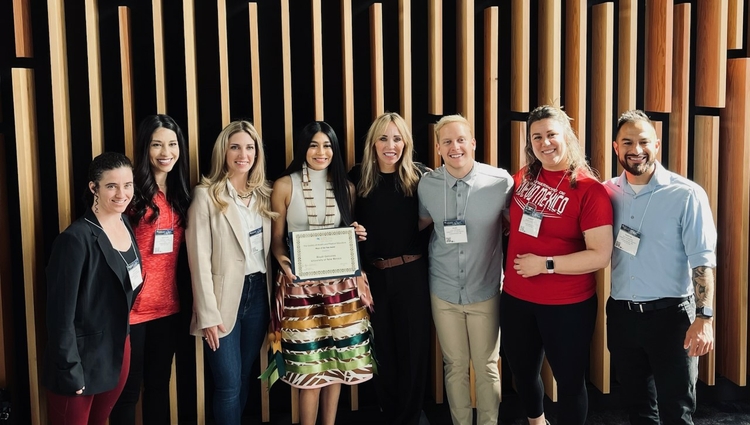
Junior Bodily Training university student Aliyah Gonzalez has been named a Main of the Year by the Modern society of Overall health and Bodily Educators (Condition). 

The award celebrates superb undergraduate college students in the health, bodily schooling, recreation, and dance professions who are nominated by a school advisor or professor. Gonzalez was regarded recently during the 137th Nationwide Conference & Expo, Main of the Calendar year Ceremony, in Seattle, Wash.

“The remarkable achievements of long term professionals like Aliyah Gonzalez are integral to the long term of Form The us and our career,” Condition The us President Kymm Ballard reported.

She was nominated by Depart​ment of Overall health, Exercise, and Sport Sciences Assistant Professor Victoria Shiver, which also gave the Higher education of Training & Human Sciences (COEHS) the chance to fund her journey to the meeting.

“Aliyah has stood out as a driven long run skilled, a chief within her cohort, and an advocate for actual physical education to be of the optimum quality for all,” Shiver mentioned. “It was a collective determination to choose Aliyah throughout all of the college in the bodily instruction teacher schooling software.”

Aliyah receives award

It is no compact feat for Gonzalez to make this award, or to show up at this meeting. Shape is the nation’s major membership organization of health and fitness and bodily education specialists, and has guided countrywide expectations and actual physical education given that its founding in 1885.

“Aliyah was able to be completely absorbed into discovering for the full week, acquire her award for the duration of an award ceremony with other esteemed majors from universities close to the nation, and network with future collaborators all operating towards the similar vision: high-quality physical schooling,” Shiver reported.

Gonzalez was thrilled to show up at and acquire every thing in.

“SHAPE was this sort of an astounding knowledge stuffed with lots of information I was capable to take in. I experienced the opportunity to network and fulfill so several new men and women throughout the region,” Gonzalez reported. “One of my favorite moments from that week was functioning collaboratively with other peers to give and boost high top quality bodily education and learning.”

Aside from standing out to COEHS college, Gonzalez previously has produced large-scale changes within Form. She spoke out in Shiver’s course, expressing a person element of SHAPE’s policy doc was not inclusive, which led to its improve.  

“Being recognized with the Important of The Calendar year Award was an unbelievable moment. There are no words to describe how honored I am to be able to receive this award from Form America,” Gonzalez said. “By receiving this award, it motivates me to proceed my difficult work and perseverance to deliver substantial-high quality actual physical education and learning.”

Gonzalez says she could not have realized this with out the aid of her previous, and the long term.

“Being a Navajo lady, this goes to exhibit the resilience we have in my neighborhood. To the youth just like me, go on your instruction since it will guide you to superb achievements that will consider you to even larger spots,” she claimed. “Huge thank you to Tori Shiver for nominating me along with the relaxation of the PETE school. You all thrust me to attempt for greatness. Most importantly thank you to my parents and relatives for supporting me along this journey.”

Spokane Falls student and ‘big dreamer’ from Madagascar taught himself English to pursue American education

Rising up in Madagascar, Tongasoa Jefferson Julianot Rakotomalala started off dreaming at just 14 decades old of finding a school instruction in the United States.

He lived in poverty in the town of Moramanga. No a person in his household concluded higher university , and they discouraged him from continuing his education.

span”One day, I’m going to be on that aircraft,” Rakotomalala would say when he observed planes go by. /span

Identified, Rakotomalala focused on discovering English – mostly self-taught – and surrounded himself with Madagascar residents who experienced researched in the U.S., together with American guests. By way of them, he absorbed data about U.S. lifestyle .

He took English proficiency tests approximately a 50 percent dozen times, unable to rating large adequate for entry into U.S. colleges, right until anyone from the Local community Schools of Spokane proposed the LanguageCert exam. He passed, getting entry to Spokane Falls Local community College and started his studies in business enterprise administration.

Previously this calendar year, Rakotomalala turned the initial to win a $1,000 Community Schools for Worldwide Advancement scholarship from LanguageCert.He went to Washington, D.C., in February to get the honor at the LanguageCert meeting. His speeches still left audience associates in tears.

Currently, he smiles as he shares the struggles, faith and past-minute assist that bought him below.

“I am a massive dreamer,” explained Rakotomalala, who claimed mainly goes by Jefferson due to the fact arriving in Spokane in September.

In Moramanga, Rakotomalala went to faculty by day and put in evenings at Starlight English Finding out Centre for 1 year of language studies. He graduated from higher faculty in 2019 and continued researching English on his individual. Rakotomalala knew he had to move a language proficiency test to get into a U.S. school.

He then moved to the funds, Antananarivo, and stayed with a pal, Jacobin Ainatsiferana, also a Madagascar native who speaks English and inspired Rakotomalala to pursue his education in America.

“I moved to the cash of Madagascar and then self-taught about there training English with close friends,” Rakotomalala said. “I utilised my cellphone. I listened to songs, looking at some YouTube movies and speaking with a lot of Us residents.”

A friend’s sister recommended he use to Spokane Community College or university.

Rakotomalala laughs now about how he accidently utilized to SFCC instead. But he was inspired when an email arrived back again from Amber McKenzie, the Community Faculties of Spokane assistant dean of world wide training.

“Amber begun replying to my email, and that was a source of inspiration for me like, ‘Oh, I received an electronic mail from a higher education in the U.S.,’” he explained. “I did an English (proficiency) exam 3 instances in person, and that was undesirable.”

McKenzie stated via talking on Zoom, she knew his English-talking competencies have been fantastic. She admired his dedication.

“I’ve been in this field 25 several years, and I have under no circumstances experienced a college student inquire from Madagascar,” McKenzie mentioned. “He’s possibly a person of the most remarkable worldwide students I’ve witnessed, just from the place he’s occur from to where by he is now. I just cannot feel the fortitude and his ability to get this considerably.”

After getting weak language take a look at scores in the to start with handful of rounds, he experimented with again with an on the net examination. He scored just a handful of points underneath what he desired to be recognized at SFCC.

“I had to keep up all night time to do it,” he reported. “I was a few factors away from getting acknowledged. I questioned Amber, ‘Is there any way you could help me? I truly want to go to college or university. I want to make a big difference.’”

That plea was timely, mainly because McKenzie had just figured out of the new language proficiency examination as a result of LanguageCert, alongside with coupon codes toward the test’s price tag. Rakotomalala grabbed the opportunity, once more likely on-line to consider what is named the Global English for Speakers of Other Languages check.

But Madagascar is known for recurrent electrical power outages. As he entered the take a look at, the electric power died, and his close friend had to help him locate transportation to get someplace he could resume the test. Inspite of the interruption, Rakotomalala passed.

“I bought a fantastic score, then I despatched it in this article and I got approved below,” Rakotomalala said.

It was not an uncomplicated route from there, but as a Christian, Rakotomalala credits faith for acquiring him through.

“In my life I say that, 1{af0afab2a7197b4b77fcd3bf971aba285b2cb7aa14e17a071e3a1bf5ccadd6db} from me and 99{af0afab2a7197b4b77fcd3bf971aba285b2cb7aa14e17a071e3a1bf5ccadd6db} from God,” Rakotomalala mentioned. “God did it. He aided me to connect with individuals.”

He attended Camp Fihavanana in Madagascar, which aids youthful pupils choose accountability in everyday living. There, he met an American who supplied to sponsor his service fees to analyze at SFCC. Rakotomalala had served at a Christian group, Cornerstone, where by individuals heard his tale.

Cornerstone designed a movie sharing Rakotomala’s tale and Hanta Ramakavelo, a popular motivational speaker in Madagascar, noticed it, featuring to link him with some of her good friends, who aided fork out for his flight to Spokane.

“That took place two months just before I left Madagascar,” he stated. “All of it appears to be impossible for my scenario, because my mother will make somewhere around $29 a month.”

The school’s worldwide support has helped him with assets and a put to stay with a host family members.

On his recent airplane flight back again from Washington D.C., LanguageCert upgraded his seat to to start with class, where he sat upcoming to an govt with the U.S. Mind Injury Alliance. He questioned Rakotomalala about his life and obtaining to college. Afterward, the person shocked him by sending him $500 for Rakotomalala to ship to his mother and other family members.

Rakotomalala isn’t finished dreaming. He wants to end his SFCC associate degree, then go to a four-calendar year college. He’d like to get a doctorate in company administration. He options to return to Madagascar to develop a company in meals conservation and transportation.

He has a few top selections for advanced degree function: Whitworth College, Japanese Washington University and one additional.

“This a single is ridiculous I’d like to go to Harvard,” Rakotomala claimed. “What I’m hoping to establish in daily life is it’s not all about dollars it’s about religion. You perform difficult and you serve. That’s what I like the most. I never just want to consider. I want to give. I want to provide. I want to go again to Madagascar.

“That’s my intention – to analyze, get the awareness and serve, because if I by no means go back, what is the rationale for persons supporting me? Good results is not I. Good results is we.”

What to know about active learning and college student identities

Fifty-five percent of students say a teaching style that didn’t work for them has impeded their success in a class since starting college. That makes it the No. 1 reported barrier to academic success in the recent Student Voice survey of 3,004 undergraduates on academic life, conducted in January by Inside Higher Ed and College Pulse. Here’s a breakdown of which students feel especially impacted by teaching style, why they may see this as a barrier and how active learning can help.

Disproportionately Dissatisfied

Among students with learning disabilities or related conditions (n=650):

  • Teaching style is still the top reported barrier—with the share of students flagging it soaring to 67 percent. Of these students who intend to graduate within the standard time frame for their institution type (two or four years), the share is larger still: 70 percent.
  • There is a strong desire for professors to experiment with different teaching styles. Fifty-seven percent of these students, versus 50 percent of those without learning disabilities or related conditions, express that professors mixing things up would help. Some five in 10 think that professors being more flexible about attendance and/or participation would promote their academic success, compared to four in 10 for all respondents.

Different demographic, similar story: Relatively more LGBTQIA+ students (n=899) cite teaching style as a barrier to academic success than do their straight peers, at 60 percent versus 53 percent, respectively. And LGBTQIA+ students are likelier to say they want professors to be more flexible with participation and attendance, at five in 10 versus four in 10.

Inside Higher Ed Careers

Search over 40,000 Career Opportunities in Higher Education
We have helped more than 2,000 institutions hire the best higher education talent.

Browse all job openings »

Another consideration is mental health. Both LGBTQIA+ students and those with learning disabilities and related conditions are likelier than other subgroups to cite mental health struggles as a barrier to academic success: nearly six in 10 LGBTQIA+ students compared to three in 10 straight students and nearly six in 10 students with learning disabilities compared to three in 10 respondents without such conditions.

Breaking Down the Concern

What are students really saying when they object to teaching style? Students who cite teaching style as a barrier to a success are more likely to name overly difficult material or exams as another barrier (58 percent versus 49 percent for the whole group). So students may associate teaching style with how hard a class is or isn’t.

But students with teaching-style concerns are significantly likelier than the group over all to say they want their professors to experiment with different teaching approaches, too. This suggests that students concerned about teaching style are balking at instructional strategies at least as much as at perceived difficulty. (And this is only amplified for students with learning disabilities and related conditions, who, again, are already more likely to report mental health struggles as a barrier to academic success.)

Which instructional strategies? Research suggests that conventional lecturing remains the dominant instructional approach in higher education, especially in the natural sciences, where many of the studies on active learning are happening.

So it stands to reason that students in the recent Student Voice survey are at least partly rejecting conventional lecturing. Preliminary data from a new Student Voice survey of 1,250 undergraduates somewhat support this idea: the largest share of students (36 percent) say they prefer an interactive lecture—in which the professor breaks at least once to ask students to complete a specific learning task related to the material—over other class formats, including the traditional lecture. (Full results of that survey are coming soon.)

The Active Learning Link

What’s a better approach than traditional lecturing? The literature offers a clear answer: active learning.

Roughly defined, active learning is instruction that demands students actively participate in the knowledge-making process. Active learning exists on a spectrum—from a single interactive moment during a professor-centered class period to an entirely student-centered experience in which the instructor facilitates learning among peers. Examples of active learning strategies include:

  • Classroom debates
  • Class polls
  • Case studies
  • Think-pair-shares
  • Individual reflection
  • Just-in-time teaching

How students feel about active learning is a bit complicated. Anecdotally, many students find traditional lectures to be less than engaging. But active learning can defy students’ expectations of what’s required of them in a college class and push them out of their comfort zones. One widely cited 2019 study on active learning led by physicist Louis Deslauriers of Harvard University found that students in an active learning classroom felt like they were learning less but actually learned more than students in a lecture-only class—something Deslauriers and his colleagues attributed to the increased cognitive effort required during active learning.

Yet however students feel about active learning, study after study demonstrates that students learn more from active learning than from lectures—and that the positive effects of active learning are especially pronounced for historically marginalized groups.

“Sustained lecturing, or a chalk-and-talk approach, continues to be the dominant mode of instruction across all subject areas—which, as the survey data strongly indicate, leaves more than half of learners behind,” says Thomas J. Tobin, a teaching and learning consultant and founding member of the University of Wisconsin at Madison’s Center for Teaching, Learning & Mentoring. “The survey data about the perceived fit of instructor methods underlines a challenge that we’ve known about for a long time: our teaching methods have long been out of step with the learning needs of our students.”

Experts therefore recommend using active learning strategies to reach students dissatisfied with current instructional approaches—with some major caveats about sensitivities to student identities.

Inclusive Teaching

Sara Brownell, a professor of life sciences and director of the Research for Inclusive STEM Education Center at Arizona State University, studies how to make science learning environments more inclusive, with a focus on concealable, stigmatized identities. These include LGBTQIA+ identities and learning disabilities and related conditions. Brownell and her colleagues have found, for example, that:

  • Students say clicker-style questions and group work during active learning can both increase and decrease their anxiety, based on how they’re used. Meanwhile, students say that cold- and random call–type questions only increase anxiety, based on fear of negative evaluation by peers.
  • Active learning classes make students’ LGBTQIA+ identities more relevant due to increased interactions among students during group work, with implications for student learning.

How Sara Brownell, a professor at Arizona State who studies how to make science learning environments more inclusive, makes active learning inclusive in her own large classes: 

  • She surveys students about their identities at the beginning of the semester and shares anonymized patterns with the class, so that students with, say, mental health concerns, know they’re not alone.
  • She uses what’s referred to as instructor talk, or non-content-specific language, to create a positive classroom culture and demystify some of her pedagogical choices, including her belief that group work builds students’ skills.
  • She gives students name tents (paper name placards) so that she and they know each other’s names and, where they feel comfortable, pronouns.
  • She gives small groups an icebreaker during active learning, such as directing the student with the longest hair in the group to speak first. And she travels around the classroom to speak with students and collect worksheets so that no one has to yell out an answer to the whole class.

Variety, flexibility and compassion underpin Brownell’s approach to active learning. “I’m a huge proponent of active learning, but our guiding hypothesis is that with active learning, we’re changing the dynamics of the classroom,” Brownell tells Inside Higher Ed. “So for different student groups that haven’t necessarily been explored through the lens of active learning, we’re starting to see issues for them. That doesn’t mean we want to throw active learning out the window. That doesn’t mean we want people to go back to traditional lecture. It means we need to be much more thoughtful about how we’re teaching using active learning.” Actions include, Brownell says:

  • Using different active learning strategies so that all students get used to a variety of experiences, some of which they may prefer over others.
  • Giving all students worksheets during group work, to promote engagement and discourage any one person taking over.
  • Giving students the option of working with each other or working independently when they need a break.
  • Incentivizing attendance via class credit, but building in “a certain number of drops, because life happens.”
  • Normalizing mental health being as important as physical health by indicating support and being “kind” when things come up.

“I let my students know at the beginning of class that my goal is for them to succeed, and I am going to work as hard as I can to get them to learn the material,” she adds. “We know that feeling like the instructor cares is so important to student success.”

‘Listen to Students’

Dynamic teaching can work for neurodivergent students, with some clarifications, says Liz Norell, an associate professor of political science at Chattanooga State Community College and faculty developer who identifies as neurodivergent. Autistic students might have sensitivities around noise levels, lack of predictability or forced social interactions, for example. So options surrounding participation, such as “back-channel” ways to contribute class discussions, matter.

Norell has found that her students are most enthusiastic about learning when she’s given them more control or agency over their learning—namely, the work they’re completing and how it’s shared.

“A lot of this evolution in my own teaching has come from embracing [Universal Design for Learning] and backwards design—focusing really intentionally on what skills students should have when they leave a class I’m teaching and then imagining, in the broadest terms possible, how they might achieve those skills.”

Norell adds an important clarification on identities and diagnoses: that many students have mental health issues or are neurodivergent, “but haven’t had the resources or opportunities for formal testing or diagnosis and hence cannot get official accommodations from the school.” In this and other respects, she says, it’s important to “listen to students.”

Faculty developer Karen Costa, who is currently writing a book on supporting college students with attention deficit hyperactivity disorder, agrees that the accommodations model of higher education translates to a “huge population of students who need support who just aren’t getting it.” Accessibility should be “in the water,” or the norm, not the exception, she says.

Costa adds this: “Higher ed executive leaders are guided by enrollment numbers yet fail to see the connection between designing for accessibility and student persistence, strangely. The hold of the power structures in higher ed is very strong. Those who figure out that truly supporting students and faculty by redesigning our work for the students, faculty and staff we have now, not those of 400 years ago, will create the institutions that will survive this volatile era.”

Active (Inclusive) Learning: Good Teaching and Good Policy

In the Student Voice survey, Black, Hispanic, Asian and first-generation students were not more likely than their white peers to say to cite teaching style as a barrier to academic success, nor were they more likely to say they wanted professors to experiment with different teaching styles. Still, it’s worth underscoring that active learning has been shown to disproportionately benefit these students.

  • One study from 2014 found that a “moderate-structure” intervention increased course performance for all students, but worked especially well for Black and first-generation students, halving the Black-white achievement gap and closing the achievement gap with continuing-generation students.
  • Another meta-study from 2020 found that active learning benefits all students but offers disproportionate benefits for individuals from underrepresented groups.

The latter analysis showed that active learning reduced achievement gaps in examination scores by a third and narrowed gaps in passing rates by nearly half. Crucially, it also found that how much active learning students are doing matters, as only classes with high-intensity active learning narrowed achievement gaps.

The study further explains the variation in efficacy within active learning studies with a “heads-and-hearts hypothesis.” In other words, “meaningful reductions in achievement gaps only occur when course designs combine deliberate practice with inclusive teaching.”

Scott Freeman, teaching professor emeritus of biology at the University of Washington and co-author of the 2020 meta-study, says that there is still a disconnect between institutions’ commitments to diversity, equity and inclusion pledges and what’s known about how students learn.

“College campuses are just full of people very concerned about DEI, but then you go into your classrooms and they’re teaching in a way that’s just really punishing to low-income and Black and brown students,” Freeman says. “Institutions need to take the data seriously. If we hire people who are trained to do effective, evidence-based teaching and reward them, we can achieve equity and student outcomes. But the fact is, we’re not doing that.”

Regan Gurung, professor and director of the general psychology program at Oregon State University, who studies teaching and learning, doesn’t necessary like the term “teaching style,” due to its potential to reinforce the debunked notion that individual students have fixed or optimal ways of acquiring knowledge. (He actually addresses the invalid science behind learning styles with his classes each semester because he says the “myth” remains pervasive in K-12 schools.)

What is indisputable, though, Gurung says, is that “good teaching is inclusive teaching.” This means designing a course that is well structured, adopting evidence-based teaching practices and providing students with multiple ways to participate.

“When you’re thinking about teaching, you think about the student-student interaction. You think about the student-instructor interaction. And you think about the student-content interaction,” he says. “Whenever we’re thinking about course design, we should be saying, ‘What are we doing to help students interact with each other, with the material and with us?’”

Read more about Student Voice survey findings on what students want and don’t want from their professors. Share your feedback here.

How online teaching can promote empathy and student success (opinion)

A obtaining from a report that I and a co-author performed on crisis distant instruction at Stanford College throughout the first two decades of COVID-19 to begin with surprised us. Considering that the report’s publication past Oct, nevertheless, we have provided a dozen or so interviews and displays sharing that getting, and the responses have convinced us that a thing distinctive transpired not just at Stanford but also at several other colleges and universities.

The finding is this: in spite of on line education’s name for becoming impersonal, the remote training successes that emerged at Stanford in the course of the pandemic could assist lay the groundwork for a new emphasis on empathy as a driver of academic success, like how greatest to include pupil voices into programs. Constructive interactions among learners and instructors enjoy a large position in mastering, and scholar well-staying is what enables learners to demonstrate up in classrooms completely ready to learn and engage. Therefore, instructors who empathize with their learners and are able to cultivate inner thoughts of belongingness in the classroom will see that their pupils are far more productive learners.

Current stories from our friends at Bowdoin School, Harvard College and the Massachusetts Institute of Engineering have arrived at very similar conclusions. They have all highlighted how the original troubles in deploying on-line tools led speedily to an awareness of the want for far more pupil-centered pedagogical procedures.

Inside Higher Ed Careers

Research in excess of 40,000 Job Alternatives in Greater Training
We have served extra than 2,000 establishments retain the services of the best higher education and learning talent.

Browse all career openings »

Definitely, unexpected emergency distant teaching proved difficult for colleges and universities. Our report at Stanford notes that we professional an uptick in tutorial integrity violations. MIT’s examine observes how isolating digital discovering environments were, Bowdoin’s identifies scholar participation concerns like monitor exhaustion and “chaotic property environments,” and Harvard’s indicators how much faculty have required to rethink traditional approaches to teaching. As the experiences totally detail, individuals worries to learning had been accompanied by specifically serious impacts on minimal-revenue and underrepresented minority pupils, a spike in student strain and psychological overall health issues, and college student frustrations and worries in excess of concurrent earth functions like Black Lives Make a difference and the 2020 presidential election.

Nonetheless, all the studies counsel that the common notion that crisis distant instruction was a failure is, at very best, one particular-sided. They concur that there is no going again to the pre-pandemic campus-certain understanding practical experience. Without a doubt, collectively, the reports place to three strategies that faculties and universities can embrace a new chapter in larger instruction: one particular that redefines the associations that institutions and faculty associates have with their students.

Listen to what learners want, but consider it with a grain of salt. Even though learners have opinions for and versus on the net mastering and its efficacy, the evidence indicates that most want it to adhere close to because of the comfort it affords. For instance, pupils at Stanford and MIT say they liked the improved versatility throughout the period of crisis distant instruction, which include the capacity to go to on-line office environment several hours and view recorded lectures online when they experienced to skip course thanks to sickness. Some Stanford college students are even petitioning their professors for the privilege.

That reported, electronic accessibility to mastering products by yourself doesn’t essentially equate to enhanced understanding results. For instance, latest literature suggests that while students say they want recorded lectures, they are inclined not to enjoy them. Instructors hardly ever give assistance on how to use them proficiently, and college students might be extra probably to disengage and multitask when seeing them, which can further hinder discovering. Recorded content can strengthen comprehension, but only when correctly scaffolded and only when pupils see it as a nutritional supplement to—not a substitution for—synchronous instruction.

In other words: just since students like sure elements of on the net teaching doesn’t suggest they are exceptional for their discovering. Learners involve strategies that problem them to the right diploma in get to boost finding out, a strategy College of California, Los Angeles, psychology professors Robert and Elizabeth Bjork contact “desirable challenges.” We know a ton about what pupils enjoy (or do not) about online mastering, but not a complete whole lot about the facets of on-line discovering that most effective assistance student finding out outcomes. Establishments that place weight on the latter, relatively than the previous, may well have far more success.

The meteoric use of ChatGPT by faculty in lecture rooms (and by students on their assessments) is just just one case in point of technological advancements in AI that could either assist or hinder scholar discovering, depending on the manner of shipping and delivery. A modern poll of Stanford pupils revealed that 17 percent used the software on their drop quarter 2022 final exams. Institutions such as the College of California, Santa Cruz the College of Pennsylvania and the University of Massachusetts are already crowdsourcing new assessment procedures for AI generative tools, acknowledging the require for technological know-how literacy and figuring out how current teaching techniques can be adjusted to account for their dependable use when selling program discovering outcomes.

Develop a lifestyle of empathy in instructing and learning. The pandemic underscored that academic local community making does not take place by natural means in online environments. It has to be intentional. In the course of emergency remote teaching, instructors could no more time think that informal social areas such as the time top up to the start and quickly next an in-individual lecture, when pupils usually strategy instructors and a single an additional with issues, are ample to make community. Pupil interactions with school transformed, much too, as prospects for networking and cultivating relationships were missing.

All those incredibly major challenges to college student properly-becoming necessary considerate answers. Missing in-individual chances for engagement, learners turned to digital classroom communities for aid. Even though all those endeavours did not usually overcome the reduction of deal with-to-facial area relationship, they provided pupils with a new and often prosperous way to communicate with their professors. The Bowdoin report notes that during the initial wave of the pandemic, 58 percent of pupils said they relied on digital business several hours, with 95 percent reporting “being content or incredibly contented with this resource.” What’s more, at Harvard, 82 percent of school are thinking about “adding instruments and methods from distant teaching to their in-man or woman lessons,” suggesting that electronic applications are right here to remain.

The four experiences on the period of time of unexpected emergency remote teaching spotlight empathic training, which will involve developing a feeling of shared connection and knowledge between learners and school, as a person technique to addressing these worries. At MIT, these instructors who were capable to establish a culture of “community, well-getting and belonging” in their virtual school rooms observed enhanced educational outcomes.

For instance, the MIT physics department piloted a peer mentoring application in slide 2020 for college students enrolled in an introductory physics training course who struggled on their very first midterm in hopes of improving “the self-efficacy and STEM identity of these college students, which is to say their very well-currently being and sense of belonging.” The system offers academic assist in addition to creating community in the physics division, “in which the pupil mentors are companions with faculty and personnel in the (academic) mission of the office.” Because of to its good results, MIT has now expanded the application to 5 courses.

In addition, at Stanford, the college presented education and means for instructors on cultivating inclusive studying environments in their courses as a result of resurrection of its (then) defunct Instructing Commons, a college-dealing with on the web teaching and mastering repository devoted to giving curated written content, including teaching guides, article content (like how-tos, pursuits and instructor interviews), as well as antiracist pedagogies to help empathic educating procedures.

As the pandemic increased the mental pressure on a generation of college learners who ended up previously reporting record degrees of melancholy, stress and anxiousness, the practical experience with unexpected emergency remote education and learning drove house how larger instruction establishments ought to give much more aid for their students. Pupil mental wellness is an crisis, and instructors, no matter if they want to be or not, are very first responders. College associates can perform a critical job as empathic listeners by presenting standard verify-ins, referring college students to institutional mental health solutions when acceptable and staying aware of the emotional toll online mastering may well be having on students.

At Stanford, for instance, flexible mental well being services—such as virtual treatment and coaching appointments and effectively-staying coaches who leverage empathic counseling to assist scholar mental health—provide scientific and holistic scaffolding outside of the classroom.

The MIT report notes that instructors can boost empathy in digital lecture rooms in a number of uncomplicated approaches. For occasion, instructors can think about implementing “start of class welcoming tactics,” which includes 5-minute university student examine-ins that request college students to describe by themselves with “a slide or a just one-minute video, permitting them to be innovative in choosing and detailing photos with metaphorical or own significance.” The report highlights that this “creates a room and time where pupils can share their struggles and joys [and] contributes to their effectively-getting and belonging.” Students who really feel protected in the classroom are far more likely to have interaction in resourceful issue-resolving and discussion.

Invite learners to be co-designers of mastering. During crisis distant instruction, college students ended up empowered to choose manage of their very own understanding in a way that they weren’t earlier. At Bowdoin and Stanford, the pandemic facilitated the increase of educating guidance structures that engaged pupils in new roles as academic technologists and class co-designers. That transpired 1st out of requirement, due to a lack of instructors and selected studying designers to changeover classes from in-individual to on the net and later due to the fact of students’ expertise in building on the web communities. School could not be everywhere you go at after and/or they needed real-time help in coming up with breakout rooms, checking a Zoom chat or redesigning an evaluation. As a end result, students—some for the extremely initially time—were available a search guiding the tutorial curtain and provided an opportunity to provide responses on syllabus and program style.

The Stanford Introductory Seminars application also formulated a new purpose for pupils in spring 2020 recognised as system enhancement assistants (CDAs), responsible for supporting college with class style and design and implementation in compact, dialogue-based mostly elective writing programs for first and second-year pupils. In contrast to teaching assistants, CDA roles are explicitly not permitted to get on obligations that would ordinarily be delegated to a TA, together with “grading, evaluating student function or having the place of an absent teacher.” As a substitute of serving as subject subject experts, CDAs are trained to offer back-stop logistical, technological and pedagogical assist for on the net courses, aiding to endorse equitable virtual classroom environments and serving in an advocate role for pupils.

Online finding out illustrates the power of instructing as a team activity, showcasing the collective ability of instructors and teaching assistants, course designers, tutorial technologists, and college students in crafting a significant mastering surroundings for their friends. The “sage” does not require to depart the stage relatively, they ought to be welcoming an ensemble forged.

And college students say that their classes are better for it. For instance, pupil digital ambassadors who have interaction with college users on training course style at Stanford report experience more connected to the class content material, their instructors and their friends. They are also more enthusiastic about academe and instructional technological innovation as possible occupation paths.

Pandemic distant teaching, even though imperfect, was, frankly, a miraculous experiment. Educators became a lot more informed of the needs of their pupils and, typically working on the fly, did their most effective to address them. That work is continuing, with a new thrust to determine what will greatest help students’ studying shifting forward. How can we advertise empathy in all of our courses—online, hybrid and in individual? We have now embarked on intentional on the net instructing and studying style and design that requires into account the complete of the university student expertise.

School-based wellness initiative shown to reduce average student BMI | MUSC

Health impacts students’ potential to master. Leaders at  MUSC’s Boeing Centre for Children’s Wellness (MUSC BCCW) imagine that classes on nutritious residing can be section of just about every student’s college expertise.

“Healthier students are improved learners, and improved learners really dwell much healthier adult life,” said Kathleen Head, M.D., MUSC BCCW affiliate health care director.


In a latest study published in the Journal of University Wellbeing, a investigation workforce led by Head and BCCW director Janice Important, M.D., as opposed the regular student body mass index (BMI) in schools both participating and not participating in the MUSC BCCW University-centered Wellness Initiative. The staff employed BMI facts from the SC FitnessGram job, a statewide plan to collect and monitor scholar overall health and physical fitness details in general public schools.

Colleges collaborating in the initiative saw their ordinary university student BMIs minimize noticeably around time, irrespective of college kind. The ordinary pupil BMI in the schools that made use of far more wellness resources and courses was up to 15{af0afab2a7197b4b77fcd3bf971aba285b2cb7aa14e17a071e3a1bf5ccadd6db} decrease than the educational institutions that employed fewer.

Implementing the College-centered Wellness Initiative


Amongst 2014 and 2018, 103 South Carolina faculties throughout 5 counties participated in  the Faculty-dependent Wellness Initiative. The method targets coverage, systems and environmental alter, this sort of as faculty-wide gardening initiatives or course-extensive stress reduction tactics, as a substitute of solely person variations.

To achieve this, the initiative takes advantage of the Faculty Wellness Checklist (SWC). The SWC options 7 categories of evidence-dependent tactics that educational institutions can use to advertise a society of wellness that incorporates finding started off, nourishment, actual physical exercise, social-psychological wellness, wellness society, staff members wellness and sustainability. Educational facilities can opt for which SWC items work ideal for them, and they are assigned details based on how numerous they use. A single intention of the examine is to figure out which of these seven groups is most associated with average scholar BMI decreases.

Designing a wellness program for a faculty utilizing the SWC is a neighborhood energy. Head reported that every single school’s Wellness Committee patterns a wellness plan distinct to that school’s needs, explaining that the committee consists of instructors, staff members, administrators and parents, as nicely as neighborhood customers, some of whom may have little ones at the school or just are living in the place and are invested in advocacy.

School Wellness Committee meeting for Charleston County school district. At the meeting, staff plan what wellness activities students will participate in throughout the school year. Photograph courtesy of the MUSC Boeing Center for Children's Wellness. 
School Wellness Committee meeting for Charleston County faculty district. At the conference, staff plan what wellness actions students will participate in throughout the college 12 months. Photograph courtesy of the MUSC Boeing Middle for Children’s Wellness.

Head emphasized that the college-dependent mother nature of the initiative is specifically significant. “The natural environment surrounding us as humans is critically crucial to our overall wellness,” she stated. “Children invest the bulk of their day, 5 times per 7 days, in faculty, consuming, studying and playing.”

Bringing the initiative to educational facilities also makes sure application equity, as school-based courses access all kids regardless of medical access. “We want to get to all kids and give additional than we can at a health care provider pay a visit to,” mentioned Essential. “The BCCW ought to go exactly where young children are, which is university.”

Defining wellness in childhood

Above the earlier 40 decades, childhood being overweight premiums have absent up 240{af0afab2a7197b4b77fcd3bf971aba285b2cb7aa14e17a071e3a1bf5ccadd6db}. Obesity is the point out of owning a BMI greater than 30, and the term over weight applies to those people with BMIs amongst 25 and 30. This group modified in 1998 from a BMI involving 27 and 30, shifting 25 million People from the standard pounds to the overweight class.

“We want to arrive at all small children and deliver much more than we can at a health practitioner take a look at. The Boeing Centre for Children’s Wellness will have to go exactly where youngsters are, which is faculty.”

— Dr. Janice Essential

About one 3rd of the pupils in the research experienced a BMI in the overweight or overweight category. Since small children are nonetheless rising, their weights simply cannot be measured towards preset ranges. As a substitute, pediatric BMIs are grouped with each other centered on age and sexual intercourse. Little ones in the 85th to 95th percentile of their team are regarded as overweight, and those higher than the 95th percentile are viewed as overweight.

Although owning an obese or obese BMI is not a just one-to-just one promise of a damaging overall health outcome, Head stated that small children who are classified as overweight are 4 moments a lot more probably to be diagnosed with diabetic issues by the time they’re age 25.

Vital expressed that there are instances in which the BMI does not give an precise picture of a child’s system composition, this sort of as in an athletic scholar who may have higher than average muscle mass mass.

“For a little something that is simple and uncomplicated to look at for a entire classroom of children, top and bodyweight is the very best we have got,” she mentioned. “But when you’re searching at an specific individual, you would go further than that.”

Creating equitable and productive systems of wellness

Regular BMIs went down in universities that participated in the initiative and went up in universities that did not. Moreover, in universities that participated for two many years or additional, a bigger SWC rating was involved with higher BMI decreases. College students in educational facilities that scored 250 SWC details ended up 15{af0afab2a7197b4b77fcd3bf971aba285b2cb7aa14e17a071e3a1bf5ccadd6db} significantly less probable to have obese or overweight BMIs than pupils in schools that earned only 50 SWC details.

“Our benefits were being the exact no matter of if the school was elementary, center or significant college, or if it was rural or city, or if it was a Title I university or a non-Title I faculty.”

–Dr. Kathleen Head.

Just as importantly, even so, benefits had been distribute evenly across universities, Head described.


“Our final results have been the exact no matter of if the college was elementary, center or large school, or if it was rural or city, or if it was a Title I college or a non-Title I faculty,” she explained.

Past college wellness packages have failed to produce well being positive aspects across various styles of faculties.

Event during mental health week at Burke High School. 
Function throughout mental health and fitness week at Burke Higher University.

Nevertheless physical exercise had the most significant association with lowered BMI, followed by social-psychological wellness and workers wellness, nutrition education and learning did not. “The disappointment to us was that lessened BMI wasn’t affiliated with the score of diet interventions,” Key said.

She spelled out that this may perhaps be due to the fact learners can actively apply actual physical activity and social-emotional wellness at faculty. Nonetheless, food stuff selection does not materialize in the similar way. Most foodstuff decisions and choices for students, such as nightly dinners, happen exterior of the university and the wellness initiative.

Even with these challenges, Essential reported that they will not give up on diet.

Workforce customers also want to diversify the info they observe to monitor the effectiveness of their program. “In the foreseeable future,” Head spelled out, “we’d like to evaluate knowledge, attitudes and behaviors connected with some of our interventions instead than skipping straight to BMI.”

Reference

Head KC, Morella K, Lugo MP, Critical JD. Participation in a College-Based mostly Wellness Initiative Connected With Enhanced K-12 College student System Mass Index Developments. J Sch Wellness. 2022 Dec 27. doi: 10.1111/josh.13292. Epub forward of print. PMID: 36575648.