Families of Oregon students with disabilities search for solutions in face of insufficient academic support

This is the second story in a series about the state of special education in Oregon, including how students and educators are faring after years of pandemic disruptions. You can read the first story here.

Even before the pandemic, Jennifer Brooks had submitted six complaints to the Lake Oswego School District on behalf of her son, Hudson.

Hudson was in the middle of third grade in March 2020, when state leaders closed classrooms and sent students home to learn on laptops in response to COVID-19.

Hudson has dyslexia and dysgraphia, learning disabilities that can make reading and writing difficult. He qualifies for special education services through an individualized education plan he’s had since second grade.

When Hudson had to shift to learning online, that extra support went online too, through a program called Lexia Core5. Brooks said it was not working for her son.

“He’s exhausted from staring at the screen and this is in addition to his full day of school,” Brooks recalled sharing with the school district.

By January 2022, back in-person, Brooks could see her son falling further behind his peers in fifth grade. She pulled Hudson out of school for tutoring and hoped his reading skills would improve before middle school.

The pandemic gave parents like Brooks a front row seat to their child’s education. For some families, the pandemic, the extended period that Oregon schools spent in distance learning and the rocky return to in-person school afterwards exposed inadequacies in the support some students with disabilities receive. Parents and educators are facing the potential for academic and developmental setbacks that may hinder progress for children with disabilities for years to come.

In Lake Oswego, school officials say online programs used in special education are “based on specific student needs.” They note many teachers have received training in a dyslexia-related program called LETRS.

But the software programs and training efforts weren’t moving quickly enough for parents like Brooks, with concerns for their children’s learning.

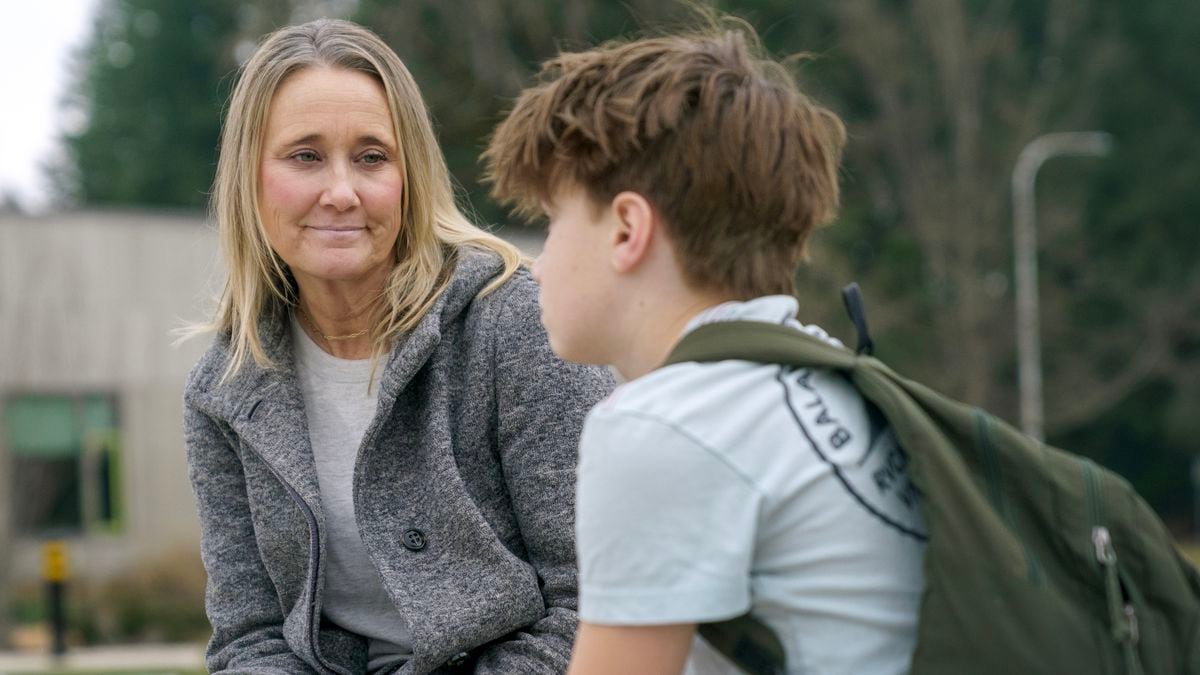
Jennifer Brooks talks with her son, Hudson, as she picks him up from school in Lake Oswego, Jan. 26, 2023. Hudson, who has learning disabilities that can make reading and writing difficult, fell behind his peers at school during the pandemic.

Jennifer Brooks talks with her son, Hudson, as she picks him up from school in Lake Oswego, Jan. 26, 2023. Hudson, who has learning disabilities that can make reading and writing difficult, fell behind his peers at school during the pandemic.

Kristyna Wentz-Graff / OPB

Now a sixth grader at Lakeridge Middle School, Hudson continues to receive outside tutoring separate from the school district.

“I have asked [the school district] to not provide any literacy intervention for reading,” Brooks said. “They don’t know how to do it.”

“He doesn’t trust them to be honest, he doesn’t really trust the school after all these years … and knowing that what they have him do doesn’t help him and then they don’t listen to that.”

Based on discussions with parents and educators in other parts of Oregon, the challenges in Lake Oswego — an affluent school district with fewer students in special education than the state average — are not unique.

At the same time, reading is having a moment. Parents and advocates across the country are speaking out about what they see as inadequate approaches to teach children to read. Oregon advocates and teachers want to see school districts spend federal COVID-19 relief funds on phonics-based reading programs. West Linn-Wilsonville parents have been advocating for more support and a new curriculum at school board meetings. Improved reading for Black students has become a focus of the NAACP nationally as a new podcast shares the story of “how teaching kids to read went so wrong.”

Hanging in the balance are students with specific learning challenges, like reading. Parents of students like Hudson and Greyson Chavez, a middle schooler in Beaverton, are pushing solutions before it’s too late.

Feeling frustrated at school and learning to read at home

If students don’t get what they need in early grades, they don’t develop those foundational skills that are necessary throughout school and life after school. Reading is an essential skill for students to build so they can learn complex subjects as they get older.

In class, Greyson, an eighth grader at Mountain View Middle School in Beaverton, didn’t like reading out loud. He’d get nervous that he might stumble on words, or mess up in front of his peers.

“It made me feel like something’s wrong, that maybe I just wasn’t trying hard enough, or wasn’t smart,” Greyson said.

Kim Harley and her son Greyson Chavez. Greyson is an eighth grader at Mountain View Middle School in Beaverton. He struggled with reading at school until his mom started teaching him herself last year using a phonics-based system she found online. With the help of a tutor, Greyson is reading at grade level.

Kim Harley and her son Greyson Chavez. Greyson is an eighth grader at Mountain View Middle School in Beaverton. He struggled with reading at school until his mom started teaching him herself last year using a phonics-based system she found online. With the help of a tutor, Greyson is reading at grade level.

Elizabeth Miller / OPB

Like Hudson, Greyson has dyslexia. Also similar to Hudson, Greyson and his mom, Kim Harley, said the support he received through the special education department at his school wasn’t working. Harley hired a tutor and found other materials so her son can learn.

“The help at home is definitely a lot better than the help at school,” Greyson said. “The help at school is … less of teaching the kids how to read or how to do math and more of putting them in front of a computer screen for a couple of hours.”

Not every child with dyslexia qualifies for special education support. They can qualify for services if they are determined to have a “specific learning disability” potentially based on weak academic performance in subjects such as reading and writing.

Like many parents across the country, Harley said the pandemic gave her an in-depth look at Greyson’s educational experience. She watched him struggle with math, reading and writing.

On reading tests in seventh grade, last year, Harley found that her son’s reading level had actually regressed from where he was in third grade. So she spent $300 on Barton reading system materials, a phonics-based program that uses little multi-colored tiles to help students differentiate between sounds. Last September, Harley had Greyson tested again and said he jumped to fourth grade reading level.

“It’s very apparent that he is very capable of learning,” Harley said. “He just was not getting what he needed at school.”

Beaverton officials say parts of their core instruction are phonics-based like the Barton system, and that students who qualify for special education services receive individual help. Similar to Lake Oswego, Beaverton officials add that specific elementary staff are currently receiving LETRS training.

Harley and Hudson’s mom, Jennifer Brooks, are part of a large number of parents and advocates who disagree with the reading interventions provided by their districts.

Greyson said that while his writing skills have improved, he’s still working on reading.

Kim Harley used this box of materials to teach her son Greyson to read last year. The box includes multi-colored tiles to help differentiate sounds.

Kim Harley used this box of materials to teach her son Greyson to read last year. The box includes multi-colored tiles to help differentiate sounds.

Elizabeth Miller / OPB

“I still don’t know if I’m as confident with reading anymore,” Greyson said. “I don’t like to read, I don’t read books, but I think I’ve gotten better with it. I can read a lot harder words now, that’s good.”

The help Harley is paying for — the tutor and the Barton system — are ultimately helping Grayson complete assignments and feel successful in eighth grade, including reading-heavy courses like history and social studies.

The tutoring paid off. In January 2023, new test results showed Greyson was reading at grade level.

“He just needs a little bit”

Some students with learning disabilities may only need a few extra minutes of support to find academic success. And not getting that support can compromise both their learning, and their attitude about learning.

Alison Gash’s son has trouble focusing in the classroom environment. He has several conditions — autism spectrum disorder, attention deficit hyperactivity disorder and visual processing problems — that make learning different for him.

To succeed, Gash said her son needs extra one-on-one support in math and writing — someone to help break down questions so he can answer them.

“He can do the math, he just can’t decode the instructions,” Gash said.

Her son is in fourth grade at a public school in Portland for high-achieving students. She has asked not to include her son’s name to avoid possible repercussions against him. Gash said the lack of adequate support has left her son with anxiety and negative feelings about his education.

“Time’s running out for him to really be able to see school as a positive experience,” Gash said.

“He comes home from school and says, ‘my brain is broken, I can’t do work’,” Gash recalled. “And I’m like, that’s just heartbreaking because your brain is awesome, we just haven’t found the setting that will allow you to see that.”

She’s been working to get her son an aide at school, but has been told there aren’t resources for him. District officials say there are two paraeducators assigned to the school.

“PPS is committed to serving all students, and will work tirelessly to ensure those requiring specialized services receive support as highlighted in their Individualized Education Plan in an inclusive and caring environment,” PPS officials shared with OPB in response to questions about lack of support for students.

Gash is a political science professor at the University of Oregon, and has worked with the university to make classrooms more accessible for students with various learning needs. She said children need spaces that support how they learn — and it’s different for every student.

“Some kids are fine being at a table with three other kids and having to do work in a classroom with 24 other kids,” Gash said. “A lot of kids aren’t, and for a lot of kids, that kind of space simply will not work for their capacity to learn.”

She said she doesn’t see a space that works for her son at his current school.

“He just needs a little bit,” Gash said. “But even the little bit that he needs, we can’t get.”

If children like hers are going to be in those classrooms, Gash said, they might need an adult in the room to help, whether that’s a paraeducator, or an aide, or a parent volunteer.

Small changes can lead to significant problems

Just as seemingly small supports can make a big difference with students, when a relatively small cut is made to services, it can cause significant problems.

At the end of October, special education staff at Kelly Elementary School in Southeast Portland were notified that their staffing was being cut from 1.5 to 1.0 — a loss of the equivalent of one part-time teacher. PPS was requiring a full-time staff member to split their time between Kelly and Lent Elementary a little over a mile away, effectively reducing support at Kelly.

That staffing cut had a ripple effect that interrupted student learning. Staff said they were unable to provide specially designed instruction, required by students’ individualized education plans. According to a letter from Kelly staff shared with OPB, as a result of the staffing change, every student with an IEP was “missing core instruction,” and that some students were missing “teacher-led recess to receive instruction.”

The letter stated that some students are now in the school’s Learning Center for over two hours to meet their required IEP minutes, something Kelly Elementary teacher Rachael Hall called “not developmentally appropriate.”

District officials said the October staffing change was based on the number of students served. Hall is also the parent of a student with disabilities, a middle schooler at Kellogg, another school in Southeast Portland. Speaking generally, Hall said resources are going to students most in need — including students who may act out physically — but that leaves every student underserved.

“The reason this — attending to these kids with these behavioral needs — is so important is because they’re kind of like the canary in the coal mine,” Hall said. “If their needs are not being met, everybody else’s needs are going to start not being met because they are a high priority when someone’s like unsafe to themselves, unsafe to others.”

Research has shown that students need to be in an environment where they feel safe in order to learn.

Parent and school volunteer Jackie Dean sees firsthand the need for more support in her son Jack’s first grade classroom at Kelly.

“I’ll sit next to Jack and I’ll help him with his work … I help Jack, and I try to help the kids that sit around him,” Dean said. “Sometimes some of the other kids start calling, ‘Ms. Jackie!’”

Dean said Jack, who has autism, struggles with getting started on his school work. She remembered helping another student with math — and how the little extra support she was able to provide helped the student progress.

With the change in Kelly’s staffing, Dean said she feels like the connection with the teacher who now works part-time has changed.

“I know she’s stretched so thin,” Dean said.

Dean is concerned about the future of her son and his classmates, and all students who don’t get what they need. She thinks about her husband, who received special education services when he was in school. As an adolescent, he went to juvenile detention and remembers someone there telling him that students who needed special education support — but didn’t get it — ended up incarcerated.

She worries about Jack and his classmates.

“Jack was so successful last year at school,” Dean said, while acknowledging kindergarten wasn’t perfect. Her concerns are bigger now.

“This year, there’s so many problems — it’s just — my first grader, I’m worried he’s going to end up in jail someday.”

Makeup time required for some students — but not always happening, or wanted

A state emergency rule enacted in 2021 ordered school districts to review student plans to determine who was eligible for COVID-19 recovery services, to make up for time lost when students were at home during the pandemic.

That rule required schools to “consider” recovery services for students receiving special education support “based on the unique needs that arise from their disability due to the impact of the COVID-19 pandemic.” But the state hasn’t been tracking how many of those 78,716 students were eligible or have received recovery services. One option for providing those services is putting it off until the summer.

Individual school districts haven’t been consistent in tracking how many students they’re providing support.

In Beaverton, “approximately 25{af0afab2a7197b4b77fcd3bf971aba285b2cb7aa14e17a071e3a1bf5ccadd6db}” of the district’s 4,638 students receiving special education services were eligible and offered recovery services, which range from summer programs and participating in the school’s extended school year program to additional services “during non-instructional times” in the school day.

More than 760 students in the Lake Oswego School District receive special education services. District officials said the number of students who qualified for recovery services varies, though they said 40 students accessed services during the summer.

Under state rules, Oregon districts have until the end of this school year to meet with families, develop recovery services if recommended and outline a plan for when those services will occur.

In Portland, 488 students received services in the summer. District officials estimate 50 students had small group instruction or tutoring outside of summer. That’s out of more than 7,300 students in PPS who receive special education services. District officials did not share how many students were eligible for the services.

Jey Buno, PPS’ interim director of student services, said only a small number of students’ education was “significantly impacted.”

“The focus is on trying to close some of the learning gaps that might have been created due to the pandemic impact,” Buno said.

“It may be additional reading instruction, it may be additional math instruction, it could be a social group-type activity, where you’re part of a club to get some specific instruction on social interactions.”

But it may be difficult for students in Portland and across the state to receive those services. District officials said they served as “many possible students as they could” last summer. A former PPS special education teacher who asked OPB for anonymity out of fear of repercussions said they are concerned about the logistics. The teacher was also worried that directing students into extra classes might feel like schools are “punishing” students.

Daralee Huntley, the parent of a Portland student with disabilities and a paraeducator in the district, agreed that more school — when other students are on summer break — can’t be the only solution, and wouldn’t work for students like her daughter.

“She needs to have that break from school,” Huntley said of recovery services offered for her daughter, Bella. “I didn’t want to put the stress of summer school … to me, that’s not going to help.”

This is the second story in a series on the state of special education. You can read the first story here. Our next story is about what it’s like to be a member of support staff working in special education classrooms.

Educational organizations in the state call for increased support for multilingual learners

Multilingual learners are the state’s quickest escalating demographic of pupils in the state.

Due to the fact 2016, the p.c of multilingual learners enrolled in Delaware educational institutions enhanced by 42{af0afab2a7197b4b77fcd3bf971aba285b2cb7aa14e17a071e3a1bf5ccadd6db}, now topping 14,500 pupils- but they aren’t finding the essential aid to realize success.

Which is according to a new actuality sheet designed by Rodel, the Delaware Hispanic Commission, the Arsht-Cannon Fund, and Delaware English Language Learners Instructors and Advocates.

It exhibits above the earlier 5 decades the substantial accomplishment gaps in between multilingual students and indigenous English speaking college students have observed very little to no advancements.

Multilingual learners confront a wide range of studying disparities, like absence of entry to educators licensed in Multilingual and English as a Second Language instructing.

The present-day range of individuals educators offered in Delaware is not maintaining up with the growing range of pupils that need to have them.

Each and every district in the state has multilingual learners, but some districts have no accredited instructors at all.

Aspira Delaware CEO Margie Lopez-Waite says greater funding to recruit additional of these teachers, as properly as certify recent teachers, is very important.

“We have academics that are extremely significantly interested and passionate about extending their credentials and discovering how to help much more college students but when you then notify them that they have to shell out for that certification them selves out of pocket it definitely makes some limitations,” explained Lopez-Waite.

Aspira Delaware is effective to assistance near the financial obstacles stopping academics from getting their certification, but point out funding for multilingual learning plans only makes up 3{af0afab2a7197b4b77fcd3bf971aba285b2cb7aa14e17a071e3a1bf5ccadd6db} of Delaware’s whole training paying out.

With extra funding needs than are presently offered from the condition, it is all-palms-on-deck for organizations supporting instruction in Delaware.

Arsht-Cannon Fund government director Christine Cannon claims 1 way her corporation supports multilingual learners is by furnishing language instruction to the whole family members.

“Back in 2008 we gave our first grant to ESL programs in the condition. And we have hardly ever stopped, we made that our priority. And a lot of the ESL plans are for grown ups, but several are relatives targeted,” reported Cannon. “Parents can carry their youngsters. So when mom and dad are discovering English, the little ones are also possessing a great deal of prospects for academic guidance.”

Growing English language proficiency in homes aids pupils greater have an understanding of the lessons in all subjects, in spite of lagging availability for in-school English instruction.

And Cannon adds that even though it is at present tricky to help all of the multilingual pupils in the state by the educational system, the fast increasing selection of students from various backgrounds represents a beneficial transform in Delaware that she hopes will proceed.

YEE offers support to Egyptian students learning Turkish language

The Yunus Emre Institute (YEE), which has been working in Egypt’s capital Cairo because 2010, instills a love of learning about Türkiye and the Turkish language in Egyptian youth by many activities it organizes.

The YEE is identified as the strongest corporation that promotes the understanding of Turkish around the world and operates in extra than 60 nations around the world. It organized an annual “Regular Understanding Contest” in which 24 Cairo YEE trainees, consisting of 8 teams, participated in the know-how competition held in the fields of tradition, art, literature and background.

The group that received the competitiveness, which involved a lot of concerns about the prevalent tradition of the Egyptian and Turkish individuals, was awarded a scholarship for the Turkish classes organized by the Cairo Yunus Emre Institute.

The YEE gives in-individual and online Turkish language classes and encourages Egyptian youth to study Turkish by means of several functions and competitions it organizes for the pupils.

The programs have been running in Cairo for about 12 yrs and instruct Turkish to somewhere around 700 students each individual semester. The on the web programs were launched in 2020 immediately after the COVID-19 outbreak.

Two trainees who participated in the online “Meet up with Turkish” courses held in the fall semester of 2022 with the participation of around 8,000 students and who adopted the social media accounts of the institute were being provided spherical-trip tickets to Türkiye by the Cairo YEE.

Yara Semir, 29, one particular of the students that received a round-vacation ticket, mentioned that she realized a ton in a very quick time from the on the internet courses arranged by the institute. “I have been watching Turkish Tv collection for a extended time thus I know a small little bit of Turkish, but I still wanted to strengthen my Turkish. Although the training course was shorter, it authorized me to find out a ton and to go to Türkiye, which was my largest aspiration,” she said, also expressing her thanks to the YEE.

Şehd Hamid, 22, the other Egyptian trainee who won a ticket to Türkiye within the scope of Cairo YEE’s gatherings, expressed that Türkiye is a wonderful place and that he wants to get to know Turkish lifestyle.

Hamid reported: “I’m not from Cairo. I am from Port Claimed. I could not consider it when I realized that the institute would give two trainees a ticket to Türkiye. I was incredibly joyful when they declared that I experienced received the gift at the stop of the class. Türkiye is a pretty attractive country. I want to visit metropolitan areas like Izmir and Istanbul.”

The Daily Sabah Publication

Continue to keep up to date with what’s occurring in Turkey,
it’s area and the world.


You can unsubscribe at any time. By signing up you are agreeing to our Phrases of Use and Privacy Policy.
This web page is shielded by reCAPTCHA and the Google Privateness Policy and Conditions of Provider utilize.

New program offers licensure support for teachers of English learners

A new program would like to support Indiana teachers get licensed to train the state’s expanding populace of English language learners.

The Indiana Instructor of English Language Learners (I-Inform) software will pay back for tuition and service fees for present-day educators to gain the extra licensure they will need to grow to be teachers of document for learners who are mastering English. It is a partnership involving the Indiana Division of Training and University of Indianapolis’ Middle of Excellence in Leadership of Learning

These academics, who oversee students’ language enhancement, are critically required in Indiana, according to state info. A current Chalkbeat examination uncovered that a single-third of all districts and two-thirds of charter schools don’t have accredited instructors of file for their English learners. Which is regardless of point out and federal staffing suggestions necessitating these types of a instructor at each and every schooling company. 

English learner instructors might also vacation among educational facilities. But that strategy can lead to large caseloads and considerably less person awareness for English learners — a populace that has developed 52{af0afab2a7197b4b77fcd3bf971aba285b2cb7aa14e17a071e3a1bf5ccadd6db} in Indiana more than the previous five several years.

“Our COVID-19 tutorial effects knowledge shows that Indiana’s English learner pupils expert significant educational impacts and have nevertheless not returned to pre-pandemic yr-in excess of-year educational advancement,” explained Indiana Secretary of Education Katie Jenner in a statement about I-Tell. “The ideal way to guarantee our college students accelerate their learning is to be certain they have quality, well-educated teachers supporting them.

Recent instructors can just take courses from one particular of 11 universities through Indiana collaborating in the application. One more pathway via Marian College also makes it possible for people today who keep bachelor’s degrees to earn a Transition to Training license with a concentration on English as a new language. 

The new I-Notify system is funded by $2 million in condition crisis federal funding.

Assisting academics afford licensure costs

Carey Dahncke, govt director of the Middle of Excellence in Leadership of Learning, reported the new application was modeled right after an initiative past yr to enable academics get their whole licensure to educate exclusive training. 

All around 650 men and women have signed up for the unique education program, Dahncke explained, and some have already completed it and commenced doing work in educational facilities. 

Similarly, Dahncke claimed the new program aims to include hundreds of new English language lecturers to the workforce by eliminating hurdles like value devoid of lowering educator quality. 

“We identify that the problem did not produce overnight and will not be solved speedily,” he explained. 

“We want to aid the procedure so it seems obtainable, so you are not experiencing fiscal barriers or a puzzling course of action.”

The financial load of pursuing extra licensure is a major barrier for lecturers who would like to learn how to better assistance their English learner pupils, explained Laura Hammack, superintendent of Beech Grove Colleges. 

The district of close to 2,800 pupils has found a sizable raise in its populace of English learners, specifically in the youngest grades, she explained. As a result, the selection of educators serving that population has grown from one particular to five — and the district hopes to double that number with the aid of the I-Tell method. 

Hammock explained the district is also looking to different pathways that make it less difficult for  paraprofessionals to earn their training licenses, which could possibly be tricky for these staffers to receive in any other case. 

These pathways are important, she explained, as the state faces a declining variety of learners heading to university and graduating from regular teacher preparation packages.

“We’re apprehensive about the reducing population of men and women to pull from,” Hammack reported.  

District leans on improve-your-have application

In 2017, Logansport Group Schools had just two educators serving a steadily growing inhabitants of English learner pupils, a lot of of whom have been very first enrolling as young people with confined proficiency in their 1st languages.

“It was just regularly working all over putting out fires,” explained Superintendent Michele Starkey, who has labored in the district for 31 many years.

But a Purdue College system, funded by a U.S. Department of Schooling grant, authorized Logansport instructors to receive the license they desired to provide English learners for free of charge. The district picks up any charges the grant doesn’t include, Starkey explained. 

As a final result, Logansport has all over 40 certified English learner teachers, with 13 extra in the system of completing the program. People who earn the license shift up on the district’s pay scale and signal an agreement to remain with Logansport schools for at the very least five years, Starkey stated. 

The new support software from the state may well give academics additional solutions to gain their licensure, and help the district with its share of the expenditures, she added. 

The district’s improve-your-possess initiatives have created it a lot more agile in addressing university student desires, claimed Tami McMahan, director of English language learners — especially in the midst of a spike in the enrollment of newcomer students, or pupils who have under no circumstances attended U.S. educational facilities before.

This August, the district saw as a lot of newcomer learners enroll as it had the complete last school year, Starkey explained. All over 46{af0afab2a7197b4b77fcd3bf971aba285b2cb7aa14e17a071e3a1bf5ccadd6db} of the district’s 4,266 learners are English learners, and of that inhabitants, 69{af0afab2a7197b4b77fcd3bf971aba285b2cb7aa14e17a071e3a1bf5ccadd6db} qualify for totally free and lowered-rate lunch. 

English learner lecturers satisfy consistently to discuss how most effective to serve these pupils, McMahan stated. They examine test success in depth and give both equally formal and informal experienced growth to their colleagues. 

Their expertise has also led to a better awareness of students’ own wants — the district commenced a food pantry and a outfits closet for these who need to have it. 

Following understanding that some English learner pupils ended up doing the job right away shifts, the district available a semi-unbiased study software that would make it possible for them to get paid credits, get language development, and entry overall health and help expert services in less college several hours a working day. That gives them additional time to slumber.

“For learners, it comes down to their demands remaining fulfilled,” McMahan claimed. “We can’t do superior till we know improved.”

Aleksandra Appleton addresses Indiana education policy and writes about K-12 educational institutions across the condition. Get in touch with her at aappleton@chalkbeat.org.

New portal aims to define and support ‘learn and work ecosystem’

Desire in how businesses locate competent personnel and people today discover the work opportunities they want is arguably at an all-time higher. It matters to employers, governments, scientists, unions—and of program to the numerous instructional institutions and schooling suppliers more and more held dependable (and sometimes uncovered wanting) for bridging that gap.

Foundations commit tens of millions in new packages aimed at smoothing the connections in between would-be workforce and possible businesses. Companies have cropped up to improve the system. The terrain is drawing expanding journalistic protection. But the subject remains murky at best—extremely intricate, not nicely-outlined. Some individuals simply call it “education and employment,” whilst other individuals choose “college to profession.”

A new world wide web portal seeks to bring better awareness and comprehension to this difficult and frequently puzzling landscape. The site, Learn & Do the job Ecosystem Library, defines that ecosystem as a link of “formal and casual studying (education and teaching) and work … composed of numerous setting up blocks” that, when performing together, allow for people today to “move additional seamlessly by the market applying a selection of qualifications to communicate the techniques and knowledge acquired in multiple configurations.”

When the ecosystem features properly, the website’s “about” area notes, it offers employers “more detailed and externally validated facts through their employing and upskilling procedures,” aids educational suppliers “count studying received outside the house of academic configurations toward a degree or other credential,” and informs the public. “For the ecosystem to purpose effectively, all sections of the system have to be connected and coordinated.”

Spoiler inform: the components of the ecosystem usually are not linked and coordinated, and that’s what inspired the creation of the portal by Holly Zanville, who has put in many years in a selection of educational, govt and foundation roles targeted on equitable access to increased education and learning and in the long run to the workforce. After 15 a long time at Lumina Foundation, she is now a exploration professor and co-director of the Software on Techniques, Qualifications & Workforce Plan at George Washington University.

“We’re striving to engage in air targeted traffic controller” amongst the several constituents, intermediaries and initiatives that operate in this area and become a central starting issue for info that can then immediate persons to other specialists to dig deeper, suggests Zanville, for whom the new venture is a labor of enjoy.12 areas essential to the Learn & Work Ecosystem

The site is at this place a prototype that Zanville and her colleague Lucia Weathers hope authorities in the subject will extend and embrace in the style of wikis.

The portal divides the ecosystem into 12 vital elements (such as credentials and suppliers, plan, research quality and value—see picture at suitable for the total collection) and presents facts about them, as properly as about 71 subcomponents. “If any of these aren’t doing the job, issues are not going well in how the ecosystem is working,” Zanville claimed.

It also has pages about an preliminary list of 88 packages and initiatives and 118 alliances and intermediaries—organizations, formal and considerably less so, that are running in this area.

Zanville explained she hopes the web site will be both a source for credible facts and a way to “fuel greater collaborations” involving people initiatives and corporations.

That will only occur, she said, if two questions are answered affirmatively: “Will individuals use it, and will they help us continue to keep it up to date?”

We must support the teachers who will be in charge of expanding Native history lessons

Just about every year, as the nation marks Indigenous American Heritage Thirty day period, educators seem for lesson plans and classroom means to have interaction their college students. Some of these lecturers are applying condition-developed sources or adhering to state mandates to educate Native heritage, such as not long ago launched components in Oregon and a new Indian Education and learning statute in California.

These states, and numerous many others, are taking measures in the appropriate way to make sure that students see the heritage and up to date experiences of Indigenous people as nuanced, applicable and impactful.

These developments, nevertheless, will be meaningless except if we are able to respond to the adhering to problem: How are we making sure that our teachers are both perfectly-geared up and perfectly-outfitted to start sharing information and facts and content they likely under no circumstances received themselves in a formal classroom environment?
