Listen to English learners on education bill

Opinion editor’s note: Star Tribune Opinion publishes a mix of national and local commentaries online and in print each day. To contribute, click here.

•••

Minnesota has the nation’s worst disparities in educational outcomes between students of color and white students.

For years, legislators have lamented that they lacked the necessary votes and funds to make real changes to our educational system. This year they have a trifecta and the money — a $17.5 billion surplus.

And yet, the Minnesota Legislature’s failure to incorporate and adequately fund certain proposals in the education omnibus bill render English-language learners (ELL), the fastest-growing student population in the state, virtually invisible.

Currently, three proposals before the Legislature could have a profound impact on academic outcomes for English-language learners: 1) Incorporating accountability into ELL funding formulas; 2) increasing teacher diversity through the Increase Teachers of Color Act, and 3) preserving teacher licensure pathways proven effective in recruiting teachers of color and teachers from low-income backgrounds.

Our organizations represent a diverse coalition of parents, teachers, educators and businesses strongly supporting these three proposals.

First, we partnered with legislators to add accountability measures to the Learning English for Academic Proficiency and Success (LEAPS) Act. Yet the LEAPS Act, passed by the Legislature several years ago, never received the funding for its implementation. The LEAPS Act would enhance professional development for teachers and administrators, recognize the diversity of multilingual learners, and engage the voices of parents, students and the community in the design and implementation of ELL programs.

Unfortunately, these measures were not included in the education omnibus bill. Funding is critical, but best practices and accountability are fundamental to changing education outcomes. More funding without accountability will preserve the status quo and widen existing gaps.

Second, we know that all students benefit from teachers of color in the classroom. Yet, our teacher workforce has not kept pace with the growing diversity of our students. The disparity is staggering. In Minnesota, there is one white teacher for every nine white students, but one BIPOC teacher for every 90 BIPOC students.

Despite this, the Legislature has underfunded critical programs within the Increase Teachers of Color Act. The Senate, for example, has proposed no new funding for the Underrepresented Student Teacher Grants program, while neither the House nor the Senate has proposed new funding for the Minnesota Aspiring Teachers of Color Scholarship program. Both programs would provide grants and scholarships for teachers of color to enter the profession.

If we can’t fully fund the Increase Teachers of Color Act now — with the historic surplus and the trifecta of supportive leadership in the House, Senate and the governor’s office — it is hard to imagine when we ever will be able to do so.

Third, amid widespread teacher shortages, Minnesota is hurtling toward a reversal of hard-fought advances in the teacher licensure system, impacting nearly 800 teachers, a disproportionate number of whom are teachers of color.

Provisions in the omnibus bill would eliminate the pathway to permanent licensure for educators with demonstrated success as Tier 2 licensed teachers (defined as three years of experience and a positive summative evaluation) — thus making a master’s degree in the content area, completing a teacher preparation program or being currently enrolled in a preparation program the only ways to stay in the profession regardless of a school’s need or the teacher’s impact.

Students, parents, teachers and school administrators are not asking for this. The Minnesota School Boards Association has voiced opposition to this bill, as have 16 other education advocacy organizations. This bill moves teacher diversity, teacher recruitment and the teacher shortage in the wrong direction.

Our children depend on our legislators to make decisions that advance equity and better our educational system. The time is now to support fully funding the Increase Teachers of Color Act, keeping and improving current tiered licensure pathways and attaching increased accountability to English Language Learner funding as outlined in the LEAPS Act. There are no more excuses.

Katya Zepeda is legislative and policy director — education at Minnesota Council on Latino Affairs. Irma Márquez Trapero is executive director at LatinoLEAD. Paula Cole is executive director at Educators for Excellence-Minnesota.

Learning to code isn’t enough

The pretty existence of these teaching endeavors reflected a mixed set of motivations on the element of the organizers, who ended up mainly white, very well-off volunteers. These volunteers tended to conflate living in an urban region with dwelling in poverty, and to presume that people living in these conditions ended up not white, and that all these types of folks could be lumped jointly beneath the heading of “disadvantaged.” They imagined that discovering to code would supply a clear-cut path out of poverty for these participants. But their thinking shown minimal understanding of the road blocks imposed by centuries of enslavement, unpaid labor, Jim Crow violence, spend discrimination, and segregated and unequal schooling, well being treatment, and housing. Mainly with their personal interests in mind, they looked to these upskilling packages as a panacea for racial inequality and the social instability it fueled. A team from a Delaware ACM chapter, a conference report instructed, considered that “in these days of urban disaster, the information processing business delivers a unique possibility to the disadvantaged to develop into involved in the mainstream of the American way of lifetime.”  

If good results is described as obtaining a steadily increasing number of Black and Hispanic adult men and ladies excellent work in the computing profession—and, by extension, offering them possibilities to form and notify the technologies that would remake the world—then these courses failed. As the scholar Arvid Nelsen observed, when some volunteers “may have been targeted on the desires and dreams of the communities on their own,” other folks were being merely trying to get a Band-Assist for “civil unrest.” Meanwhile, Nelsen notes, companies benefited from “a source of inexpensive employees with a great deal additional confined electric power.” In shorter, schooling persons to code did not mean they would protected greater, increased-­paying, a lot more steady jobs—it just meant that there was a bigger pool of attainable entry-degree personnel who would drive down labor expenditures for the increasing pc industry.

In truth, observers determined the shortcomings of these initiatives even at the time. Walter DeLegall, a Black computing specialist at Columbia University, declared in 1969 that the “magic of information processing training” was no magic bullet, and that fast-correct education programs mirrored the deficiencies of American general public instruction for Black and Spanish-speaking learners. He questioned the determination guiding them, suggesting that they were from time to time arranged for “commercial motives or simply to de-fuse and dissipate the burgeoning discontent of these communities” alternatively than to promote equity and justice.

The Algebra Challenge

There was a grassroots hard work that did answer to these inadequacies, by coming at the computing revolution from an fully diverse angle. 

Through the late 1970s and early 1980s, the civil legal rights activist Robert P. Moses was residing with his spouse and children in Cambridge, Massachusetts, the place his daughter Maisha attended the community Martin Luther King University and he volunteered teaching algebra. He discovered that math teams have been unofficially segregated by race and course, and that substantially significantly less was expected of Black and brown learners. Early on, he also identified computers—and knowledge get the job done dependent on pcs—as a mounting source of financial, political, and social energy. Attending school was more and more vital for attaining that variety of electricity, and Moses saw that 1 vital to finding there was a foundation in superior university arithmetic, specially algebra. He recognized the Algebra Undertaking through the early 1980s, starting in Cambridge general public educational institutions and supported by a MacArthur “genius grant” that he obtained in 1982.

In a guide that he later coauthored, Radical Equations: Civil Rights from Mississippi to the Algebra Job, Moses clearly articulated the connections among math, computing, financial justice, and political ability, specially for Black Individuals. “The most urgent social problem impacting bad individuals and people today of shade is financial obtain. In today’s world, financial access and total citizenship count crucially on math and science literacy,” he wrote. “The computer system has turn into a cultural force as effectively as an instrument of operate [and] although the visible manifestation of the technological change is the pc, the concealed society of computer systems is math.” 

Arming Black pupils with the tools of math literacy was radical in the 1980s exactly since it challenged electric power dynamics.

Moses had earned his bachelor’s degree at Hamilton University in New York and a master’s degree at Harvard University right before instructing math at the Horace Mann University in the Bronx from 1958 to 1961. For him, arming Black pupils with the tools of math literacy was radical in the 1980s specifically mainly because access to technological innovation meant entry to power. “Who’s going to attain access to the new technological know-how?” he asked. “Who’s heading to control it? What do we have to desire of the instructional system to prepare for the new technological era?”

Moses mobilized students and mom and dad alike to assure that algebra was made available to all college students at the Martin Luther King College. He devised new methods to instructing the subject, and drawing on his encounter with grassroots civil rights arranging, enrolled college students to train their friends. College admission prices and test scores rose at the college, and the Algebra Undertaking spread to at least 22 other web sites throughout 13 states. It concentrated on math due to the fact Moses determined math as the basis of coding, and the stakes were normally connected to economic justice and academic fairness in an financial system constructed on algorithms and knowledge. 

CSUF Leads K-12 Asian Language Education Consortium

&#13
&#13

&#13
&#13

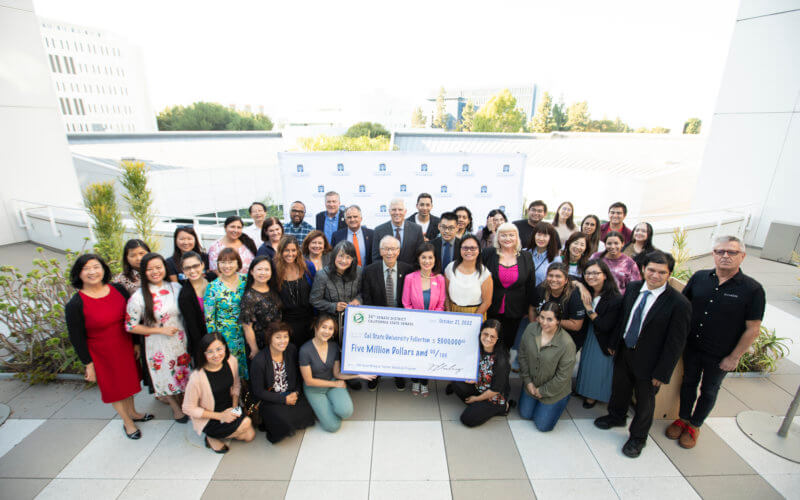
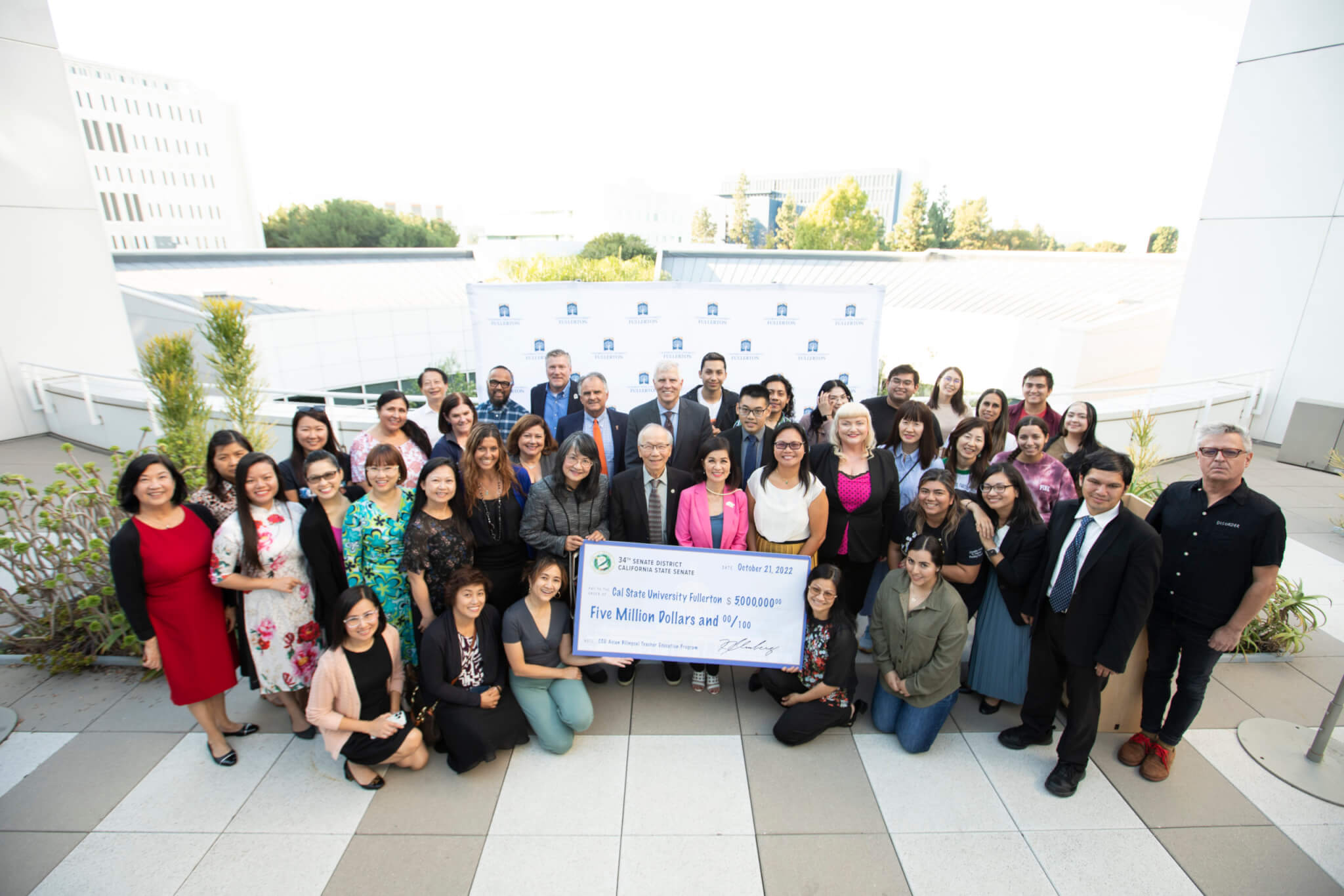
To deal with the statewide shortage of K-12 educators to educate in Asian languages, Cal Condition Fullerton’s College of Training is main the California Point out College Asian Language Bilingual Instructor Instruction Application Consortium.

Funded by the California Legislature, the target of the $5 million effort and hard work is to improve the quantity of credentialed teachers with Asian bilingual authorization to educate Vietnamese, Mandarin, Cantonese, Korean, Japanese, Hmong, Tagalog and Khmer (Cambodian).

“The consortium signifies a collective effort and hard work to help and develop Asian language bilingual instructor schooling plans not only in the CSU but statewide,” reported consortium software director Natalie Tran, professor of academic management and secondary education and learning in CSUF’s Faculty of Education.

“This funding benefits CSU bilingual authorization instructor candidates, faculty and university districts throughout the condition. The consortium plays a essential part in addressing the growing calls for for Asian twin-language immersion plans and trainer shortages in Orange County and California as a entire.”

With a bilingual authorization, academics can present instruction in both equally English and an additional language, this sort of as Korean or Vietnamese. 

“There is a wonderful want for bilingual instructors who can talk with learners and dad and mom in their native language,” said Fernando Rodriguez-Valls, professor of secondary education and learning, the coordinator of CSUF’s bilingual authorization program. 

CSUF is distributing money to the other seven CSU campuses in the consortium for the 5-yr system, Tran reported. Participating CSU campuses are Cal Condition Dominguez Hills, Cal State Lengthy Seaside, Cal State LA, Cal Poly Pomona, San Diego Point out, San Jose State and Stanislaus Condition. 

Tran anticipates that much more CSU campuses will be a part of the consortium all over the grant cycle. Funds will be employed for scholarships, university student outreach and recruitment, and to help consortium school and administrative functions.

Current and future instructors enrolled at CSU campuses will profit from the consortium method by way of scholarships. 

Instructor candidates interested in earning a training credential and bilingual authorization in Asian languages are eligible for a $20,000 scholarship. Latest teachers can get both a $2,200 scholarship or enroll in the required courses for absolutely free, Tran stated. 

Through the consortium, enrolled students can get classes at other campuses to comprehensive their bilingual authorization, Tran reported.

Currently, CSUF’s School of Training features Asian language bilingual authorization courses only in Vietnamese, Korean and Khmer. 

In CSUF’s bilingual authorization system, about 20 pupils complete the Asian language authorization just about every calendar year, Tran reported. 

“We anticipate this range to grow with an growing quantity of faculty districts providing Asian language twin-language immersion programs in the location and across the state,” she included.

In Orange County, for instance, Westminster School District, Garden Grove Unified School District and Anaheim Union Substantial College District all provide Vietnamese dual-language systems. 

Anaheim Elementary School District and Fullerton College District give programs in Korean. 

Mandarin dual-language programs are made available in Orange Unified Faculty District, Newport-Mesa Unified College District, Capistrano Unified School District, and quickly, in Anaheim Elementary Faculty District, Tran said.

CSUF’s National Resource Heart for Asian Languages, directed by Tran, in collaboration with California Division of Training funded initiatives, these types of as EL Increase!, also gives qualified growth for Asian language teachers. 

&#13

What do NY parents want from English education?

ALBANY, N.Y. (Information10) – How considerably does New York treatment about studying? According to a survey commissioned by the nationwide training organization the American Reading Organization, the response is fairly a bit.

The American Studying Business has launched the effects of a survey done by YouGov, which consulted parents of small children in college from kindergarten to 12th grade in New York, and questioned for their views on how studying should really be taught in faculties. The the vast majority of mother and father mentioned they want their children to learn from reading curriculums that involve classes on phonics, texts with a grounding in history and science, and day-to-day writing time.

“Parents value robust examining capabilities and seek out a curriculum with information setting up and express phonics that aids set the phase for them to not just be solid audience but to build a love of reading,” claimed Chris Melchiorre, Senior Vice President at YouGov.

The survey obtained responses from 2,062 dad and mom throughout the United States, all mothers and fathers amongst the ages of 6 and 17. The New York-area mother and father amongst those surveyed gave feedback these kinds of as:

  • 86{af0afab2a7197b4b77fcd3bf971aba285b2cb7aa14e17a071e3a1bf5ccadd6db} in favor of a curriculum with phonics in addition to producing, as nicely as studying elements with a aim on science and heritage
  • 82{af0afab2a7197b4b77fcd3bf971aba285b2cb7aa14e17a071e3a1bf5ccadd6db} really feel it is vital for their boy or girl to not only be a superior reader, but to like reading and to discover from what they study
  • 54{af0afab2a7197b4b77fcd3bf971aba285b2cb7aa14e17a071e3a1bf5ccadd6db} really feel that really like of reading is additional crucial than proficiency, at 46{af0afab2a7197b4b77fcd3bf971aba285b2cb7aa14e17a071e3a1bf5ccadd6db}

“At these a divisive instant, it is heartening to listen to so considerably agreement from mothers and fathers,” said American Looking at Enterprise CEO Gina Cline Rose. “Writing issues, science and heritage make any difference, foundational expertise make a difference, and a adore of reading through matters.”

That arrangement grew in other parts. 99{af0afab2a7197b4b77fcd3bf971aba285b2cb7aa14e17a071e3a1bf5ccadd6db} of surveyed New Yorkers explained college students will enjoy reading through extra when they can choose topics themselves. 97{af0afab2a7197b4b77fcd3bf971aba285b2cb7aa14e17a071e3a1bf5ccadd6db} reported pupils must be ready to use their reading competencies for crafting and investigate and must get pleasure from discovering to go through. 96{af0afab2a7197b4b77fcd3bf971aba285b2cb7aa14e17a071e3a1bf5ccadd6db} stated looking through comprehension and producing really should be part of all learning topics, and 93{af0afab2a7197b4b77fcd3bf971aba285b2cb7aa14e17a071e3a1bf5ccadd6db} agreed that college students ought to start off mastering to write as shortly as they learn to study.

Purdue Commits to Physical AI Research, More Online Learning

Purdue College aims to capitalize on rapid-expanding curiosity and potential in synthetic intelligence with a new study hub, for which it will hire 50 new tenure-keep track of college members over the next five many years.

In accordance to a information launch this 7 days, the new “Purdue Computes” initiative is a a few-pronged work: devoting academic resources to computing departments, exploring strategic applications of artificial intelligence, and selling schooling and innovation in semiconductors. The effort and hard work will centre about a new Purdue Institute for Physical AI (IPAI), which will make use of present and rising college analysis facilities to discover open agricultural information, neuromorphic computing, deepfake detection, edge AI programs, clever transportation info and AI-primarily based manufacturing.

In addition to hiring 50 faculty positions, the college will offer new diploma and certificate applications for both of those residential and on the internet students interested in bodily purposes of AI, while it has nevertheless to release specifics regarding additional curriculum and new regions of online instruction. Furthermore, the college will increase 250 Presidential Doctorate Excellence Awards to entice PhD pupils among now and 2028, in accordance to the information release.


Significantly of this initiative will be led by a 17-member faculty steering committee symbolizing departments across campus, and the IPAI advisory board will consist of alumni who function in management positions at providers this sort of as Tesla, Apple, Intel and Ring.

“Through this strategic investigate leadership, Purdue is concentrating recent and future assets on locations that will have investigate into the up coming generation of technology,” Karen Plaut, the university’s executive vice president of research, reported in a general public assertion. “Successes in the lab and the classroom on these subject areas will assist tomorrow’s leaders deal with the world’s evolving worries.”

In conjunction with this initiative, Purdue University trustees this week endorsed an “Online Mastering 2.0” eyesight assertion that pledges not just to meet up with the wants of regular undergraduate learners and mid-job students doing work toward state-of-the-art degrees, but also non-standard grownup pupils functioning on a college degree while balancing other obligations at do the job, residence or in the military services.

In accordance to a information release, the eyesight assertion also commits the university to expanding applications with the U.S. Department of Protection and raising workforce improvement systems in semiconductor, pharmaceutical producing and cybersecurity industries.

The information release reported systems at Purdue University Online include master’s degrees in electrical engineering, industrial engineering and mechanical engineering, as very well as in communications, health-care administration and hospitality management. The college also has an on the net veterinary know-how certification application.

Libraries, publishers, and the battle over e-books : Planet Money : NPR

ALA customers Alan Inouye, Barb Macikas, and Sari Feldman march in direction of the offices of a main publisher, Macmillan, in Manhattan. They carry containers of petitions dealt with to John Sargent, at the time Macmillan’s CEO. The petitions protest a controversial plan on e-publications in libraries.


American Library Affiliation/ALA


conceal caption

toggle caption


American Library Affiliation/ALA


ALA customers Alan Inouye, Barb Macikas, and Sari Feldman march toward the offices of a big publisher, Macmillan, in Manhattan. They have bins of petitions tackled to John Sargent, at the time Macmillan’s CEO. The petitions protest a controversial policy on e-guides in libraries.


American Library Association/ALA

In 2019, a group of librarians (quietly) stormed the workplaces of a significant guide publisher, Macmillan. They carried boxes stuffed with petitions. They’d collected countless numbers of signatures, and now, they required to supply them in particular person. Their aim: to place an conclude to a controversial policy known as “windowing.” It would prohibit libraries from loaning out far more than just one duplicate of a new e-ebook in the to start with 8 weeks following its launch, major to very long hold out situations for bestsellers. Librarians observed this as a risk to their mission to freely share understanding with the public.

But Macmillan claimed: we are the ones who are threatened listed here. More and far more people are borrowing e-books from libraries. And of course, when you borrow a reserve, you will not obtain it. Publishers commenced to really feel that libraries had been threatening their business enterprise design, and building it more challenging for authors to remain afloat, as well.

It truly is in some approaches a familiar story. An sector goes digital, and that alterations the calculation of who would make funds. Think audio streaming–Spotify comes together, and musicians and labels have to adapt. Besides, in this scenario, the organization that Macmillan reported was disrupting the whole system was…the pleasant nearby library.

On present day clearly show, we go inside of the fight between libraries and publishers above e-guides. The stakes could not be higher: every person feels like they’re battling for their extremely right to exist.

New music: “Tales from the Attic,” “Hunky Dory,” and “When You’re Long gone.”

Aid aid Earth Revenue and get bonus episodes by subscribing to Planet Revenue+ in Apple Podcasts or at moreover.npr.org/planetmoney.

Generally cost-free at these back links: Apple Podcasts, Spotify, Google Podcasts, NPR Just one or wherever you get podcasts

Discover additional World Income: Twitter / Facebook / Instagram / TikTok our weekly Newsletter.