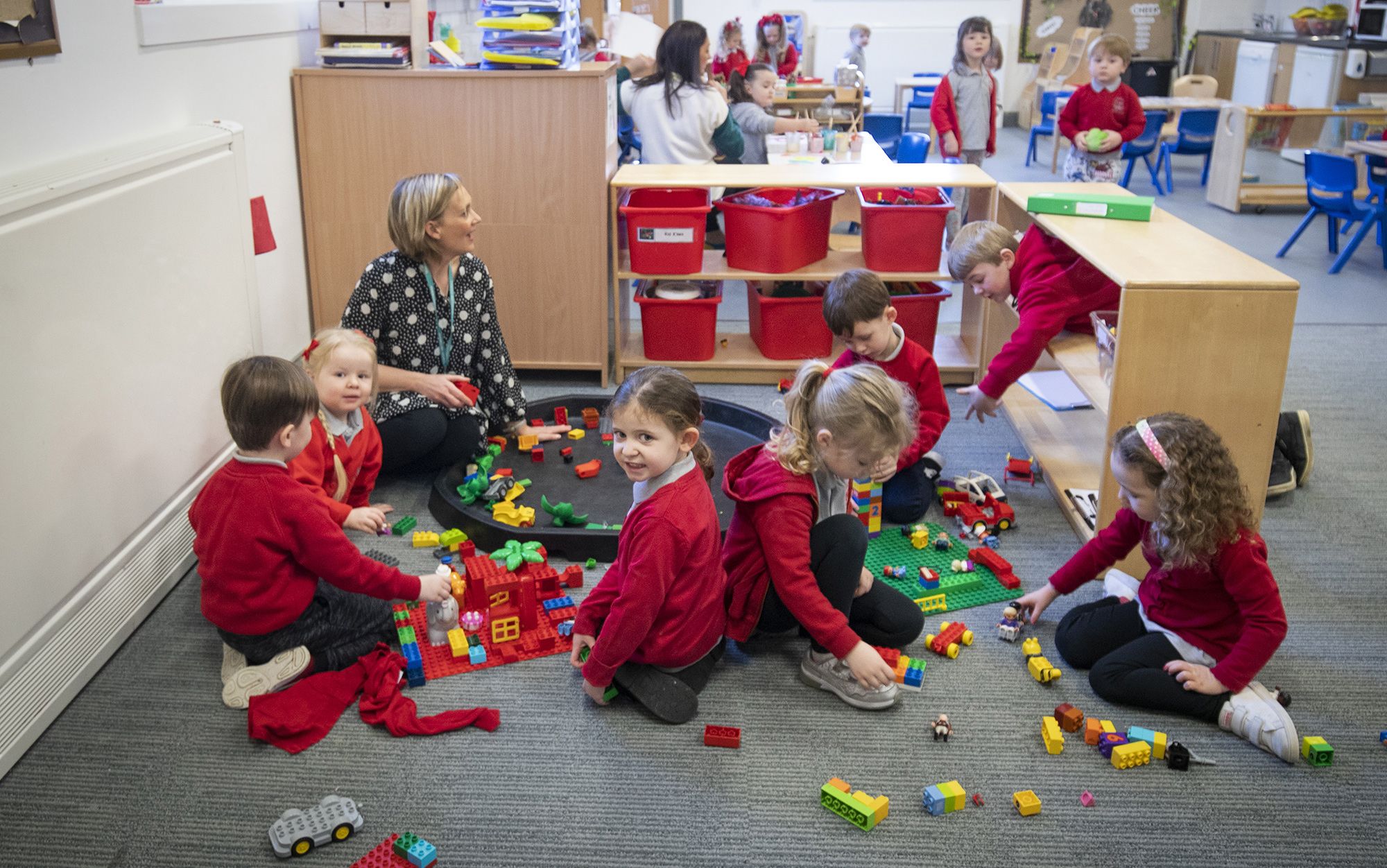
Picture two English classrooms. In the first, the teacher is teaching Macbeth to a group of eager students, and has planned the lesson meticulously, taking into account their individual learning differences, with the children sitting in three groups. All students have been tested to determine which learning style suits them, and the content has been carefully curated to reflect their individual needs. For the visual learners, there is a diagram of the characters and a map of the locations mentioned in the play, accessed through iPads. For the auditory learners, there is an audio production of the play, replete with sound effects; and, for the kinaesthetic learners, there is an opportunity to act out some of the battles and to engage with physical props from the play. All students are highly engaged and, as the teacher moves from group to group, there is a sense of purpose and endeavour.
A senior leader enters the room and monitors what is happening. They observe the students’ engagement and ask some questions, such as how the teacher is differentiating the lesson content to meet the individual needs of each student, and how the students show progress within the lesson. The teacher gives evidence on both counts, and the lesson is awarded a top mark.
In the second classroom, the desks are in rows facing the front and there are no iPads or phones. The teacher is using explicit instruction to explain the scene from Macbeth as the class reads through it. Periodically, the teacher will ask probing questions using an approach called ‘cold call’ where all students keep their hands down and the teacher chooses who will answer. In addition, the class will do retrieval practice in the form of short tests in which they will have to bring to mind key knowledge from previous lessons, usually at the start of the lesson. Next, the teacher will model a worked example of how to answer a question, then do it together with the class, and finally everyone in the class will write a paragraph by themselves in silence.
If the first classroom sounds more fun and sophisticated to you than the second, it’s likely many teachers and parents today would agree with you – seeing the ‘learning styles’ approach as an example of innovative and evidence-informed teaching fit for the 21st century. That’s in contrast with the second classroom style, which many teachers will often refer to as ‘instructionist’, or mere ‘chalk and talk’, a hangover from the 19th century. Unfortunately, anyone favouring the first class couldn’t be more mistaken.
Learning styles theory contends that people learn in different ways, mainly through visual, auditory or kinaesthetic modes, and so material should be presented to students to accommodate these differences, consistent with the ‘meshing hypothesis’ where instruction is tailored to preferences. Teachers should provide visual learners with visual representations of content, such as diagrams; auditory learners with lectures or audio recordings; and, for the kinaesthetic learner, the opportunity to have a hands-on approach where they can move around.
The Institute for Learning Styles Research, where you can become a certified ‘Multi-Modal Paired Associates Learning Test’ practitioner for just $1,895, claims that there are in fact seven different ‘perceptual styles’, including the olfactory learner who ‘learns best through the sense of smell and taste’. This may well have been the inspiration for a satirical article in The Onion from 2000 on ‘odour-based’ learning, which claims that ‘Reyna Panos, director of the Nasal/Olfactory Secondary Education (NOSE) certification program at Brown University’ said that ‘nasal learners do best when they are encouraged to use odour-based recall techniques in testing situations, and are allowed to organise and prioritise items by scent’. The biggest challenge now, the article quotes her apparently saying, ‘is to educate the educators’. It’s a farcical and humorous piece but one that sadly contains a disturbing reality when we look at just how prevalent learning styles theory is within education.
Learning styles theory has enjoyed extraordinary success over the past 50 years, and not just in the classroom. Not only did the theory become uncritically accepted on teacher training courses for many years and subsequently in the classroom, but it was also widely adopted in the mainstream media. As recently as 2014, it was featured on the BBC as a ‘key skill’. Depressingly, the theory was also a central part of classroom practice. Even august institutions such as the British Council have information about learning styles on their ‘Teaching English’ website. Despite the fact that ‘educating the educators’ on key findings from cognitive science has been a core aim of various strands of education reform over the past 20 years, a study in 2012 showed that more than 90 per cent of teachers believed that students learn best when material is presented in their preferred learning style: visual, auditory or kinaesthetic.
Learning styles theory represents a form of retrospective absolution
There’s little sign of the situation changing. A systematic review in 2020 found that 95.4 per cent of trainee teachers agreed that matching instruction to learning styles is effective.
The broad, intuitive appeal of the theory stems from the fact that it seems self-evidently true. Many people will say that they cannot learn by listening to a lecture and that they ‘learn by doing’, or that they need to move around or listen to music while studying. Others will contend that they are ‘verbal learners’ who learn best through reading or listening to an audiobook. For many adults, school was a frustrating experience where they did not learn as much as they could, and their sense of individual agency was negated. Learning styles theory represents a form of retrospective absolution where, if only their teachers had tailored instruction to match their learning style, then they could have achieved their potential.
Yet, despite its appeal, there is simply no credible evidence to support the idea that attending to learning styles actually supports learning, regardless of how well-intentioned the teacher might be. To paraphrase the physicist Wolfgang Pauli, not only is it not right, it’s not even wrong.
The fact that so many teachers continue to practise and endorse methods that have no discernible beneficial impact on their students is as scandalous as it sounds. How have we reached this point? To answer this question, it is necessary to look beyond the superficial appeal of learning styles, to consider the historical developments that provided the fertile soil into which such a misguided approach has taken root.
Learning styles theory emerged out of a broader trend in the 20th century informed by the self-improvement movement, which sought to affirm individual agency and championed student autonomy, but the roots of the idea that people can be grouped according to their disposition stretch much further back. As early as around 450 BCE, Hippocrates claimed that people display one of four temperaments or humours, depending on certain fluids in the body – melancholic, sanguine, phlegmatic, and choleric – and, in his Nicomachean Ethics, Aristotle stressed the importance of respecting individual needs in various contexts, from medicine to sport to friendship. The Hippocratic belief that personality types were rooted in certain biological functions would endure well into the Middle Ages, and they were even used by Pavlov in the 19th century as biomarkers of temperament types in dogs.
However, learning styles as a theory of mind rather than a taxonomy of personality emerges out of a far more recent progressive tradition, which was closely aligned with a scientific, but ultimately mistaken, conception of how learning happens.
In his book Émile (1762), Jean-Jacques Rousseau – possibly the most influential figure in education in the modern era – espoused the view that learning should begin from the child’s viewpoint, with their capacities developed through their own interests rather than from established knowledge in books. Rousseau would provide the inspiration for the Pestalozzian and Montessori principles of schooling, with the former gaining huge traction in the West from the 18th century onwards, and the latter developed in the 20th century. It is in the latter approach in particular that we can see the beginnings of learning styles as not just a progressive movement but also a scientific one.
Johann Pestalozzi was a Swiss educational reformer who established educational institutions, largely based on Rousseau’s ideas, in the late 18th and early 19th century. He believed that children were uniquely different in their capacities but that they should learn through sense perception and self-motivation. His motto was ‘Learning by head, hand and heart.’ One of the many schools that adopted his methods was a school in Aarau attended by one Albert Einstein who would later note: ‘It made me clearly realise how much superior an education based on free action and personal responsibility is to one relying on outward authority.’
Education was largely shaped by mass industrialisation, and privileged efficiency over individualism
Notable educational examples in Britain include Bedales (established in 1893) and Summerhill (established in 1921), two privately funded schools that gave children the freedom to choose what they did with their time. A S Neill, Summerhill’s founder, would claim that ‘the function of a child is to live his own life – not the life that his anxious parents think he should live, not a life according to the purpose of an educator who thinks he knows best.’
The Montessori method, named after Maria Montessori, an Italian educator, also privileges the interior over the exterior with an emphasis on student choice and the social construction of knowledge, rather than it being imparted externally. In addition, this era saw the idea of progressive education married to a more scientific approach.
However, despite these progressive movements, education in the 19th century was largely shaped by mass industrialisation with a more utilitarian view of education, which privileged efficiency over individualism. In the United Kingdom, mass schooling grew out of the Sunday school movement where children were given instruction mainly on reading and literacy. The National Society for Promoting the Education of the Poor was established in 1811 to provide education for disadvantaged students in the burgeoning industrial towns. By the 1830s, there was growing recognition of the widespread exploitation of children and the need for society to better attend to children’s wellbeing. A parliamentary report made it clear that there was an obligation ‘to promote the religious and moral education of the labouring classes’.
In the United States, there was often a single room in which children of different ages and stages were taught, with the youngest being at the front and the oldest at the back. The school day was shorter than in modern classrooms as many children had other jobs to attend to in the afternoon. The curriculum was, again, largely based on reading and arithmetic, and much of the ‘learning’ was about the rote memorisation of knowledge, rather than the application of it.
The state-funded and state-sanctioned mass education programmes first introduced in Europe and the US in the late 18th and early 19th century were also heavily influenced by the Prussian model of education, with a key component being the professional training of teachers. This form of school involved an eight-year compulsory programme, in which pupils were given instruction on core curriculum subjects such as languages and mathematics but with a specific focus on discipline. Indeed, perhaps the greatest difference between then and now, and something that would shock most people today, is the focus on punitive measures as a means of control. Although the Prussian model eschewed physical punishment, corporal punishment was still rife in this era. Children were regularly beaten for the slightest of infringements, often with instruments such as a cane or a paddle. The idea of attending to individual differences and needs of children would have been anathema to most teachers in this period.
Early in the 20th century, a leading educational figure from the US was John Dewey who espoused a more experiential method of learning, where the authoritarian Victorian schoolmaster was replaced by a more benign figure who should help the student learn through experience. The view that knowledge is socially constructed would be developed further by Jean Piaget and Lev Vygotsky whose theory of the zone of proximal development (ZPD) continues to be a mainstay on many teacher-training courses.
Meanwhile, the psychologist Edward Thorndike’s seminal text Education Psychology (1903) is often seen as the beginning of educational psychology and the modern application of cognitive science to learning – an approach that would greatly influence learning styles theory with its focus on measurable traits and the mind as an observable mechanism.
What emerges by the mid-20th century, then, is a tension between two visions of learning. The first, largely rooted in Rousseau’s ideas, views learning as an innately emergent property that grows from the child’s own interests and motivations. In this model, the educator’s job is to support and foster that force, and allow the child to follow their own interests. This view sees children as highly heterogeneous in type, with a differing range of needs that need to be met. The second sees learning as largely an external process that must be administered in some way to the child through often coercive methods, and which claims that children are more similar than dissimilar in how they learn. As Dewey noted in 1938: ‘The history of educational theory is marked by opposition between the idea that education is development from within and that it is formation from without.’
Through the 20th century, a related but distinct contributing influence to the emergence of learning styles theory was from personality psychology and the idea of different typologies or ‘styles’ as a way of explaining human behaviour. With echoes of Hippocrates’ humours, Carl Jung’s Psychological Types (1923) purported four cognitive capacities: thinking, feeling, sensation, and intuition. In Personality (1937), the US psychologist Gordon Allport wanted to explore the mechanisms through which people process information and solve problems; to do so, he favoured the more empirical method of value scales rather than what he considered to be the more ambiguous and interpretive approach of psychoanalysis. He proposed the term ‘cognitive style’ to describe the different ways that people think, and it’s in his writings that we begin to see claims of a clear delineation from one individual to another in how they learn and retain material. Indeed, as Allport himself claimed, his central idea was ‘the uniqueness of the individual’.
Teachers were working twice as hard as their students, who were learning half as much as they could have
The first appearance of the specific term ‘learning styles’ emerges in the literature in the 1950s through the work of the US education scholar Herbert Thelen, who noted that: ‘Learning by students is complicated by the fact that different kinds of learning require different roles and that learning experience is complex, involving thoughts, feelings, actions, emotions and desires.’ Then in the 1970s, the US educationalist David Kolb developed the learning style inventory (LSI), in which he proposed that there are four different types of learner: the ‘accommodator’ who learns in a practical, hands-on way; the ‘converger’ who thrives in abstract conceptualisation; the ‘diverger’ who is more imaginative and artistic in nature; and the ‘assimilator’ who is interested in planning, research and creating theoretical research.
However, the idea of learning styles as we know it today really began to take shape with the VARK model (visual, auditory, reading, kinaesthetic), which is most associated with the New Zealand teacher Neil Fleming, but was actually first developed in the late 1970s by the US educator Walter Burke Barbe as VAK (visual, auditory, kinaesthetic). The reason Fleming tends to get the credit is that he popularised perhaps the most recognisable application of learning styles, which is the notion that visual learners learn best when information is presented visually, auditory learners learn best when listening to recordings, and kinaesthetic learners learn best when engaging in physical or tactile activities. This led to some educationalists suggesting that teachers can use games such as a tic-tac-toe or Twister-style floor activity to accommodate kinaesthetic learners. Although well intended, such claims would lead to a classroom climate where teachers were working twice as hard as their students, who were learning half as much as they could have been.
Around the same time, the US psychologist Howard Gardner published his theory of multiple intelligences, which claimed that individuals have different modalities of intelligence, rather than a single monolithic or general intelligence as popularised by Alfred Binet in the early 1900s in the form of the IQ test. According to Gardner, individuals might have strengths in visual-spatial or linguistic intelligence, which could manifest in fields such as sport or the arts, rather than in traditional academic endeavours.
Looking back, learning styles can be seen not only as a reaction to the earlier ‘factory school’ model of education but something that emerged from a progressive movement that stressed individual differences in children and sought to apply more empirical methods to the study of how learning happens. Developments in personality psychology based on grouping people by the way they relate to the world lent a further scientific plausibility to the learning styles approach.
By the end of the 20th century, learning styles had become a pedagogical behemoth that fuelled a whole industry of books, workshops, consultants and even government support. The intentions behind the movement are worthy and understandable when placed in historical context. Yet, along the way, something went badly wrong as the theory took on a life of its own and became detached from science and reality. In 2004, when the British education scholar Frank Coffield led a review of the relevant research literature, his team identified an astonishing 71 different models or ways of classifying learning styles, and they compiled a wide array of associated journal articles, magazine features, websites and conference papers, few of which were peer-reviewed or conducted in well-designed studies.
With its huge popularity and deep roots in educational reform and psychology, you might wonder what is so problematic about learning styles theory. There are multiple issues to consider, but the first is the validity of the learning styles concept – that is, whether ‘learning style’ is a real and specific property of individuals, whereby they learn material better when it is presented to them in a particular modality. And, if it is real, can a learning style actually be measured?
The most generous assessment is that what learning style tools measure is not a learning style, but rather a learning preference. It may well be the case that someone prefers to listen to audiobooks as opposed to reading a physical book. The problem is, there is no evidence that using audio will lead such a person to a better understanding of the content or retention of knowledge gained from it. Consider a 2016 study that tested whether visual learners learned better when presented with material in the form of pictures vs words, and whether verbal learners learned better when material was presented as words vs pictures. Although the visual learners felt more confident when studying pictures and the verbal learners felt more confident studying words, the researchers actually found no difference in the learning performance of the groups for the different kinds of material. This result and others like it suggest that, even if we accept that individuals have preferences for how they learn, there is no way of assessing their postulated learning style with any accuracy.
These measurement problems likely reflect the fact that people do not cluster into discrete groups in terms of learning as neatly as learning styles theory implies. In the same way that not everyone born between 20 April and 20 May is as stubborn and uncompromising as the star sign Taurus suggests, there simply isn’t a group of individuals who learn content better when it is presented verbally as opposed to visually. Usually, what is more important than a learner’s subjective preferences is the nature of the material to be learned. It’s obvious to anyone that if you were learning about the geography of Africa, for example, a visual map would be far more effective that an audio recording of someone explaining it; and if you were learning to speak Spanish, hearing the pronunciation of certain words is far more helpful than some kind of kinaesthetic activity.
A tool can’t usefully distinguish individuals’ learning styles if almost everyone selects the same option
What’s more, there is no real agreement on what ‘learning styles’ actually are and a large part of that is because of the vague and nebulous language used in defining them. For example, as the US education scholar Steven Stahl pointed out in 1999, learning style questionnaires are much like fortune-telling, where people are given a set of simple, Delphic statements that will fit most people’s situation – they have the ring of truth, which will then form the basis of the supposed divination. These ambiguous items are ‘just specific enough to sound like they mean something, but vague enough to allow different interpretations,’ as he put it, such as these from the reading style inventory (RSI) devised by the researcher and staunch learning styles advocate Marie Carbo:
A) I always like to be told exactly how I should do my reading work.
B) Sometimes I like to be told exactly how I should do my reading work.
C) I like to decide how to do my reading work by myself.
Again, these descriptions are really just tapping people’s preferences, which most of us can relate to, but the greater problem is that most people end up picking the same preference (which is C, that they like to decide for themselves) and a tool can’t usefully distinguish individuals’ learning styles if almost everyone selects the same option. As Stahl observed (in the context of questionnaires focused on visual, auditory and kinaesthetic learning):
[N]early everybody would agree that one learns more about playing tennis from playing than from watching someone else play. Again, this does not mean that people are tactile/kinaesthetic, but that this is how one learns to play sports.
Yet another major issue is reliability, which is related to the consistency of learning style measurements and whether the results they provide hold across time. Stahl claimed that there were what he called ‘moderate reliabilities’ for the Carbo inventory, lower than you would expect for a diagnostic measure. A lot of this comes from the self-report method, which has proven to produce highly unreliable results in terms of individuals identifying the ways in which they learn best. It may be that the preferences are stable, but this inventory doesn’t consistently identify that; so if a student’s self-described learning style varies from one day, week or month to the next, the idea of teaching them according to that style becomes virtually meaningless.
Lastly and most importantly, does teaching according to the principles of learning styles improve learning and educational outcomes? The answer is a resounding ‘no’. Probably the most authoritative report on the matter was carried out in 2008 by the Association for Psychological Science (APS). Led by the US psychologist Harold Pashler, the APS panel set out in clear terms what would count as evidence of learning styles efficacy and what would not. For the theory to be trustworthy, the panel stated, individuals who were classified as visual learners would need to perform better when content was presented to them in a visual mode, and auditory learners would need to demonstrably learn better when material is presented in their preferred mode, and so on and so forth. The panel found that these claims did not hold, and they concluded that:
[A]t present, there is no adequate evidence base to justify incorporating learning-styles assessments into general educational practice. Thus, limited education resources would better be devoted to adopting other educational practices that have a strong evidence base, of which there are an increasing number.
In a similar vein, research by the Canadian psychologists Gregory Krätzig and Katherine Arbuthnott in 2006 failed to find a significant correlation between whether students had been taught to their preferred learning styles and their performance in standardised tests. And a 2015 review by the US educational psychologist Joshua Cuevas found that, despite enjoying ‘broad acceptance in practice’, the majority of research evidence suggests ‘that [the learning styles approach] has no benefit to student learning’.
It is emblematic of a wider malaise in education, still hugely prone to faddism and pedagogical snake oil
These negative results are not too surprising when you consider people’s preferences often depart from what is best for them. As the educational psychologist Paul Kirschner in the Netherlands put it, ‘while most people prefer sweet, salty, and/or fatty foods, I think we can all agree that this is not the most effective diet to follow, except if the goal is to become unhealthy and overweight.’ The nutritional analogy is an appropriate one; people are of course different, and certain people will react very differently to different foods but, on average, people who eat more salt, sugar and processed foods are generally unhealthier than those who eat more fruit and vegetables – just as students taught by methods unsuited to the material will generally learn more poorly. This is an important consideration in education where policymakers and school leaders need to make large-scale decisions based on average effects.
Overall, the evidence at this point is about as clear as you can get in the field of social science – the learning styles approach isn’t workable and doesn’t help students. As Stahl puts it, there has been an ‘utter failure to find that assessing children’s learning styles and matching to instructional methods has any effect on their learning’. And yet, the numbers of educators who still believe in learning styles as an appropriate teaching method makes for a depressing picture. Among some advocates, there is an almost cultish devotion, with one researcher interviewing a teacher who claimed that ‘even if the research says it doesn’t work, it works.’ This statement is a damning one for a profession in which so much is at stake, and it is emblematic of a wider malaise in education, which is still hugely prone to faddism and pedagogical snake oil.
Probably the most worrying aspect of learning styles theory is its enduring prevalence and almost total acceptance in some areas of education, despite the complete lack of evidence. Part of the reason it has endured is that the movement has the veneer of a more considerate, caring view of education. However, there is little care and consideration in the tragedy of a child not achieving their potential because of pseudoscientific theories of learning.
The popularity of learning styles theory can also be explained in part by the Shirky principle, which states that institutions will attempt to preserve the problem to which they are the solution. The fact that learning styles theory became a multimillion-dollar industry with many stakeholders in business and education meant that there was a self-perpetuating element to its enduring appeal. Indeed, as the US social activist Upton Sinclair put it in 1934: ‘It is difficult to get a man to understand something, when his salary depends upon his not understanding it.’
Confirmation bias is likely another large factor at play. As the US psychologists Cedar Riener and Daniel Willingham pointed out in their 2010 essay for Change magazine, ‘learning styles theory has succeeded in becoming “common knowledge”. Its widespread acceptance serves as an unfortunately compelling reason to believe it.’
It is one thing to identify and accept the significant problems with learning styles theory and to lament its enduring popularity, but arguably the harder challenge is to propose an alternative pedagogic approach that more effectively satisfies the underlying needs that learning styles fails to address – that is, to help create the best conditions for learning while also respecting learners’ individuality.
A good place to start is with some of the robust findings from cognitive science, going back more than 100 years, which we should use as a base to inform how we design and sequence learning. It is now well established that ‘working memory’ – which we use to hold and manipulate information over short time intervals – is limited in capacity and duration, while long-term memory is seemingly limitless, and forms the basis for expertise. This basic division of memory function has profound consequences for learning, and much has been discovered about the optimal ways to foster deeper, long-lasting learning.
Let’s return for a moment to the two classrooms I mentioned at the start of this essay. Part of the reason that the first classroom has immediate appeal to many teachers and others is because it gives the superficial impression that a lot of learning is going on. I suggest you take another read of those two classroom scenes; but, before you do, ask yourself these questions:
What are the students attending to cognitively?
Are they thinking about the underlying meaning of something or just its superficial features?
What happens when they encounter new knowledge and ideas? Are they assimilating that with existing knowledge and furthering their understanding, or are they merely performing a cognitive mime act?
Evaluating learning through things such as student engagement is a poor proxy indicator of learning
In considering these questions, two concepts from the US psychologists Elizabeth Bjork and Robert Bjork are helpful. Firstly, they make a distinction between learning and performance, where students can give the impression that they are learning by being actively engaged in an activity but with little actual cognitive expenditure. So, for example, the students in the first classroom who were identified as kinaesthetic learners might be doing things like drawing an outline of King Duncan from Macbeth on the floor, treating it as a crime scene and conducting a murder inquiry into who committed the crime. It might look like they are learning, and indeed they might be learning something, but the risk is that it’s relatively superficial in comparison with what other students are learning – especially those in the second classroom, who are learning new vocabulary, such as what a soliloquy means and why it was such an important part of Shakespearean drama, and then connecting that to existing knowledge they’ve built up on the play. Now, there may well be a purpose in the former activity as part of a broader scheme of work but, if we are considering learning and deepening student understanding, then there is a clear difference between these two approaches.
So, while some students can appear on the surface to be learning without actually learning, other students can paradoxically acquire long-lasting learning gains while seemingly appearing not to. Indeed, as Robert Bjork and his colleague Nicholas Soderstrom noted in a 2015 literature review, across multiple studies and contexts, student ‘performance provided no indication that learning was actually taking place’. In other words, it’s very difficult to tell whether learning is actually happening through observing a classroom. So, the student who is listening to a teacher explain or give an interpretation of a key scene, and then listening to another student’s question, answer and discussion of the topic, and even simply reading in silence, could well be radically transforming their understanding of the play, albeit in a seemingly passive way. Certainly, evaluating learning through things such as student engagement is a poor proxy indicator of learning. As groundbreaking research by the New Zealand educational scholar Graham Nuthall has shown:
[S]tudents can be busiest and most involved with material they already know. In most of the classrooms we have studied, each student already knows about 40-50 per cent of what the teacher is teaching.
In many of the classrooms Nuthall observed, students were merely performing, not learning.
The Bjorks’ second helpful concept to consider is the notion of ‘desirable difficulties’, in which students are encouraged to do things in the short term that feel difficult but that result in the ‘desirable’ goal of long-term learning. The rationale for this relates to another paradox about learning: things that feel productive in the short term – including the activities going on in the first classroom – can end up being unproductive in the long term. For instance, students studying for a test can be doing things like re-reading material and underlining things and feeling like they are learning the material, and they may well even perform well on a test in the short term, but this knowledge is easily forgotten. This process is not so much learning as low-level perceptual priming, and gives the ‘illusion of competence’, as Robert Bjork and Asher Koriat put it in 2005.
A ‘desirable difficulties’ approach, by contrast, would include switching up the conditions of learning, creating a sort of unpredictability by asking students to retrieve knowledge or generate an answer to a question from their memory, rather than passively being presented with it (as was happening in the second classroom); interleaving teaching on separate topics; spacing out one’s practice, rather than cramming just a day or two before an exam; and considering tests as a pre-emptive driver of learning, rather than as a post-hoc way of measuring it. Decades of research, often replicated, has shown these approaches to have been highly effective in causing long-term change in memory.
These important insights from educational psychology show that the way learning really happens is often counterintuitive – and they help to explain the allure of that first classroom scene – and how we can form the impression of learning happening when, really, it isn’t. Yet all that is to overlook a further, probably the most important, reason why learning styles continues to endure, which is that it contains a highly persuasive claim: all students are unique.
Of course, that claim is true. I am the father of twins and, despite the fact that they are both girls born on the same day to the same parents, they are completely different, and we treat them differently according to their needs. But the question is, how different? One of them doesn’t sleep very well and needs comfort and reassurance, and of course we provide that; but should we apply the same approach in other areas, such as what she eats? Would it be appropriate to give one daughter a completely different – potentially inferior – diet simply because she ‘prefers’ different foods? Of course not: we try as much as possible to feed both our daughters at regular times and with the healthiest food we can trick them into eating.
Similarly, all students are different but – and this is crucial – to what degree are they different in terms of how they learn? In a 2012 essay for the journal Educational Leadership, the US psychologists Daniel Willingham and David Daniel offered a model for thinking about this in terms of three different classes. Class 1 are characteristics that all students share, which is the basic cognitive architecture common to all humans; Class 2 are characteristics that vary across students, but that are classifiable, such as categorising students according to their ability level or by their interests; and Class 3 characteristics also vary across students but are not classifiable, and they might include things such as background experiences and personalities. In terms of Class 3, it’s clear that teachers should get to know their students and respond to them as individuals according to their basic needs and personalities. This is an uncontroversial point. However, it’s possible to be attentive in that way, but at the same time, for the purposes of learning and optimal teaching methods, to focus on those Class 1 commonalities. So, what are those Class 1 commonalities that should guide teaching?
Firstly, all students need factual knowledge. Educators are right to focus on the end goal of critical thinking skills, but what are they going to think with? Thinking about something without knowledge of that thing is like a chef trying to cook without any ingredients. The most obvious example of this is the importance of knowing what letter-sound correspondences are, how to blend them to read, and then how to understand the meaning of those words. It’s pointless to focus on comprehension skills if students can’t decode the words represented by strings of letters and text in the first place.
Saying ‘this works for me and my students’ – based purely on it feeling good – is not enough
Secondly, all students need to engage in learning practices that will automate their knowledge and skills in long-term memory. Every time they fully commit something to memory in this way, they are laying the bricks for their future selves to build upon. In that very real sense, students are architects of their own understanding. To return to the example of reading, if a student has to sound out letters and words every time they read something, they will have very little bandwidth to focus on the deeper meaning of what is being read.
Lastly, students need feedback from a knowledgeable source so that they can refine and improve their practice. These three ingredients – facts, depth of memorisation, and feedback – are essential aspects of facilitating learning, common to almost all students. Without them, learning is not always guaranteed. Sure, a minority of students are auto-didacts and can learn complex domains of knowledge by themselves, but it would be folly to design an education system around those rare cases. As Willingham and Daniel put it: ‘The available evidence strongly supports using our knowledge about common properties of students’ minds …, whereas the evidence for categorising students is much less certain.’
I began my teaching career in an inner-city school many years ago and I deeply regret the fact that I spent those first few years using approaches like learning styles, which, though well-intentioned, did not afford my students the best conditions for learning. I believe that there is an ethical imperative for all educators to not just be aware of, but also to be actively using and refining the best bets we have from research on how learning happens. I don’t blame those who advocated learning styles back then: I don’t believe anyone is actively trying to limit student learning. But to persist with defective approaches, when there is now a huge body of evidence to say that approaches such as learning styles theory do not support learning, is ultimately a dereliction of duty as an educator. Saying ‘this works for me and my students’ – based purely on it feeling good – is not enough. We would not accept that kind of delusion in other fields such as medicine, nor should we accept it in education.
I’ve discussed how learning styles theory speaks to an understandable and humane need or motivation that many teachers and parents feel; that is, to respect each child’s individual needs, and provide them some autonomy in the ways they learn. However, it is all too easy to confuse the notion of students as individual human beings and students as learners. The former has much greater variance than the latter.
Taken together, I believe the story of the rise and failure of learning styles theory carries three central implications for the classroom: firstly, teachers should not be afraid to teach. This means explicit explanation of complex ideas, questioning and discussion based on key knowledge; modelling what success looks like; and then guiding students toward independent mastery of a specific area. Secondly, individual difference theories – learning styles being the most prominent – impair rather than support that process. The weight of available evidence does not endorse their use. Finally, yes, teachers should treat every student as an individual in terms of who they are as people.
This last point is where teaching gets very complex and where the science of learning is of little use. Knowing that a certain student has certain difficulties at home, or that they have anxiety about a certain topic, or that they just don’t have confidence in one area, requires a human response not a scientific one. Teachers need to not only know how students learn but also how they are as individual human beings; if a particular student is going through a personal issue, then applying the science of learning to that problem is obviously wrong.
So we arrive at a paradox but one that I find hopeful: we teachers should treat each of our students as individuals, but at the same time we should base our teaching practices on the fundamental aspects of learning that are common to all students. In this way, we will help all our students to ultimately flourish as individuals in the long term – to create a bridge between their future and past selves, and the ways they can make sense of the world.