Biden administration gutting online education with new ‘harmful’ guidance, warn experts, lawmakers

The Biden administration will now be able to crack down on private companies that contract with colleges and universities to help the schools run their online education programs, raising alarm bells among experts and lawmakers who warned the federal government could stifle remote learning for students.

The Education Department issued guidance last month saying online program managers (OPMs), which are outside contractors that recruit students for and operate schools’ online academic programs, are officially considered third-party servicers, or entities involved with the administration of “any aspect” of an institution’s federal student financial aid.

As a result, these companies can be subjected to stricter federal oversight in a manner that, critics argue, will hurt not only the schools and contractors, but also ultimately the students they serve.

One of the most prominent critics of the department’s new guidance is Rep. Virginia Foxx, R-N.C., chairwoman of the House Committee on Education and the Workforce.

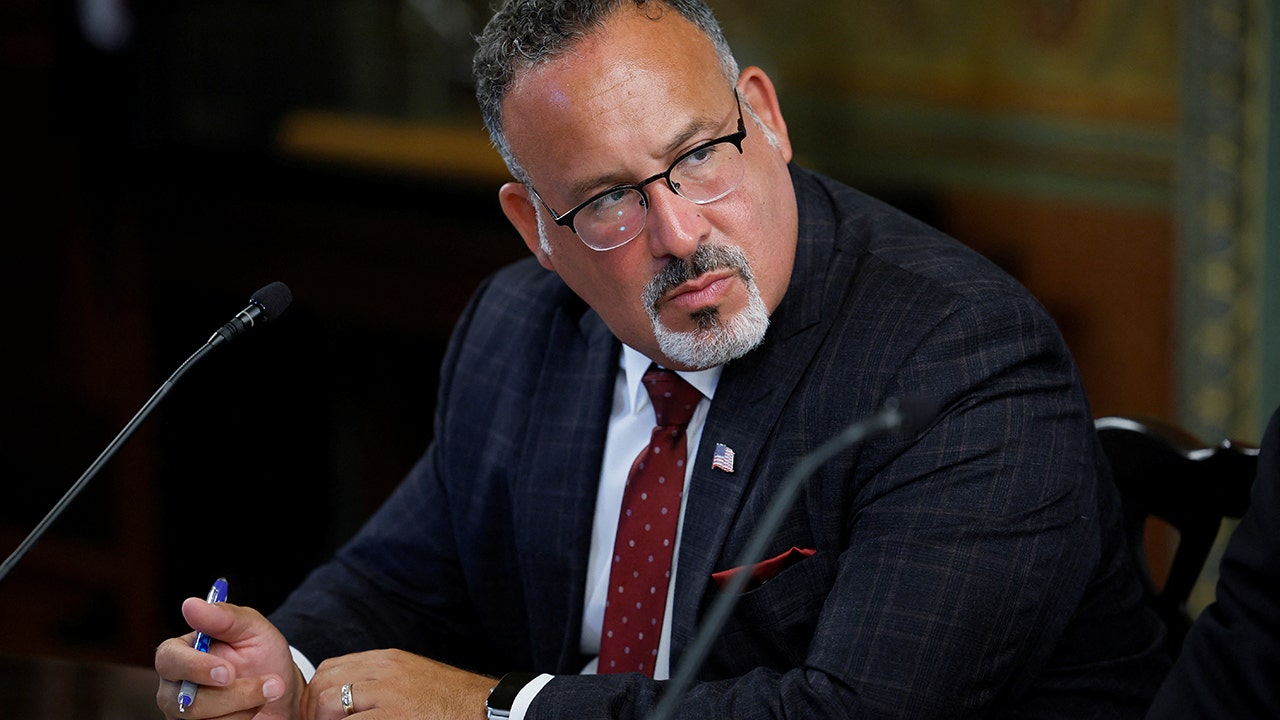
President Biden with Education Secretary Miguel Cardona, right, on Aug. 24, 2022 in the Roosevelt Room of the White House in Washington, D.C.

President Biden with Education Secretary Miguel Cardona, right, on Aug. 24, 2022 in the Roosevelt Room of the White House in Washington, D.C. (OLIVIER DOULIERY/AFP via Getty Images)

GOP SENATORS ACCUSE EDUCATION DEPARTMENT OF ALLOWING ‘TAXPAYER-FUNDED ANTISEMITISM’ ON COLLEGE CAMPUSES

“The growth of technology and its applications in providing students with a well-rounded education is exciting and should be commended,” Foxx told Fox News Digital. “More options for students mean more opportunities for success. For the department to conflate access to online education with rising federal student loan debt diminishes that fact and ultimately hurts the partnerships between institutions, innovators, and the students they serve.”

“The department seems to be more interested in controlling the actions of private companies and creating unnecessary headaches for institutions than it is ensuring students have every tool to succeed academically,” Foxx continued. “I urge the Biden administration to reverse course on this harmful guidance.”

OPMs have long been the target of congressional Democrats and consumer groups, which believe the companies can, through their contractual arrangements, drive up the price of higher education and draw students to low-value academic programs.

Sen. Elizabeth Warren, D-Mass, for example, has raised “concerns about the impact of OPM partnerships on rising student debt loads.”

Under Secretary of Education James Kvaal echoed that sentiment in a statement when the department released its new guidance.

A girl participating in online education training class with teacher and other students using laptop at home.

A girl participating in online education training class with teacher and other students using laptop at home. (iStock)

NEW ONLINE PLATFORM HELPS CONNECT PARENTS WITH TEACHERS OF THEIR CHOICE

“Online education has the potential to meet the needs of many students and lower costs,” he said. “But we are concerned about the growth in loan debt and want to ensure students get value for their money.”

However, many colleges and universities do not have the in-house funding and expertise to develop the online programs they need and need outside help, according to experts familiar with the issue.

OPMs are not the only ones affected by the Education Department’s rules, which critics argue will have a broader negative impact than government officials may realize.

Local police departments helping to compile and analyze campus crime statistics and hospitals providing clinical experiences and “the related educational programing for nurses and other medical professionals” are among the outside entities helping schools through contractual agreements that are being considered third-party servicers, according to the American Council on Education.

The council recently wrote a letter to Education Secretary Miguel Cardona, outlining some of the problems it had with the department’s guidance.
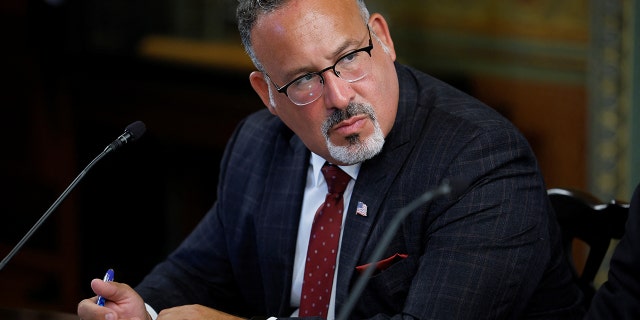
Secretary of Education Miguel Cardona in the Eisenhower Executive Office Building in Washington, D.C., Aug. 8, 2022. 

Secretary of Education Miguel Cardona in the Eisenhower Executive Office Building in Washington, D.C., Aug. 8, 2022.  (REUTERS/Evelyn Hockstein)

BIDEN’S EDUCATION SECRETARY LOBBIES COLLEGES TO DROP OUT OF US NEWS RANKING IN NAME OF EQUITY

“The broadened definition of a [third-party servicer] appears to cover entities that are beyond the common understanding of that term,” the letter states. “Our hope, if given appropriate time to comment, is to provide the department with a fuller picture of the variety of important institutional arrangements that exist so it may better understand the guidance’s impact … We believe the department would benefit from a deeper understanding of the potential that the guidance could trigger an unintended disruption of services to students currently provided by institutions through these entities.”

The letter was co-signed by 46 other higher education interest groups and associations, including accreditors.

Other experts see the department’s actions as not merely misguided but intentional overreach.

“The Department of Education’s crusade against for-profit colleges is now ensnaring a wide range of service providers,” Adam Kissel, visiting fellow at the Heritage Foundation, told Fox News Digital. “This is a classic case of overregulation by overzealous bureaucrats. Every new rule or interpretation like this makes it harder for colleges to serve their students.”

Whatever the department’s motivation, what is clear is the new guidance will present a host of new hurdles for both schools and companies.

A woman working form home with a laptop.

A woman working form home with a laptop. (iStock)

PRESIDENT BIDEN’S STUDENT DEBT RELIEF IS ‘COMFORTABLY WITHIN’ LAW, DOJ ARGUES TO SCOTUS

One challenge, according to legal experts, is that third-party servicers are legally required to sign a contract with their educational partner to be “jointly and severally liable” to the Education Department for any federal violations.

“Third-party OPMs have been able to hide behind really crafty language in their contracts that keeps them from being responsible for any violations,” Stephanie Hall, a senior fellow at the Center for American Progress, told Inside Higher Ed. “It places all the responsibility on the institution.”

Critics have countered that, beyond creating a major new legal hurdle to overcome, the liability requirements could hurt smaller companies, which unlike bigger players, may be unwilling or unable to indemnify their campus partners. Duane Morris, a law firm that works with colleges, has also noted that while a purpose of the guidance may be to hold OPMs liable, the reverse would also hold true; the school would be liable for any violation committed by the third-party servicer.

Another challenge is that third-party servicers are subject to regular audits, which would require these companies to make all their contracts available to federal regulators.

As a result, OPMs and educational institutions will need to take the extra time and effort to carefully redo all their contracts, and some may not even want to continue their partnerships, according to Tony Guida, an attorney at Duane Morris who focuses on education issues.

A tour group makes a stop at the Sterling Memorial Library on the Yale University campus in New Haven, Connecticut, June 12, 2015.

A tour group makes a stop at the Sterling Memorial Library on the Yale University campus in New Haven, Connecticut, June 12, 2015. (Photographer: Craig Warga/Bloomberg via Getty Images)

MARYMOUNT UNIVERSITY STUDENTS LAUNCH PROTESTS AFTER SCHOOL AXES MAJORS LIKE MATH, ENGLISH, RELIGIOUS STUDIES

“OPMs will have to be much more intentional about services they provide,” Guida told Fox News Digital. “With more liability, some companies won’t want to take the risk.”

All these changes would be disruptive to the service of providing online education, critics argue, and have a downstream negative effect on student learning and the quality of higher education.

However, in a statement to Fox New Digital, the Education Department defended its guidance, arguing its simply meant to ensure all parties are complying with federal law.

“The updated third-party servicer guidance is intended to provide much needed clarity and transparency on existing requirements regarding companies that work with colleges around the administration of federal student aid,” a department spokesperson said. “It will help ensure these companies are in compliance with federal rules and regulations so that students can make the best possible decisions about their education.”

“The department is seeking public comment on this guidance, and we will carefully review all comments received,” the spokesperson added. “In the meantime, we will work with colleges to ensure the requirements are clear and that they have ample time to meet reporting deadlines.”

The Department of Education Building.

The Department of Education Building. (iStock)

BIDEN EDUCATION OFFICIAL CLAIMS DEMOCRACY, FATPHOBIA BASED ON WHITE SUPREMACY

Perhaps most importantly, however, these voices argue expanding who falls under the umbrella of third-party servicers also increases the control of the federal government.

“If you’re a regulated entity, the Education Department has broad investigative powers over you,” said Guida. “They can request documents, other things of that nature that would make operating much more difficult. And if third-party servicers don’t comply, this guidance could be weaponized against them.”

Supporters of the department’s guidance counter that the current situation is too opaque.

“That will provide important transparency into what’s going on,” Robert Shireman, senior fellow at the Century Foundation, told Inside Higher Ed. “The Department of Education and then the rest of us will learn more about the contracts that institutions have, and there will be greater scrutiny and accountability for the OPM contractors if they are involved in recruiting students.”

A key issue for the Education Department and those critical of OPMs is how these companies share revenue with academic institutions. In many cases, the company receives a share of the schools’ tuition revenue. However, contractors are increasingly moving away from the revenue-sharing model, instead charging fixed fees for specific services. Some observers claim these companies are having the effect of increasing school tuition rates and profiting from it.

Education Secretary Miguel Cardona speaks during the 2022 National and State Teachers of the Year event in the East Room of the White House in Washington, April 27, 2022.

Education Secretary Miguel Cardona speaks during the 2022 National and State Teachers of the Year event in the East Room of the White House in Washington, April 27, 2022. (AP Photo/Susan Walsh, File)

RANDI WEINGARTEN CLAIMS CHILDREN ‘DO BETTER IN SCHOOLS UNDER TEACHERS UNIONS’

However, others see such arguments — and the department’s new guidance — as ultimately an effort to combat efforts to profit in the education space.

“With the new guidance released last month, the Biden administration seems to be following in the footsteps of President Obama in trying to extinguish private sector, profit seeking participation in higher education,” Beth Akers, senior fellow at the American Enterprise Institute, told Fox News Digital. “There seems to be an attitude that there is no place for profit seeking in higher education. It’s a nice idea to think that all service providers in education should be motivated by benevolence, but profit is what often motivates major innovation — something desperately needed in higher education.”

“Higher education,” continued Akers, “is a realm that has been remarkably stagnant. Instead of trying to stamp out profit seeking and the innovation that would come with it, the Department of Education should focus instead on ousting poorly performing institutions and programs of study from the federal dole by cutting off student aid (loans and grants) from colleges whose graduates fail to out-earn workers with just a high school diploma.”

CLICK HERE FOR THE FOX NEWS APP

The department initially gave colleges and universities until May 1 to report details of their agreements to the government and 30 days to submit comments on the changes. Following widespread outcry, however, the department said that in response to “confusion,” the guidance would not take effect until Sept. 1, rather than immediately as of last month. It also pushed back the end date of the public comment period through March 29.

“This seems to be a solution in search of a problem rather than the other way around. The department hasn’t identified what harm it’s trying to prevent,” said Guida. “It appears to be a broad regulatory grab.”

Community college leaders warn of ‘dire’ consequences of proposed transfer rules

Emma Gallegos/EdSource

Students get ready for graduation at California Condition University Bakersfield in 2021.

A statewide effort and hard work to streamline transfer to California’s two community college systems is struggling with controversy about which classes college students really should be needed to choose at their local community schools right before earning the change. 

The proposed normal education pathway — a list of reduce-division system prerequisites — to transfer to the University of California and the California State College so much does not include courses in these kinds of spots as psychology, bodily instruction, wellbeing science and baby advancement. Group colleges are protesting that omission, saying it will bring about a collapse of enrollment in those people programs and hurt the two faculty and pupils.

Carole Goldsmith, chancellor of the Central Valley’s Point out Centre Community University District, reported the proposed pathway would consequence in “severe unintended repercussions,” resulting in faculty to reduce program loads and generating fewer programs transferable, hurting the learners it was meant to assistance.

The situation is so “dire,” she said, that the Group University League of California, which represents the state’s 73 districts, signed a resolution in November asking officers to reconsider the omission of individuals courses. In December, group college or university presidents and chancellors in the Central Valley asked for “at the pretty least” an effects examination on what the fallout would be. 

But advocates, such as the Marketing campaign for Higher education Option, say the alarm bells are getting sounded prematurely and without having proof that the repercussions would be so terrible.

The debate springs from AB 928, a condition law passed in 2021 that aimed to reduce the confusion and conflicting specifications that group higher education students experience when striving to transfer to UC and CSU. The regulation termed for creating a one pathway of lessons to enhance transfers and lower the time it requires for pupils to finish the 1st two a long time of faculty. 

Facts and implementation have been left in the palms of the Intersegmental Committee of the Academic Senates (ICAS), which features college leaders from California Community Faculties, CSU and UC. The subcommittee has till Could 31 to make the pattern, which will then be executed by the 2025-26 university 12 months, according to the law.

The proposed new pathway does not consist of recent CSU necessities for what is called Place E, or “lifelong learning and self-advancement.” It is left up to every local community college or university to pick out which classes are in that tutorial grouping, but Space E could include things like student good results methods, human behavior, sexuality, nourishment, actual physical and psychological well being, pressure management, data literacy and social interactions, according to the CSU.

People lessons are at present not a UC necessity for transfer. 

The vast majority of transfers go into CSU. Getting no Area E needs would discourage learners from enrolling in the courses, steering clear of significant classes that might support them be successful, group higher education presidents say.

Claudia Habib, president of Porterville Higher education in Tulare County, said she believes AB 928 is perfectly-supposed, “but a single answer is not the exact same for every person, (and) the effect is not the exact for each and every faculty.”

If physical schooling, kinesiology, and college student good results courses are no more time expected to transfer, enrollment in these classes may possibly plummet at some universities, and there would be fewer classes to train, Habib said.

“We have a whole lot of personnel that aid these spots,” she reported. 

Part of the challenge is that the laws suggests that the new consolidated pathway can need no much more models than the a person UC at this time works by using, which is 34 semester models. The latest CSU pathway has 39 units. So anything experienced to give, officials stated. And given that UC did not need Region E, it was slice to create a typical established of courses.  

Kevin Walthers, president of Hancock Faculty in Santa Maria, said the proposed pathway, as it is, will lessen the amount of transferable courses for pupils.

“When you make issues far too slender, it just helps make fewer option for students to get a diploma,” he stated. 

The new pathway tends to make a student suitable for a transfer but does not warranty it, based on grades and levels of competition for place. In an option route, an Affiliate Degree for Transfer, or ADT, ensures transfer from a neighborhood university to a spot someplace in the CSU. But UC has resisted producing these a method-wide ensure, despite seeking to boost transfers.

Walthers stated university presidents did not fully grasp the probable fallout ahead of the transfer-relevant invoice handed, and they’d like to have a voice in the make any difference. 

“It form of flew less than the radar,” he stated. “We all want better transfer, ideal? I desire the CSU program would provide the pupils in my neighborhood — they are woefully inadequate in serving pupils on the central coastline. But when the invoice handed, I really don’t assume everyone seriously explained, ‘Oh this would be an possibility for the UC and CSU to rewrite transfer in a way that severely impacted neighborhood school. No one particular actually obtained that.”

Walthers and Habib both said community schools normally provide the state’s most susceptible populations, this sort of as to start with-generation college pupils and learners of colour, who profit from having the higher education results abilities courses.

1 study reveals little effects

The Kern Group College or university District has accomplished an effect evaluation, taking into account which students ordinarily enroll in Spot E courses, and located the state proposal would cause small impression at its a few schools: Bakersfield, Porterville and Cerro Coso.

“The bottom line was that for KCCD, the elimination of Location E would not precipitate any kind of a main enrollment crisis,” reported Craig Hayward, the dean of institutional effectiveness at Bakersfield College. “There are some concerns around currently being in a position to round out or preserve the workload of faculty coaches, but there are methods to consider to get ahead of that and make confident that doesn’t come to be an issue.”

Hayward explained his assessment confirmed that a the vast majority of pupils in the district normally acquire classes in Space E for other motives than to satisfy the CSU necessity, these kinds of as needing it for their associate degree, or taking pleasure in the class.

For example, psychology is an Spot E study course option that is also a important requirement to gain an AA in psychology. And the scholar success classes are filled with twin enrollment students from substantial school. PE programs these kinds of as weightlifting are only one device, whilst three models are necessary for transfer. So alternatively of taking PE programs for transfer assistance, learners are usually having it “because they want to have that actual physical activity,” Hayward mentioned.

To simplicity problem that school coaches could get rid of their complete-time job status, Bakersfield Faculty is doing the job to diversify the established of classes that college coaches can educate.

While KCCD may well not see key unfavorable modifications, Hayward claimed an effect analysis must even now be performed on a wider scale for the reason that each and every higher education classifies the classes in various techniques.  

How did we get in this article?

Group school students can at this time pick a pathway with different specifications based on which university they want to transfer to. The CSU works by using its “CSU GE Breadth,” and UC takes advantage of the Intersegmental Basic Training Transfer Curriculum (IGETC). Whilst there are some similarities, the two pathways have several dissimilarities. For example, the CSU demands oral interaction, and UC doesn’t, and UC calls for a language other than English, and CSU does not. Both of those have to have English, math, arts and humanities, and social and behavioral sciences. 

The new pathway, named CalGETC, was proposed in May possibly 2022. It stored English and math specifications and included oral interaction, which was not beforehand required for UC. The arts and humanities and behavioral sciences specifications were also lessened from three courses to two programs just about every, and ethnic reports now falls in a new different place.

To generate a bachelor’s diploma, college students need to take classes in their key, as properly as basic schooling courses, and numerous of these can be finished at local community college or university, and transferred over for credit history. 

Whilst a lot of pupils intend to transfer, couple do. In accordance to the General public Coverage Institute of California, only about 19{af0afab2a7197b4b77fcd3bf971aba285b2cb7aa14e17a071e3a1bf5ccadd6db} of local community college learners transfer inside of 4 a long time. Black and Latino college students are slipping guiding other teams. Even even though they have identical rates of declaring transfer as a purpose, “only 9{af0afab2a7197b4b77fcd3bf971aba285b2cb7aa14e17a071e3a1bf5ccadd6db} of Black learners and 10{af0afab2a7197b4b77fcd3bf971aba285b2cb7aa14e17a071e3a1bf5ccadd6db} of Latinx pupils transfer in four several years, in contrast to 17{af0afab2a7197b4b77fcd3bf971aba285b2cb7aa14e17a071e3a1bf5ccadd6db} and 27{af0afab2a7197b4b77fcd3bf971aba285b2cb7aa14e17a071e3a1bf5ccadd6db} of their white and Asian American friends, respectively,” the PPIC reported in a 2020 report.

The intersegmental subcommittee created of 3 associates from each college senate, furthermore pupil and administrative advisers, started assembly in late 2021 and evaluating the two pathways to locate the greatest way forward, according to Virginia Might, a math professor at Sacramento Town University and president of the Academic Senate of California Neighborhood Colleges. 

“What would be provided had been issue places that were being frequent to (both of those) the patterns, because the units were decreased,” she reported. 

“Because UC has no this kind of prerequisite and does not desire to include one particular, CSU agreed to get rid of Lifelong Understanding from the Cal-GETC,” according to a document from ICAS.

The Educational Senate for California Neighborhood Faculties despatched out a study to all the educational senate presidents, curriculum chairs and articulation officers, May reported. Numerous of the 2,169 responses centered around the reduction of Place E.

That senate then looked for a further way to maintain scholar desire powerful in these lessons. It passed a resolution urging the CSU to make it a graduation prerequisite, which means it could be taken at the community school stage, as opposed to an higher-division need that has to be taken at the college. Those people lessons would not be necessary for transferring, but a lot of pupils may perhaps nonetheless just take them at local community colleges.

The CSU Senate will now talk about those people options.

Even though May possibly doesn’t see a way forward in which Region E is involved in CalGETC, “we are nowhere near finished,” she explained. The panel is attempting to operate with every person, “and there are a large amount of interests associated,” she included.

Up coming, the intersegmental panel will convene again to establish if all 3 school segments concur on the proposed route. 

“And then,” she explained, “we can see where by we go from there.”

To get a lot more reports like this 1, click on right here to signal up for EdSource’s no-expense each day e mail on most current developments in schooling.